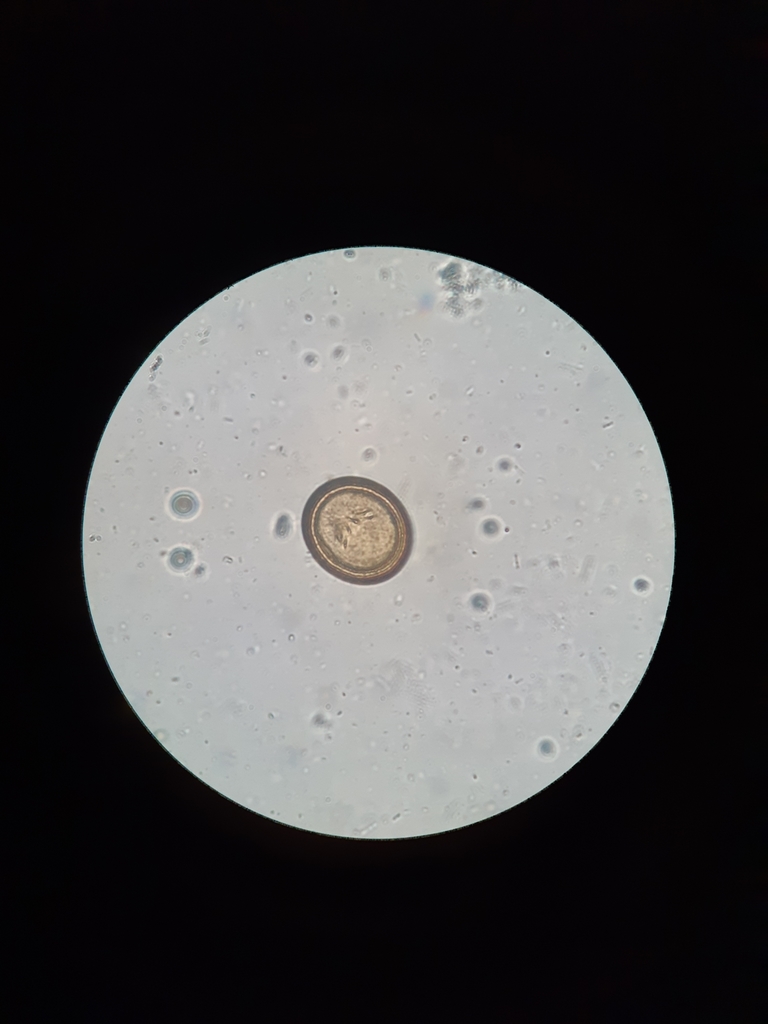
Taenia pisiformis
Taenia pisiformis, commonly called the rabbit tapeworm, is an endoparasitic tapeworm which causes infection in lagomorphs, rodents, and carnivores. Adult T. pisiformis typically occur within the small intestines of the definitive hosts, the carnivores. Lagomorphs, the intermediate hosts, are infected by fecal contamination of grasses and other food sources by the definitive hosts. The larval stage is often referred to as Cysticercus pisiformis and is found on the livers and peritoneal cavities of the intermediate hosts. T. pisiformis can be found worldwide.
From the article Taenia pisiformis on Wikipedia (CC BY-SA), quoted section by section
Description
T. pisiformis typically infect dogs and other carnivores such as coyotes and foxes. In rabbits, T. pisiformis larvae attach themselves to the liver and intestines, forming cysts 6–18 mm (0.24–0.71 in) in diameter. This is referred to as cysticercosis. In adult T. pisiformis, the long hooks of the scolex are on average 239.9 μm (0.00944 in) and the short hooks are 140.1 μm (0.00552 in). The dimensions of the suckers are 322.3 μm × 288.1 μm (0.01269 in × 0.01134 in). They can have from 34 to 38 hooks, which can be up to 234 μm (0.0092 in) in length. Adult T. pisiformis can grow between 0.5 to 2 m (20 to 79 in). The intermediate host is represented by hares and rabbits, in which are found the mesacestoide (the larval stage) known as cysticercus pisiformis. This is found in the peritoneum of the intermediate host and can be ingested by the definite host when the dog or cat feeds on the viscera of such an infected intermediate.
What it does
Eggs are introduced into the environment through infected canine feces. In the feces are the gravid proglottids that house the T. pisiformis eggs that will eventually be released from the proglottid onto nearby vegetation. The eggs are then ingested by a rabbit or from any member of the Leporidae family. Once inside the rabbit's gut the larva or oncosphere phase will then penetrate into the intestinal wall until they reach the blood stream. When the worm reaches the liver the larva transforms into a cysticercus form. This cysticercus will stay in the liver for about two to four weeks, then move to the peritoneal cavity where it will wait for the definitive host to eat the rabbit. The definitive hosts are ether dogs or other members of the Canidae family. Once ingested the cysticercus finds its way into the intestine and attaches to the intestinal wall with hooks and suckers. After the worm has time to develop and grow in size, the gravid proglottids is released from the distal end of the parasite and passed in the feces to start a new cycle.
Wikipedia: “Life cycle”
Where it lives
Recorded sightings
—
geo-referenced records in GBIF, from museums, herbaria and field observers.
Drag the globe to turn it. Dots are where records exist, not a range map; darker means more records.
In the stacks
Searching the stacks…
Every page naming Taenia pisiformis in the Biodiversity Heritage Library →
This page is assembled live from iNaturalist, GBIF, Wikipedia, the Source Library and the Internet Archive. It is not yet part of the hand-edited codex. iNaturalist taxon 1021208.