- Animals
- ›Chordates
- ›Vertebrates
- ›Cartilaginous Fishes
- ›Sharks and Rays
- ›Sharks
- ›Galean Sharks
- ›Ground Sharks
- ›Weasel Sharks
- ›Hemigaleus
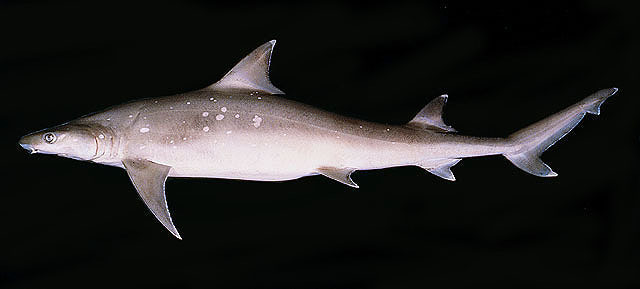
Sicklefin Weasel Shark
Hemigaleus microstoma
The sicklefin weasel shark (Hemigaleus microstoma) is an uncommon species of ground shark in the family Hemigaleidae. It is native to southern India, southern China, and parts of Southeast Asia, living in shallow waters down to a depth of 170 m (560 ft). This lightly built shark is characterized by its very short mouth, broad upper teeth with serrations only on the trailing edge, and strongly sickle-shaped fins with obvious white tips on the two dorsal fins. It is light grey or bronze in colour, often with small white blotches on its sides; it reaches a maximum known length of 1.1 m (3.6 ft).
Spending most of its time close to the sea floor, the sicklefin weasel shark is a specialist predator of cephalopods. Its reproductive mode is viviparous, in which the unborn young form a placental connection to their mother. Females probably give birth twice a year, with each litter consisting of two to four pups. The sicklefin weasel shark is widely caught by artisanal fisheries and used for meat, fins, and fishmeal; its low natural abundance and reproductive rate mean that it cannot sustain much fishing pressure. Given that fishing activity is intense throughout its range, the International Union for Conservation of Nature (IUCN) has assessed this species as vulnerable.
From the article Sicklefin weasel shark on Wikipedia (CC BY-SA), quoted section by section
Description
The sicklefin weasel shark is a slender-bodied species reaching 1.1 m (3.6 ft) in length. The snout is fairly long and rounded, with the nostrils preceded by short flaps of skin. The large, oval eyes are equipped with nictitating membranes and are followed by minute spiracles. The mouth forms a very short, wide arch and conceals the teeth when closed. Moderately long furrows are present at the corners of the mouth. It has 25–34 upper and 37–43 lower tooth rows; the upper teeth are broad and angled with a smooth leading edge and strongly serrated trailing edge, while the lower teeth are narrow, erect, and smooth-edged. The five pairs of gill slits are short. The fins are strongly falcate (sickle-shaped), particularly the dorsal fins, pelvic fins, and lower caudal fin lobe. The pectoral fins are narrow and pointed. The first dorsal fin is positioned about halfway between the pectoral and pelvic fins. The second dorsal fin is about two-thirds as tall as the first and is positioned slightly ahead of the anal fin. The anal fin is smaller than the second dorsal fin. The dorsal surface of the caudal peduncle bears a crescent-shaped notch at the caudal fin origin. The asymmetrical caudal fin has a well-developed lower lobe and a long upper lobe with a ventral notch near the tip. The dermal denticles are small and overlapping; each has five horizontal ridges leading to marginal teeth. …
Range & habitat
The sicklefin weasel shark is found off southern India and Sri Lanka, as well as from southern China and Taiwan to Java and Borneo. It may also occur around the Philippines and in the Red Sea, though specimens from these regions need to be compared taxonomically with those from its confirmed range. It does not seem to be very common naturally. This species inhabits continental and insular shelves from inshore waters to at least a depth of 170 m (560 ft), and usually swims close to the sea floor.
Wikipedia: “Distribution and habitat”
What it does
The diet of the sicklefin weasel shark is composed almost entirely of cephalopods, though crustaceans and echinoderms may be infrequently eaten. Its small mouth and short gill slits may be adaptations for capturing cephalopods by suction, while its weak jaws and small teeth reflect a diet of mostly soft-bodied prey. This species is viviparous, wherein the developing embryos are sustained to term through a placental connection formed from the depleted yolk sac. Females likely produce two litters per year, implying a gestation period under six months. Between two and four pups are born at a time (average 3.3); newborns measure roughly 45 cm (18 in) long. Males mature sexually around 74–75 cm (29–30 in) long, while females mature around 75–78 cm (30–31 in) long.
Wikipedia: “Biology and ecology”
Where it lives
Recorded sightings
—
geo-referenced records in GBIF, from museums, herbaria and field observers.
Drag the globe to turn it. Dots are where records exist, not a range map; darker means more records.
In the stacks
Searching the stacks…
Every page naming Hemigaleus microstoma in the Biodiversity Heritage Library →
This page is assembled live from iNaturalist, GBIF, Wikipedia, the Source Library and the Internet Archive. It is not yet part of the hand-edited codex. iNaturalist taxon 102560.