On eBird ↗
Purple Honeycreeper
Live sightings near you, the range map, bar charts of when it is seen, and Macaulay Library photos and recordings.
Purple Honeycreeper
Cyanerpes caeruleus
The purple honeycreeper (Cyanerpes caeruleus) is a small bird in the tanager family. It is found in the tropical New World from Colombia and Venezuela south to Brazil, and on Trinidad. A few, possibly introduced birds have been recorded on Tobago. The species is a bird of northern South America, and besides the Amazon Basin and the Guianas, a coastal range occurs west of the Andes, including parts of southern Panama. In the south, its range...
From the article Purple honeycreeper on Wikipedia (CC BY-SA), quoted section by section
Description
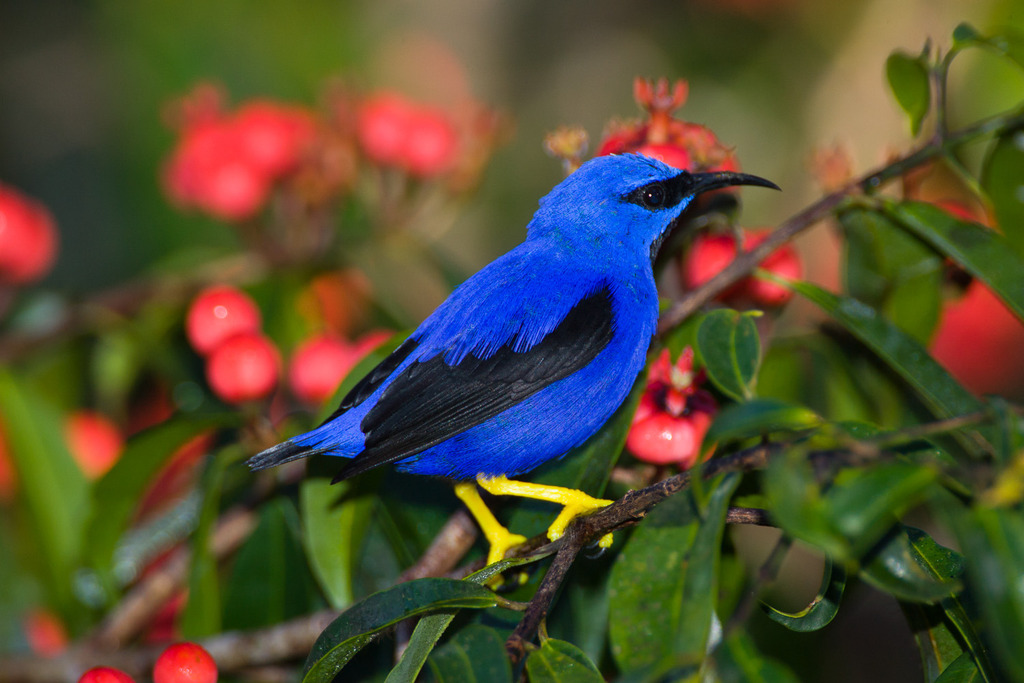
The purple honeycreeper is 9.3 to 11.4 cm (3.7 to 4.5 in) long and weighs 7.8 to 14 g (0.28 to 0.49 oz). The species is sexually dimorphic. Adult males of the nominate subspecies C. c. caeruleus are mostly violet-blue with a slightly lighter face. They have black lores and a narrow black mask to past the eye. The center of their throat is black. Their upperwing coverts, flight feathers, and tail are black. Adult females have a green crown and nape, buffy lores, a buffy eye-ring, a bright blue malar stripe, and a cinnamon-buff supercilium and ear coverts. Their upperparts and tail are green. Their throat is buffy, their breast and flanks off-white with greenish olive streaks, their belly a light yellow, and their undertail coverts white. Their flight feathers are dusky with variable amounts of yellow-green and green on the edges. Juveniles resemble adult females with somewhat plainer breast and flanks. Both sexes of all subspecies have a brown to black iris and a slender decurved black bill. Males have yellow legs and feet; females' are light green to olive-yellow. The other subspecies of the purple honeycreeper differ from the nominate and each other thus:
C. c. chocoanus: slightly smaller than nominate with a shorter bill; males are a paler, less purple, blue; females have less streaking on the underparts C. c. …
Range & habitat
The purple honeycreeper has a disjunct distribution. The subspecies are found thus:
C. c. chocoanus: from extreme eastern Panama in Darién Province south along the Pacific slope of Colombia and Ecuador to El Oro Province C. c. caeruleus: from the eastern slope of Colombia's [[Cordillera Oriental (Colombia) |Eastern Andes]] into Venezuela's Falcón; the Venezuelan Coastal Ranges from Carabobo east to Sucre and Delta Amacuro; Venezuela's eastern Amazonas and most of Bolívar states and across the Guianas and north-central Brazil to the Tapajós River and northwestern Maranhão state
C. c. hellmayri: Guyana's Potaro Highlands C. c. longirostris: Trinidad C. c. microrhynchus: Venezuela's western and southern Zulia, western Andean base in Táchira and Mérida, and eastern Andean base from Táchira to Lara; south of the Orinoco River in Venezuela's western Amazonas south through the southeastern third of Colombia, eastern Ecuador, and eastern Peru into northern Bolivia; east from that north-south line in Amazonian Brazil into Mato Grosso The purple honeycreeper inhabits several types of evergreen forest in the lowlands and foothills. In the Amazon Basin it occurs in both terra firme and várzea forest. It also occurs in clearings within the forest, secondary forest, and the ecotone between evergreen forest and less fertile savanna, cerrado, and white-sand landscapes. …
Wikipedia: “Distribution and habitat”
What it does
The purple honeycreeper feeds primarily on arthropods including insects and spiders, and also includes significant amounts of fruit and nectar in its diet. Fruit and nectar are sourced from a very wide variety of plants and the species is "considered very important pollinators and seed dispersers". Its bill shape allows it to take nectar from bromeliads and fleshy arils from plants such as Clusia rosea. At the Asa Wright Nature Center on Trinidad it readily feeds on nectar from hummingbird feeders and on banana and papaya on tray feeders. The species forages actively, primarily in the forest subcanopy and canopy. They typically forage in pairs or family groups and often join mixed-species feeding flocks. In one study they took most insect prey from small twigs and lesser amounts from leaves, flowers, and in mid-air.
Wikipedia: “Feeding”
Listen
Looking for field recordings…
Where it lives
Recorded sightings
—
geo-referenced records in GBIF, from museums, herbaria and field observers.
Drag the globe to turn it. Dots are where records exist, not a range map; darker means more records.
In the stacks
Searching the stacks…
Every page naming Cyanerpes caeruleus in the Biodiversity Heritage Library →
This page is assembled live from iNaturalist, GBIF, Wikipedia, the Source Library and the Internet Archive. It is not yet part of the hand-edited codex. iNaturalist taxon 10261.