On eBird ↗
Orangequit
Live sightings near you, the range map, bar charts of when it is seen, and Macaulay Library photos and recordings.
Orangequit
Euneornis campestris
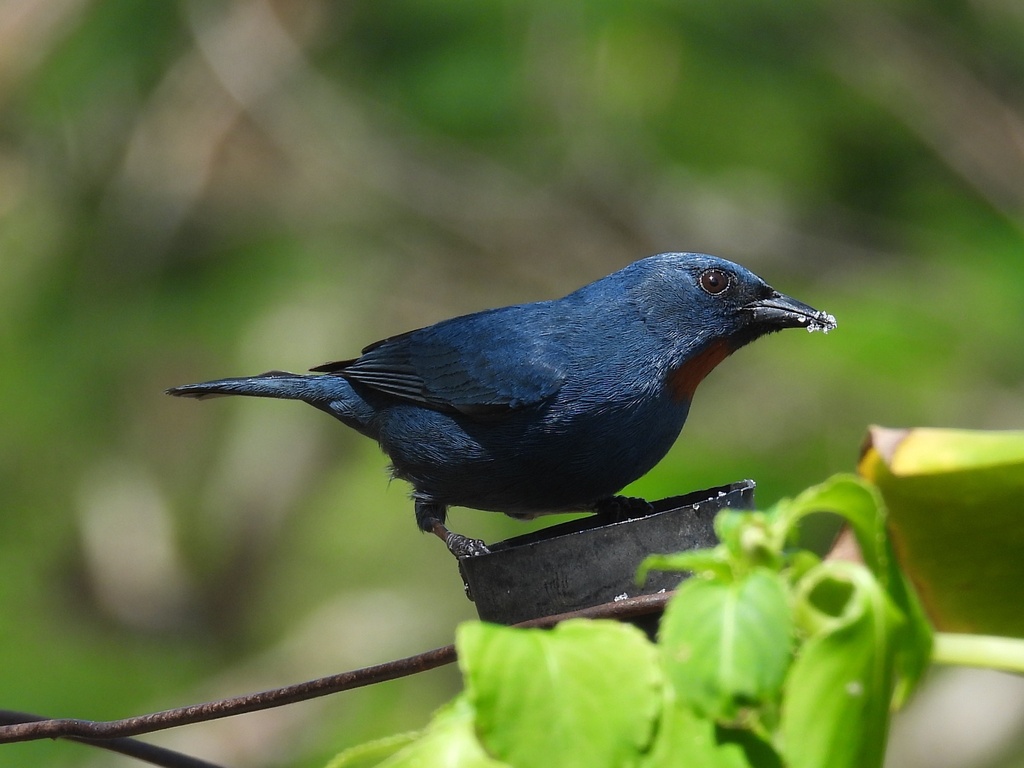
The orangequit (Euneornis campestris) is a species of bird in the family Thraupidae. It is the only member of the genus Euneornis. It is endemic to Jamaica. Its natural habitats are subtropical or tropical moist lowland forests and heavily degraded former forest.
From the article Orangequit on Wikipedia (CC BY-SA), quoted section by section
Description
The orangequit is 14 cm (5.5 in) long and weighs 13.2 to 19.2 g (0.47 to 0.68 oz). The species is sexually dimorphic. Adult males are gray-blue except for their orange-red throat. Adult females have an olive-gray crown and nape and an otherwise grayish white head. Their upperparts are a warmer brownish gray. Their underparts are grayish white with faint streaks overall and a light buffish wash on the flanks. Both sexes have a dark brown iris, a slightly decurved black bill, and black legs and feet. Juveniles are like adult females.
Range & habitat
The orangequit is found throughout the island of Jamaica. It inhabits humid forest and woodlands and also shade coffee plantations. Sources differ on its maximum elevation. Two say it is 1,500 m (4,900 ft) and a third says the species is found "at all elevations". Two note that it is most common in middle elevations.
Wikipedia: “Distribution and habitat”
What it does
The orangequit feeds primarily on nectar. It also includes fruit, seeds, and invertebrates in its diet and has been observed feeding on tree sap from holes drilled by Sphyrapicus sapsuckers. It forages singly or in pairs, usually between the forest's lower and mid-levels.
Wikipedia: “Feeding”
Listen
Looking for field recordings…
Where it lives
Recorded sightings
—
geo-referenced records in GBIF, from museums, herbaria and field observers.
Drag the globe to turn it. Dots are where records exist, not a range map; darker means more records.
In the stacks
Searching the stacks…
Every page naming Euneornis campestris in the Biodiversity Heritage Library →
This page is assembled live from iNaturalist, GBIF, Wikipedia, the Source Library and the Internet Archive. It is not yet part of the hand-edited codex. iNaturalist taxon 10268.