On eBird ↗
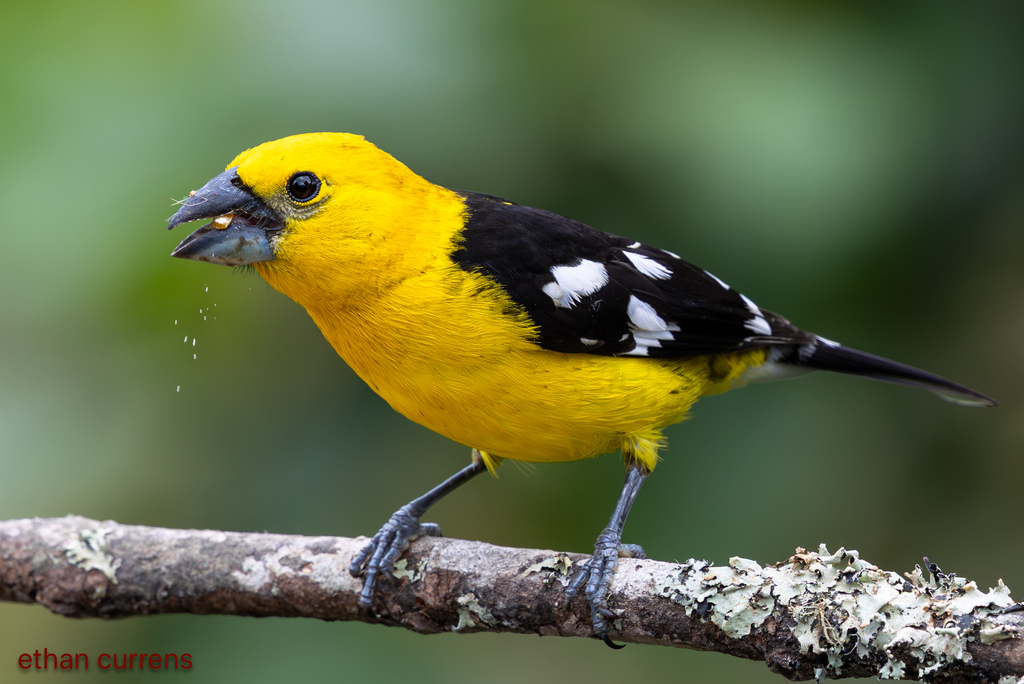
Golden Grosbeak
Live sightings near you, the range map, bar charts of when it is seen, and Macaulay Library photos and recordings.
Golden Grosbeak
Pheucticus chrysogaster
The southern yellow grosbeak (Pheucticus chrysogaster), also known as golden-bellied grosbeak or golden grosbeak, is a species of grosbeaks in the Cardinalidae family. It is very similar to, and has sometimes been considered conspecific with, the Mexican yellow grosbeak.
From the article Golden grosbeak on Wikipedia (CC BY-SA), quoted section by section
Description
The golden grosbeak is 21.5 cm (8.5 in) long and weighs about 54 to 60 g (1.9 to 2.1 oz). Adult males of the nominate subspecies have an orange-tinged deep yellow head and nape. Their back is black, their rump yellow, and their uppertail coverts black with white tips. Their wings are mostly black with wide white tips on the greater and median coverts, white bases on the primaries, and white tips on the outer webs of the secondaries and tertials. Their tail is mostly black with much white on all but the innermost two pairs of feathers. Their throat and underparts are mostly bright yellow with white undertail coverts. Their thigh feathers are black. Adult females have a dull yellow crown with heavy black streaks. Their mantle is gray-brown with a greenish tinge and the rest of their upperparts greenish yellow with blackish streaks. Their wings have about the same pattern as the male's but are mostly blackish gray with smaller areas of white. Their tail is blackish brown with small white tips on the outermost feathers. Their chin, throat, and underparts are mostly yellow with greenish yellow flanks and white undertail coverts. Juveniles have heavy black streaks on their head and upperparts and much less white on their wings than adults. Males of subspecies P. c. labumanni have thin olive-yellow edges on the scapulars and wide white edges on the outer half of most primaries. …
Range & habitat
The golden grosbeak has a disjunct distribution; the subspecies are widely separated. Subspecies P. c. labumanni is the more northerly of the two and has a much smaller range than the nominate. It is found in northern Colombia's isolated Sierra Nevada de Santa Marta, in the Serranía del Perijá on the Colombia-Venezuela border, and discontinuously in Venezuela in northern Lara, in the Venezuelan Coastal Range from Aragua to Miranda, in the interior mountains of Aragua, and in southern Sucre and northern Monagas. The nominate is found from Nariño Department in far southwestern Colombia south along the Andes of Ecuador and Peru to Cuzco Department and also between the coast and the Andes from northern Manabí Province in Ecuador south to Arequipa Department in Peru. The golden grosbeak inhabits a variety of generally dryish and somewhat open landscapes including the edges of forest, woodlands, scrublands, pastures and cultivated areas with some trees, and gardens. It also occurs in more humid landscapes on the eastern side of the Andes of Peru. In elevation it ranges between 950 and 2,000 m (3,100 and 6,600 ft) in Venezuela, between 1,600 and 2,800 m (5,200 and 9,200 ft) in Colombia, and from near sea level to 3,500 m (11,500 ft) in Ecuador and Peru.
Wikipedia: “Distribution and habitat”
What it does
The golden grosbeak's diet has not been studied but is known to include insects, seeds, and berries. It usually forages singly or in pairs and takes prey and plant food from foliage, generally fairly high in the habitat. It usually does not join mixed-species feeding flocks.
Wikipedia: “Feeding”
Listen
Looking for field recordings…
Where it lives
Recorded sightings
—
geo-referenced records in GBIF, from museums, herbaria and field observers.
Drag the globe to turn it. Dots are where records exist, not a range map; darker means more records.
In the stacks
Searching the stacks…
Every page naming Pheucticus chrysogaster in the Biodiversity Heritage Library →
This page is assembled live from iNaturalist, GBIF, Wikipedia, the Source Library and the Internet Archive. It is not yet part of the hand-edited codex. iNaturalist taxon 10270.