- Animals
- ›Chordates
- ›Vertebrates
- ›Cartilaginous Fishes
- ›Sharks and Rays
- ›Sharks
- ›Squalean Sharks
- ›Cow and Frilled Sharks
- ›Cow Sharks
- ›Hexanchus
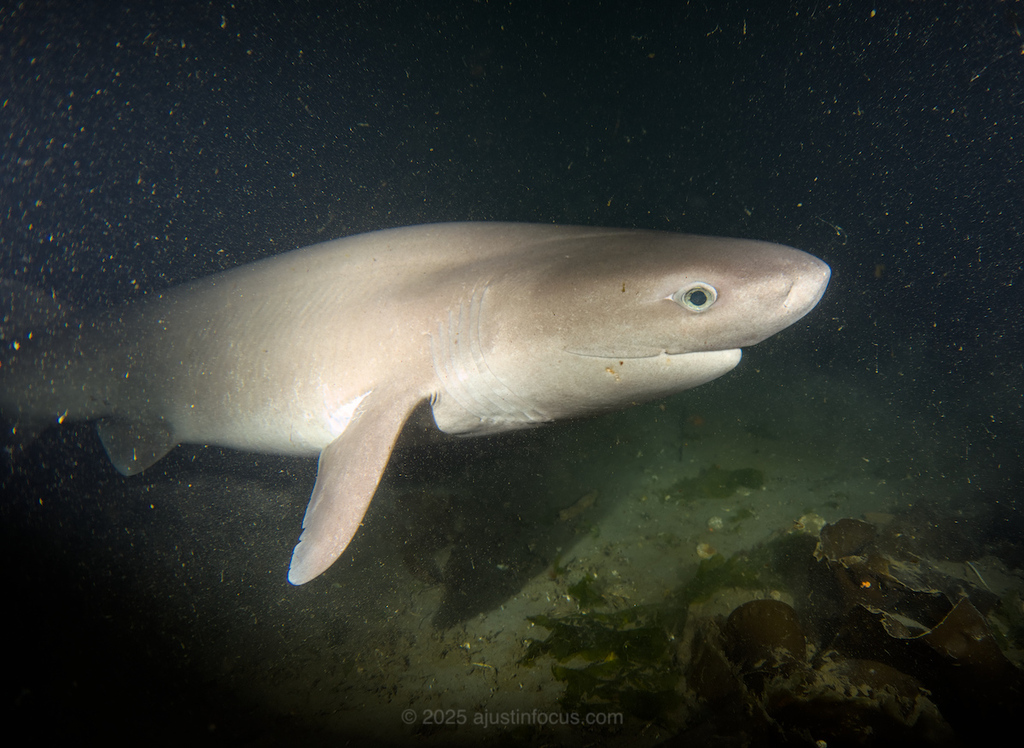
Bluntnose Sixgill Shark
Hexanchus griseus
The bluntnose sixgill shark (Hexanchus griseus), often simply called the cow shark, is the largest hexanchoid shark, growing to 18 ft (5.5 m) in length. It is found in tropical and temperate waters worldwide. Its diet varies widely depending on the habitat.
The bluntnose sixgill is a species of sixgill shark, of genus Hexanchus, which also consists of two other species: the bigeye sixgill shark (Hexanchus nakamurai) and the Atlantic sixgill shark (Hexanchus vitulus). By analyzing their base pairs of mitochondrial genes COI and ND2, these species can be easily distinguished.
From the article Bluntnose sixgill shark on Wikipedia (CC BY-SA), quoted section by section
Description
The bluntnose sixgill shark has a large body and long tail. The snout is blunt and wide, and its eyes are small. There are 6 rows of saw-like teeth on its lower jaw and smaller teeth on its upper jaw. Skin color ranges from tan, through brown, to black. It has a light-colored lateral line down the sides and on the fins' edges, and darker colored spots on the sides. They also get stains/spots on their neural arches, and the number of stains increase as they get older. Its pupils are black and its eye color is a fluorescent blue-green. The bluntnose sixgill shark can grow to 5.5 m (18 ft). A work from the 1880s stated that a bluntnose sixgill shark caught off Portugal in 1846 measured 9 m (30 ft). This specimen was originally reported in an 1846 work and said to be only 0.68 m (2.2 ft) long. Adult males generally average between 3.1 and 3.3 m (10 and 11 ft), while adult females average between 3.5 and 4.2 m (11 and 14 ft). The average weight of an adult bluntnose sixgill shark is 500 kilograms (1,100 pounds). Large specimens may reach 6 m (20 ft) in length and 1,000 kg (2,200 lb) in weight.
The bluntnose sixgill shark resembles many of the fossil sharks from the Triassic period. A greater number of Hexanchus relatives occur in the fossil record than are alive today. They have one dorsal fin located near the caudal fin. The pectoral fins are broad, with rounded edges. …
Range & habitat
With a global distribution in tropical and temperate waters, the bluntnose sixgill shark is found in a latitudinal range between 65°N and 48°S in the Atlantic, Indian, and Pacific oceans. It has been seen off the coasts of North and South America from North Carolina to Argentina and Alaska to Chile. In the eastern Atlantic, it has been caught from Iceland to Namibia, in the Indo-Pacific it has been caught from Madagascar north to Japan and east to Hawaii and in the Mediterranean it has been caught in Greece and Malta. Fossilized remains of this species from the Middle Miocene have also been discovered in the Duho Formation of South Korea. It typically swims near the ocean floor or in the water column over the continental shelf in poorly lit waters. It is usually found 180–1,100 m (590–3,610 ft) from the surface, inhabiting the outer continental shelf, but its depth range can extend from 0–2,500 m (0–8,202 ft). Juveniles will swim near the shoreline in search of food, sometimes in water as shallow as 12 m (39 ft), but adults typically stay at depths greater than 100 m (330 ft). It can be seen near the ocean's surface only at night. On December 2, 2017, the ROV camera of Paul Allen's research vessel RV Petrel captured video footage an adult bluntnose sixgill shark lurking around a World War II shipwreck in Ormoc Bay, Philippines at a depth of 259 m (850 ft). …
Wikipedia: “Distribution and habitat”
What it does
Sixgill sharks possess variability in their feeding mechanisms that could have contributed to their evolutionary success and global distribution. These sharks are able to protrude their jaws and vary their methods of feeding depending on the situation. They utilize sawing and lateral tearing techniques to manipulate food. Sixgill sharks also lower their pectoral fins right before they strike in order to stop forward progressions, making it easier for them to forage.
Wikipedia: “Feeding behavior”
Where it lives
Recorded sightings
—
geo-referenced records in GBIF, from museums, herbaria and field observers.
Drag the globe to turn it. Dots are where records exist, not a range map; darker means more records.
In the stacks
Searching the stacks…
Every page naming Hexanchus griseus in the Biodiversity Heritage Library →
This page is assembled live from iNaturalist, GBIF, Wikipedia, the Source Library and the Internet Archive. It is not yet part of the hand-edited codex. iNaturalist taxon 102743.