On eBird ↗
Black-crowned Palm-Tanager
Live sightings near you, the range map, bar charts of when it is seen, and Macaulay Library photos and recordings.
Black-crowned Palm-Tanager
Phaenicophilus palmarum
The black-crowned tanager or black-crowned palm-tanager (Phaenicophilus palmarum) is a species of bird formerly placed in the family Thraupidae. It is found in Haiti and the Dominican Republic. Its natural habitats are subtropical or tropical dry forests, subtropical or tropical moist lowland forests, subtropical or tropical mangrove forests, subtropical or tropical moist montane forests, and heavily degraded former forest.
From the article Black-crowned palm-tanager on Wikipedia (CC BY-SA), quoted section by section
Description
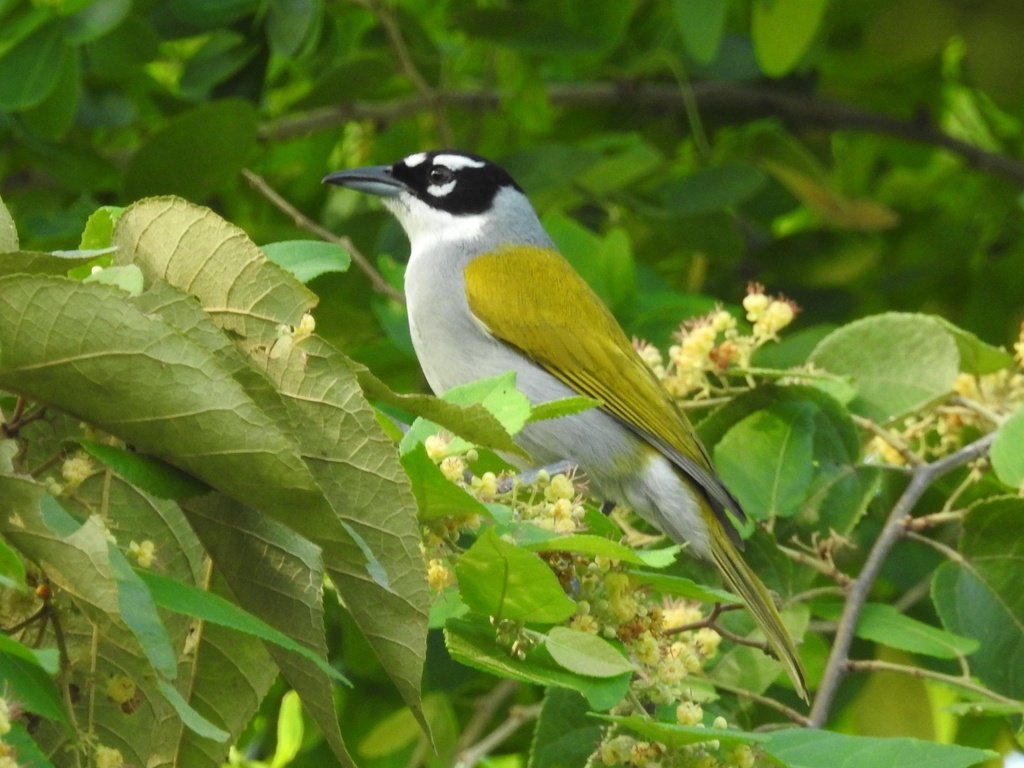
The black-crowned palm-tanager is 17 to 18 cm (6.7 to 7.1 in) long and weighs about 24 to 32 g (0.85 to 1.1 oz). The sexes are not particularly dimorphic. The species has a long, strong, sharply pointed bill with a black maxilla, and a blue-gray mandible with a black tip. The adults' head is mostly black with a white patch above the bill, a larger white patch above and beyond its red-brown eye, and a thin arc of white below its eye. Its nape is gray and the rest of the upperparts, including the tail, are bright yellowish olive. Its throat and the middle of the breast are white; the sides of its breast and its flanks, belly, and undertail coverts are gray. Immatures have a dusky gray head instead of black and a buff tinge to the throat.
Range & habitat
The black-crowned palm-tanager is found throughout the mainland Dominican Republic (including on Saona Island) and in Haiti (except for the Tiburon Peninsula). It inhabits almost every landscape on Hispaniola, in many forest types from dry to humid and open to dense. It also occurs in rural and urban gardens and parks. In elevation it ranges from sea level to about 2,500 m (8,200 ft) but is most common well below 2,000 m (6,600 ft).
Wikipedia: “Distribution and habitat”
What it does
The black-crowned palm-tanager forages in pairs or family groups at all levels of the forest and also sometimes joins mixed-species foraging flocks. Its diet is about 2/3 insects and 1/3 fruit with a small amount of nectar also taken.
Wikipedia: “Feeding”
Listen
Looking for field recordings…
Where it lives
Recorded sightings
—
geo-referenced records in GBIF, from museums, herbaria and field observers.
Drag the globe to turn it. Dots are where records exist, not a range map; darker means more records.
In the stacks
Searching the stacks…
Every page naming Phaenicophilus palmarum in the Biodiversity Heritage Library →
This page is assembled live from iNaturalist, GBIF, Wikipedia, the Source Library and the Internet Archive. It is not yet part of the hand-edited codex. iNaturalist taxon 10290.