On eBird ↗
Azure-shouldered Tanager
Live sightings near you, the range map, bar charts of when it is seen, and Macaulay Library photos and recordings.
Azure-shouldered Tanager
Thraupis cyanoptera
The azure-shouldered tanager (Thraupis cyanoptera) is a species of bird in the tanager family, Thraupidae. Described by the French zoologist Louis Pierre Vieillot in 1817, it is only found in the Atlantic Forest of southeastern Brazil, from southeastern Bahia, eastern Minas Gerais, and Espírito Santo south to northern Rio Grande do Sul. It inhabits humid montane forests, open woodlands, secondary growth, and forest edges and can be found at elevations of up to 1,600 m (5,200 ft), but usually stays below 1,200 m (3,900 ft).
The species feeds on fruit, flowers, and leaves. Its habit of eating leaves is an unusual aspect of its diet. Foraging takes place in mixed-species or single species flocks of as many as 15–20 birds. Like other tanagers in southeastern Brazil, the azure-shouldered tanager's breeding season begins after the end of the dry season. Nests are generally built deep inside tangles of epiphytic bromeliads in trees. Eggs are laid in clutches of two and may be either pale blue with some very dark purple spots or white with evenly spread-out small brown splotches. As of 2024, it is classified as being least concern on the IUCN Red List, an upgrade from its previous assessment of near threatened.
From the article Azure-shouldered tanager on Wikipedia (CC BY-SA), quoted section by section
Description
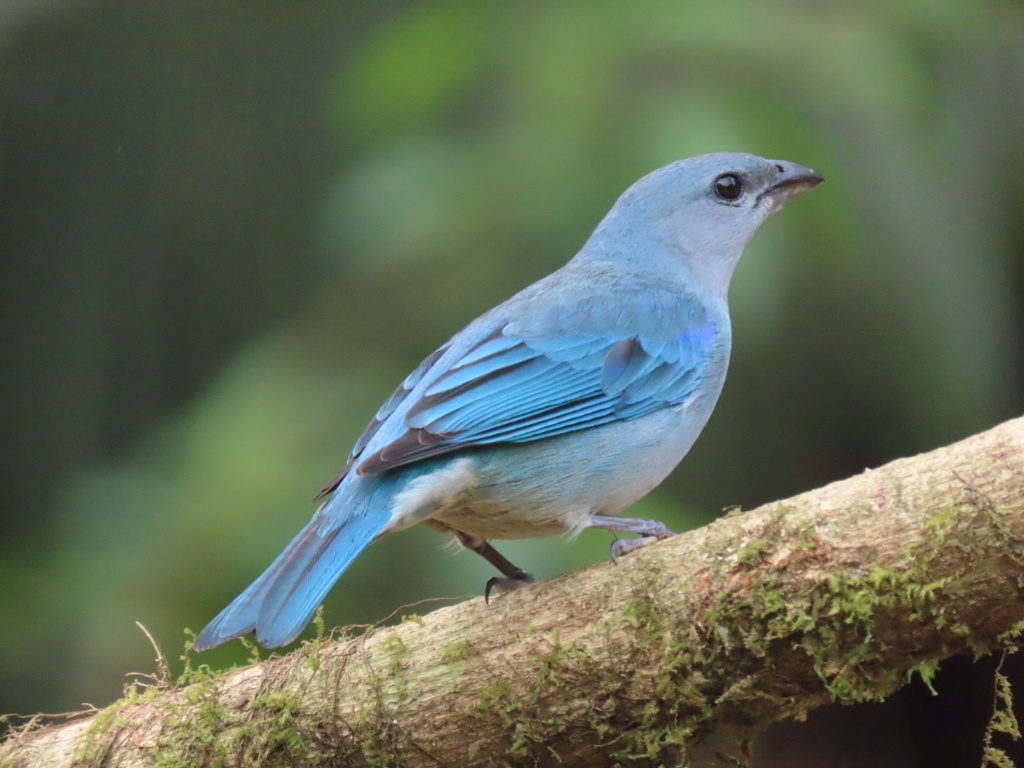
The azure-shouldered tanager is a large, thick-billed tanager with an average length of 18 cm (7.1 in) and a mass of 41–46 g (1.4–1.6 oz). Both sexes look alike and have similar dimensions. Adults are overall bluish in color, with gray-blue upperparts and heads, darker lores, and more bluish crowns. The throat and underparts are paler than the upper body, while the rump, uppertail coverts, and tail are bright blue. The flanks have a greenish wash. The upperwing-coverts are a rich, glossy violet-blue and the greater coverts are dark with wide turquoise-blue edges. The primary coverts and flight feathers are also dusky broad turquoise fringes. The upper mandible of the bill is blackish, while the lower mandible is blue-gray. The iris is dark brown and the legs are dark horn-gray. Juveniles are duller than adults.
Vocalizations. The azure-shouldered tanager's song is very different from that of other Thraupis tanagers; it has an initial assortment of soft notes, followed by clear, musical jittle-jittle-jittle, jeeeyr-jurr notes. These notes are usually repeated twice or thrice and can also be transcribed as look heeere, right heeere, drink-drink-jrrr. The song is initially complex and later becomes slower and more melodic. The species's calls include a thin sweee and several other squeaky notes.
Range & habitat
The azure-shouldered tanager is only found in the Atlantic Forest of southeastern Brazil, from southeastern Bahia, eastern Minas Gerais, and Espírito Santo south to northern Rio Grande do Sul. It has been reported as far west as Paraguay, but these records are thought to represent misidentified sayaca tanagers. The azure-shouldered tanager prefers forested habitats more than other Thraupis tanagers and inhabits humid montane forests, open woodlands, secondary growth, and forest edges. On Santa Catarina Island, it has also been recorded from orchards. It is mainly found on the Atlantic slopes of Serra do Mar. The species can be found at elevations of up to 1,600 m (5,200 ft), although it usually stays below 1,200 m (3,900 ft). It is likely non-migratory, but may migrate in the far south of its distribution.
Wikipedia: “Distribution and habitat”
What it does
Azure-shouldered tanagers are frugivorous and feed on fruit, flowers, and leaves. Species consumed include Psychotria constricta and P. velloziana, the fruit of melastomes, Livistona palms, and Eugenia umbelliflora, flowers and leaves of Acnistus arborescens and Solanum species, and Sechium leaves. The species' habit of eating leaves is an unusual aspect of its diet. Like other tanagers, azure-shouldered tanagers will chew fruit and leave parts of the fruit below the tree; although they have small gapes, they will crush larger fruit externally, allowing them to eat fruit of a variety of sizes. A study of network organization in Brazilian Atlantic Forest found the azure-shouldered tanager to have the third-largest contribution to the network topology, a fact that may be attributable to its highly frugivorous diet. A study of seed dispersal in E. umbelliflora found that although azure-shouldered tanagers are likely to move seeds to places that are favorable for germination, they have a low probability of seed removal. Foraging takes place in mixed-species or single species flocks of as many as 15–20 birds. The azure-shouldered tanager's foraging behavior is similar to that of the sayaca tanager; foraging occurs in tall trees and, in Espírito Santo, in moss on large branches. The species is aggressive to sayaca tanagers.
Wikipedia: “Diet”
Listen
Looking for field recordings…
Where it lives
Recorded sightings
—
geo-referenced records in GBIF, from museums, herbaria and field observers.
Drag the globe to turn it. Dots are where records exist, not a range map; darker means more records.
In the stacks
Searching the stacks…
Every page naming Thraupis cyanoptera in the Biodiversity Heritage Library →
This page is assembled live from iNaturalist, GBIF, Wikipedia, the Source Library and the Internet Archive. It is not yet part of the hand-edited codex. iNaturalist taxon 10301.