On eBird ↗
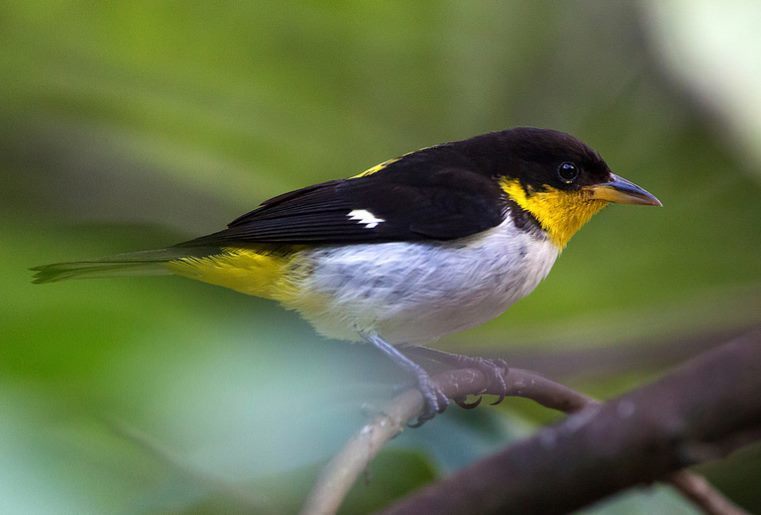
Yellow-backed Tanager
Live sightings near you, the range map, bar charts of when it is seen, and Macaulay Library photos and recordings.
Yellow-backed Tanager
Hemithraupis flavicollis
The yellow-backed tanager (Hemithraupis flavicollis) is a species of bird in the family Thraupidae, the tanagers and allies. It is found in Panama and every mainland South American country except Argentina, Chile, Paraguay, and Uruguay.
From the article Yellow-backed tanager on Wikipedia (CC BY-SA), quoted section by section
Description
The yellow-backed tanager is about 13 cm (5.1 in) long and weighs 11 to 15 g (0.39 to 0.53 oz). It is a smallish tanager with a relatively slender bill. The species is sexually dimorphic. Adult males of the nominate subspecies H. f. flavicollis have a mostly brownish black head and upper back. Their lower back and rump are bright yellow. Their uppertail coverts are mostly bright yellow with the longest being brownish black. Their wings are mostly brownish black with a thin white band on the outer web of the outer primaries; the white shows as a small patch on the closed wing. Their tail is brownish black. Their throat and adjoining sides of the neck are bright yellow. Their underparts are mostly off-white with a gray tinge and sometimes some black mottling on the sides. Their undertail coverts are bright yellow. Adult females have an olive-green head and upperparts. Their upperwing coverts and flight feathers are darker with yellowish green edges. They have mostly yellow underparts; the color is brightest on the throat and breast and the flanks have an olive tinge. Both sexes of all subspecies have a dark brown iris, a dusky maxilla, a pinkish to yellow mandible, and dark gray legs and feet. The other subspecies of the yellow-backed tanager differ from the nominate and each other thus:
H. f. ornata: male is deeper yellow than nominate on rump, throat, and undertail coverts H. …
Range & habitat
The yellow-backed tanager has a disjunct distribution. The subspecies are found thus:
H. f. ornata: eastern Darién Province of Panama south into northwestern Colombia's Chocó Department H. f. albigularis: northern Colombia from the Sinú River in Córdoba Department east and south in the Magdalena River valley to Antioquia and Santander departments H. f. flavicollis Suriname, French Guiana, and Brazil north of the central Amazon River H. f. peruana: east of the Andes from Meta Department in central Colombia south through eastern Ecuador into northern Peru to the Marañón and Amazon rivers H. f. aurigularis: from southeastern Colombia east into southern Venezuela's Bolivar state in the Cuyuní River basin and northern Brazil's upper Uaupés and Negro river basins H. f. hellmayri: southeastern Venezuela's Bolívar and Amazonas states east into western Guyana H. f. sororia: northern and eastern Peru south of the Marañón H. f. centralis: southeastern Peru, northern and central Bolivia, and south-central Brazil east into northern Mato Grosso H. f. obidensis: north of the Amazon to the Atlantic in Brazil's Pará state H. f. melanoxantha: eastern Brazil from Pernambuco south to Bahia H. f. …
Wikipedia: “Distribution and habitat”
What it does
The yellow-backed tanager feeds on arthropods and fruit. It forages in pairs and family groups and almost always as members of a mixed-species feeding flock. It forages mostly in the forest canopy by gleaning while perched and less frequently by hover-gleaning or with a short sally.
Wikipedia: “Feeding”
Listen
Looking for field recordings…
Where it lives
Recorded sightings
—
geo-referenced records in GBIF, from museums, herbaria and field observers.
Drag the globe to turn it. Dots are where records exist, not a range map; darker means more records.
In the stacks
Searching the stacks…
Every page naming Hemithraupis flavicollis in the Biodiversity Heritage Library →
This page is assembled live from iNaturalist, GBIF, Wikipedia, the Source Library and the Internet Archive. It is not yet part of the hand-edited codex. iNaturalist taxon 10305.