On eBird ↗
Pileated Finch
Live sightings near you, the range map, bar charts of when it is seen, and Macaulay Library photos and recordings.
Pileated Finch
Coryphospingus pileatus
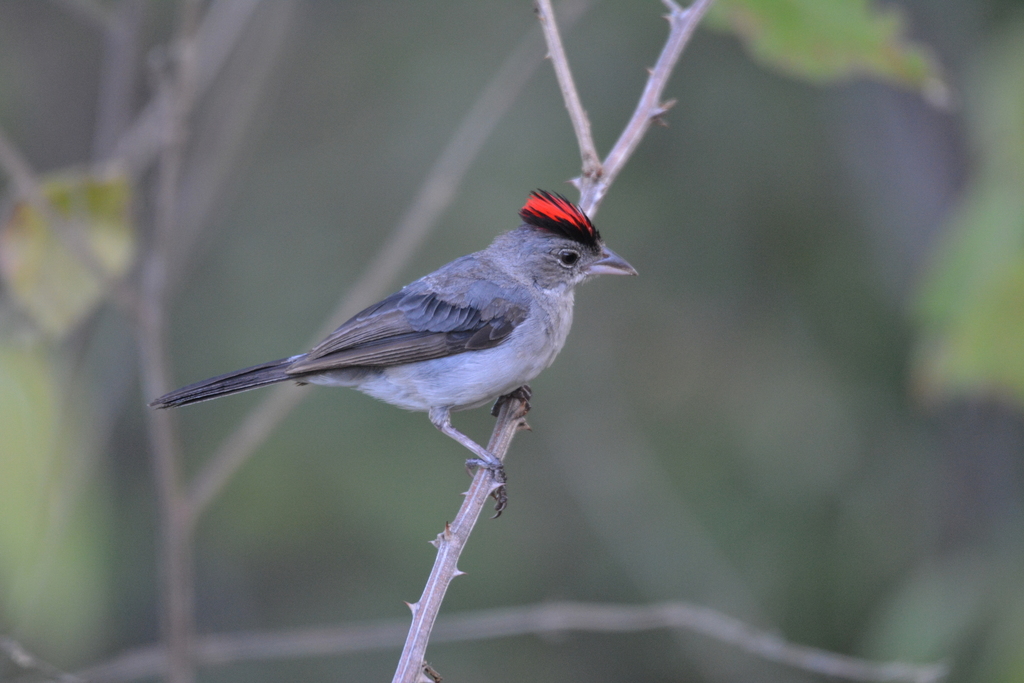
The grey pileated finch (Coryphospingus pileatus), also known as the pileated finch, is a species of bird in the family Thraupidae, where it has recently been moved to from the Emberizidae. It is found in Brazil, Colombia, French Guiana, and Venezuela in subtropical or tropical dry forests, subtropical or tropical moist lowland forests, subtropical or tropical dry shrubland, and heavily degraded former forest.
From the article Grey pileated finch on Wikipedia (CC BY-SA), quoted section by section
Description
The grey pileated finch is about 13.5 cm (5.3 in) long and weighs 12 to 18 g (0.42 to 0.63 oz). It has a shortish tail and a longish bill. The species is sexually dimorphic. Adult males of the nominate subspecies C. p. pileatus have a black crest with a red central stripe; the crest is usually held flat. Their face is gray with white crescents above and below the eye. Their nape and upperparts are grayish and their wings and tail blackish gray. Their throat is white and their underparts mostly whitish with a dull grayish wash on the sides and flanks. Adult females have a brownish crown with no red. Their face is grayish brown with the same eye crescents as males. Their upperparts, wings, and tail are grayish brown and their underparts mostly off-white with buff-gray flanks. Juveniles are similar to adult females but are slightly more olive and have some streaking on the underparts. Subspecies C. p. rostratus has the same plumage than the nominate but a visibly longer bill and a shorter tail. C. p. brevicaudus has paler lores than the nominate and a shorter tail. Both sexes of all subspecies have a dark iris, a blackish maxilla, a horn to grayish mandible, and dark gray legs.
Range & habitat
The grey pileated finch has a highly disjunct distribution: Each subspecies is separate from the others. They are found thus:
C. p. rostratus: central Colombia in the upper valley of the Magdalena River C. p. brevicaudus: the isolated Sierra Nevada de Santa Marta in northern Colombia and east into Venezuela, where it is found across northern Zulia, Falcón, and northern Lara states, east to Sucre state, and south into Apure and northern Bolívar states; also Margarita Island C. p. pileatus: central and eastern Brazil south of a line roughly from western Mato Grosso northeast to the Atlantic in Maranhão and north of a line roughly from Mato Grosso southeast to the Atlantic in southern Rio de Janeiro state The South American Classification Committee also has unconfirmed records in Bolivia and French Guiana. All three subspecies of the grey pileated finch primarily inhabit dry and somewhat open landscapes. These include scrublands, thorn scrub, and open woodlands; it also inhabits shrubby edges of moister woodlands including gallery forest and grassy edges along roads. In elevation it reaches 400 m (1,300 ft) in Colombia and 1,000 m (3,300 ft) in Brazil. In Venezuela it is found up to 750 m (2,500 ft) north of the Orinoco River and only to 100 m (300 ft) south of it.
Wikipedia: “Distribution and habitat”
What it does
The grey pileated finch's diet has not been studied. One source states that it feeds on seeds. It forages on the ground near or under shrubs and other low vegetation. In the non-breeding season it forms small flocks.
Wikipedia: “Feeding”
Listen
Looking for field recordings…
Where it lives
Recorded sightings
—
geo-referenced records in GBIF, from museums, herbaria and field observers.
Drag the globe to turn it. Dots are where records exist, not a range map; darker means more records.
In the stacks
Searching the stacks…
Every page naming Coryphospingus pileatus in the Biodiversity Heritage Library →
This page is assembled live from iNaturalist, GBIF, Wikipedia, the Source Library and the Internet Archive. It is not yet part of the hand-edited codex. iNaturalist taxon 10311.