- Animals
- ›Chordates
- ›Vertebrates
- ›Ray-finned Fishes
- ›Carps, Characins, Catfishes and Allies
- ›Minnows, Suckers, Carps, and Loaches
- ›Carps and Minnows
- ›Cyprinids
- ›Mahseers, Yellowfishes and Allies
- ›Hypselobarbus
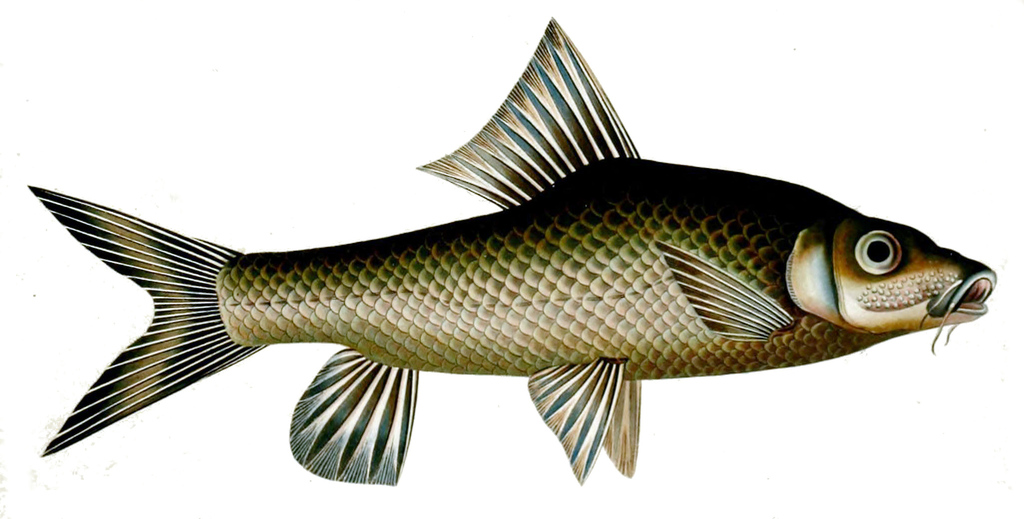
Humpback Mahseer
Hypselobarbus mussullah
Hypselobarbus mussullah is a species of freshwater ray-finned fish from the Indian endemic genus Hypselobarbus in the carp and minnow family Cyprinidae. Historically, this name was used to refer to a species of humpback mahseer from Southern India, but this was erroneous; the humpback mahseer is now referred to as Tor remadeviae.
From the article Hypselobarbus mussullah on Wikipedia (CC BY-SA), quoted section by section
Description
Hypselobarbus mussullah is a large cyprinid that has a laterally compressed body which is just over a quarter as deep as it is long (standard length). with a steep dorsal profile forming an obvious hump which runs to the base of the dorsal fin and then slopes gently away to the caudal fin. It has a narrow, thick lipped mouth which is downward facing with two pairs of short barbels behind the mouth. One pair is rostral and one pair is maxillary and this is one of the features that distinguishes it from otherwise similar species. The dorsal fin origin is just in front of the origin of the pelvic fins and the dorsal fin is concave on its upper margin, with a strong, smooth and stiff spine. The caudal fin is deeply forked with small tubercules on the rays. The overall colour is brown with a paler abdomen and it may have dark tips to the fins. It can grow to a maximum total length of 150 cm (59 in) and a weight of 90 kg (200 lb). …
Range & habitat
H. mussullah is endemic to the Western Ghats in southern India. It has been recorded from the Krishna and possibly the Godavari in the states of Karnataka, Maharashtra and Kerala. It occurs in isolated pockets and the species' distribution is extremely fragmented and the total area of the species range is probably less than 500 km2 (190 sq mi).
Wikipedia: “Distribution”
What it does
This species shows a preference for the deeper stretches of clear, fast flowing large jungle streams and rivers in upland areas. It has an omnivorous diet and feeds on fish, crustaceans, molluscs, frogs, fruits and algae.
Wikipedia: “Habitat and ecology”
Where it lives
Recorded sightings
—
geo-referenced records in GBIF, from museums, herbaria and field observers.
Drag the globe to turn it. Dots are where records exist, not a range map; darker means more records.
In the stacks
Searching the stacks…
Every page naming Hypselobarbus mussullah in the Biodiversity Heritage Library →
This page is assembled live from iNaturalist, GBIF, Wikipedia, the Source Library and the Internet Archive. It is not yet part of the hand-edited codex. iNaturalist taxon 103188.