- Animals
- ›Chordates
- ›Vertebrates
- ›Cartilaginous Fishes
- ›Sharks and Rays
- ›Rays
- ›Skates
- ›Hardnose Skates
- ›Rostroraja
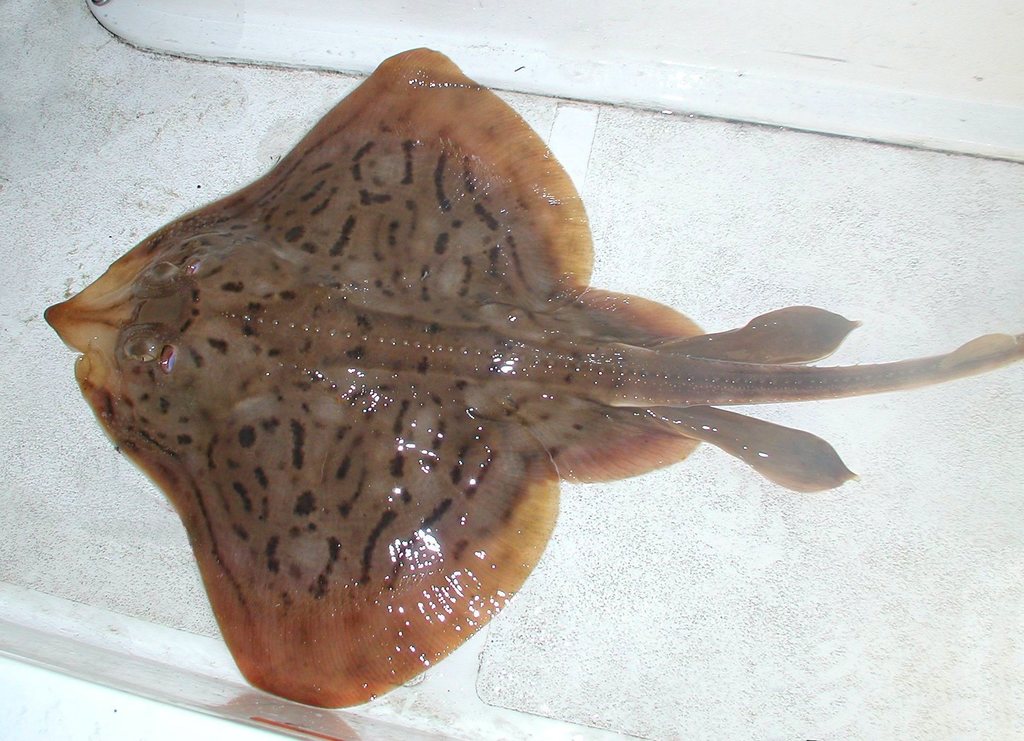
Clearnose Skate
Rostroraja eglanteria
The clearnose skate (Rostroraja eglanteria) is a species of cartilaginous fish in the family Rajidae. R. eglanteria is also known by other common names such as the brier skate and summer skate. Clearnose skates are easily identified by the translucent patches on either side of their snouts and their mottled dorsal surface. They are found along the Atlantic and Gulf coasts of the United States in shallow waters of the continental shelf.
From the article Clearnose skate on Wikipedia (CC BY-SA), quoted section by section
Description
Clearnose skates are named for the characteristic light-colored to translucent patches along both sides of the rostrum. The dorsal surface is primarily brown to grey in color, while the ventral surface is white. The dorsal side of the pectoral fins also exhibits dark brown to black bars and spots. R. eglanteria has a roughly rhombic disc shape, with the snout and pectoral fins making an approximate right angle. Mature clearnose skates reach up to 79 cm (31 in) in total length and 52 cm (20 in) in width. The tail is approximately half the total length. Another notable characteristic of clearnose skates is their line of thorns along the middle of the back and tail. The remainder of the dorsal surface is covered in small prickles, yielding the common name of brier skate. These prickles are concentrated on the anterior portion of the disc, as well as along the spine, like the thorns.
Range & habitat
The range of R. eglanteria includes the eastern coast of the United States, with its northernmost range in Massachusetts and southernmost in Florida. The clearnose skate's range then extends around the Florida peninsula to the eastern and north portions of the Gulf of Mexico. Like other skate species, clearnose skates are demersal. They can be found on soft substrates like mud and sand, or on harder surfaces like rock and gravel. Clearnose skates prefer shallow water that is at least partially saline (≥22 ppt). These skates are most commonly found at depths less than 111 m, but can be in waters as deep as 330 m. Clearnose Skate depth and distance from shore is dependent on season and latitude. In general, in the Mid-Atlantic Bight these skates are closer to shore in the spring, summer, and fall. R. eglanteria can be found in water anywhere from 41 to 86 °F (5 to 30 °C). Preferred temperature ranges are dependent on latitude, with skates in the northern regions of their range tolerating a larger temperature range than their southern counterparts.
Wikipedia: “Habitat and distribution”
What it does
The diet of clearnose skates includes crustaceans and molluscs, such as shrimp and fiddler crabs, as well as small fish. Hunting occurs primarily at night, with the skates searching along the seafloor for food. Clearnose skates have 46 to 54 teeth in their upper jaw and approximately the same number in their lower jaw. These teeth are blunt, small, and close together, enabling the skate to crush the hard shells of its prey. Male clearnose skates have sharper teeth than females, although this is probably to aid in copulation rather than feeding.
Wikipedia: “Feeding”
Where it lives
Recorded sightings
—
geo-referenced records in GBIF, from museums, herbaria and field observers.
Drag the globe to turn it. Dots are where records exist, not a range map; darker means more records.
In the stacks
Searching the stacks…
Every page naming Rostroraja eglanteria in the Biodiversity Heritage Library →
This page is assembled live from iNaturalist, GBIF, Wikipedia, the Source Library and the Internet Archive. It is not yet part of the hand-edited codex. iNaturalist taxon 1032432.