- Animals
- ›Chordates
- ›Vertebrates
- ›Ray-finned Fishes
- ›Carps, Characins, Catfishes and Allies
- ›Minnows, Suckers, Carps, and Loaches
- ›Suckers
- ›Suckers
- ›Buffalofish and Carpsuckers
- ›Ictiobus
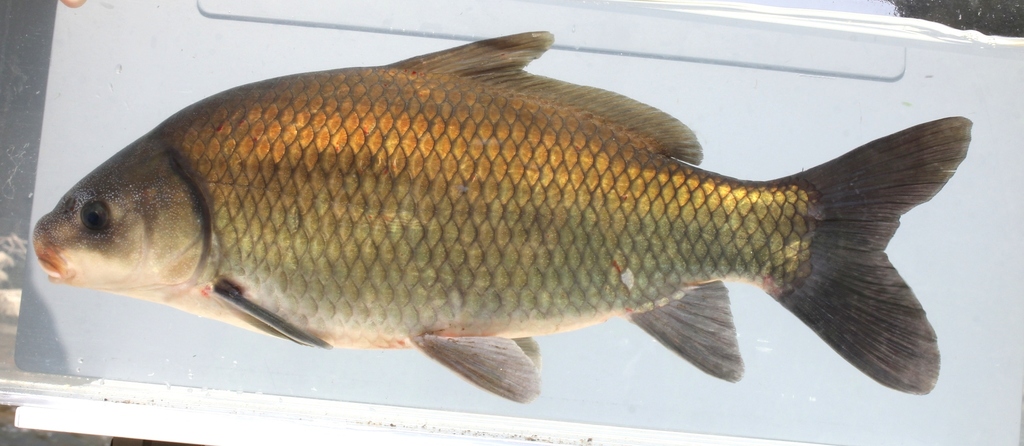
Smallmouth Buffalo
Ictiobus bubalus
The smallmouth buffalo (Ictiobus bubalus, from the Greek for "bull-fish" and "buffalo") is a catostomid fish species native to the major tributaries and surrounding waters of the Mississippi River in the United States, as well as some other water systems where it has been introduced. It is a long-lived, stocky fish like its relatives the bigmouth buffalo (I. cyprinellus) and the black buffalo (I. niger). The smallmouth buffalo's mouth is located ventrally like other Catostomidae species, whereas the bigmouth buffalo's mouth is terminal and opens forward. It is thought that smallmouth buffalo eyes are significantly larger than those of the black buffalo. Despite being members of different scientific suborders, these three species are sometimes conflated with common carp (Cyprinus carpio), but an easy and notable difference is that all catostomids lack the characteristic barbels of carp, and carp are not native to North America whereas buffalofish are. The smallmouth buffalo is recently realized as one of the longest-lived fishes, capable of living more than a century. The smallmouth buffalo is in decline across large portions of its range, and is subject to unregulated exploitation. Like the other buffalofish species, the smallmouth buffalo is targeted by modern bowfishing.
From the article Smallmouth buffalo on Wikipedia (CC BY-SA), quoted section by section
Description
The coloration of smallmouth buffalo ranges from shades of gray to brown and coppery green dorsally and pale yellow to white ventrally. Fins color match the portion of the body where they attach and are generally darker towards the tips. They are characteristically stocky, having a hump that rises up from the operculum. Pectoral fins protrude ventrally like the anal fins, the caudal fin has even lobes, and the dorsal fin protrudes from the top of the hump to a blunt point, then shortens and runs the remaining length of the body to the base of the tail. Typical adults reach a length around 40–60 cm (16–24 in), with some specimens reaching as much as 30.1 kg (66.4 pounds) and 101.5 cm (40.0 in).
Range & habitat
The smallmouth buffalo is a hardy fish that frequents clear, moderate to fast-moving streams, but has been occasionally known in some lakes and ponds. If prefers waters with dense aquatic vegetation and a silty bottom. It has a high tolerance for hard water and can survive in waters with pH ranges of 6.5–8.5.
Wikipedia: “Habitat”
What it does
The smallmouth buffalo's diet is primarily that of a detritivore, using its ventral sucker mouth to pick up vegetation and other organic matter from the bottom of its habitat, often scraping algae off of rocks. It is also quite the invertivore, consuming zooplankton, insect larvae, mollusk larvae, and small crustaceans.
Wikipedia: “Diet”
In human culture
Spawning usually takes place in spring and summer, with more specific times depending on the location of the population. Migration is negligible. Spawning often occurs in shallower sections of streams where the egg can adhere to vegetation and gravel to keep from flowing away. Each female can lay tens of thousands to hundreds of thousands of eggs at a time depending on her size, and no parental care is applied and the eggs hatch in one to two weeks. The young hide in aquatic vegetation to avoid predators. The lifespan of a smallmouth buffalo was historically not well known because of limited study on their otoliths and a reliance instead on other structures (e.g. scales, fin rays, gill plates) that are inadequate for age analysis. However, a 2019 study took an initial look at their otoliths (earstones) from a commercially harvested population in the middle Mississippi River drainage and found that even with harvest, about half of the sample was 20 years or older, with the oldest being 39 years of age. A 2020 study on a single female specimen from Oklahoma found it was 62 years old. In 2023, smallmouth buffalo otoliths were age validated, with longevity more than 60 years in Oklahoma. In Arizona, smallmouth buffalo as old as 90–100 years of age were discovered. …
Wikipedia: “Life history”
Where it lives
Recorded sightings
—
geo-referenced records in GBIF, from museums, herbaria and field observers.
Drag the globe to turn it. Dots are where records exist, not a range map; darker means more records.
In the stacks
Searching the stacks…
Every page naming Ictiobus bubalus in the Biodiversity Heritage Library →
This page is assembled live from iNaturalist, GBIF, Wikipedia, the Source Library and the Internet Archive. It is not yet part of the hand-edited codex. iNaturalist taxon 103292.