- Animals
- ›Chordates
- ›Vertebrates
- ›Reptiles
- ›Snakes and Lizards
- ›Lizards
- ›Iguanas and Allies
- ›Dragons and Chameleons
- ›Chameleons
- ›Kinyongia
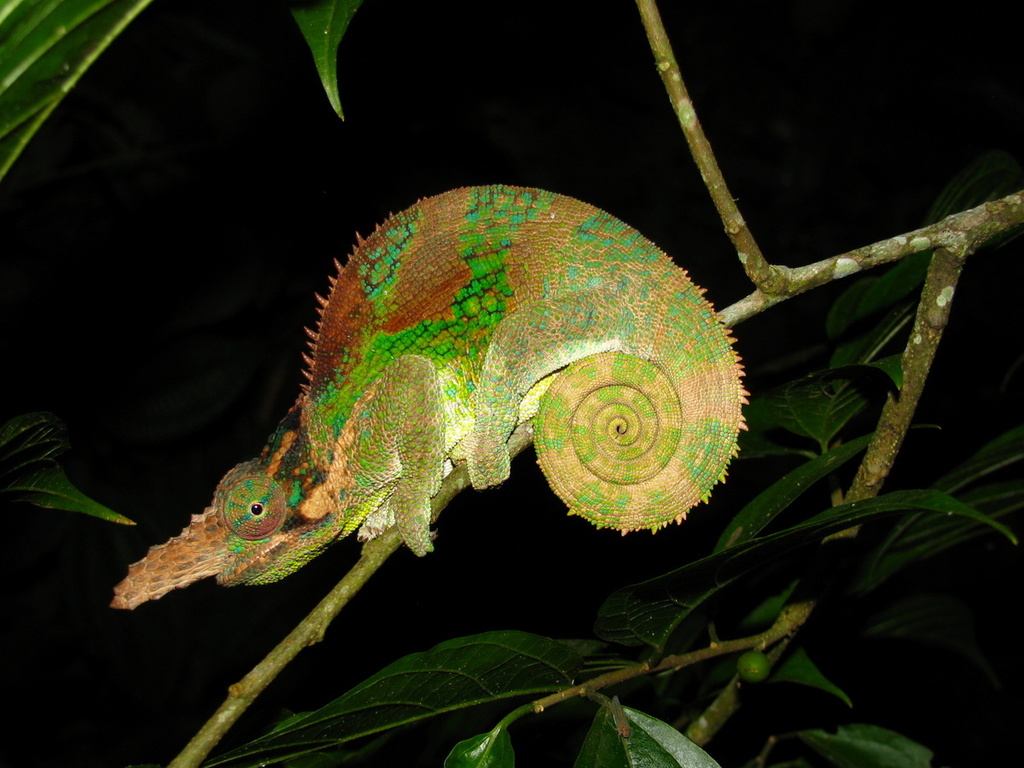
Vosseler's Blade-horned Chameleon
Kinyongia vosseleri
Kinyongia vosseleri, the Vosseler's blade-horned chameleon, is an endangered species of chameleon that is endemic to forests in the East Usambara Mountains in Tanzania. It was formerly included in K. fischeri, which is not found in the range of K. vosseleri.
From the article Kinyongia vosseleri on Wikipedia (CC BY-SA), quoted section by section
Description
K. vosseleri is a medium-large species in the genus Kinyongia at up to 29.5 cm (11.6 in) in total length, with the tail making up more than half of that. Females do not grow as large as males. Adult males have a large pair of converging horns on the nose. Uniquely in the "two-horned Usambara group", adult females of K. vosseleri entirely lack horns (in K. matschiei and K. multituberculata, adult females have small horns; however, juveniles are essentially hornless). The only close relatives where the adult female lacks horns are K. boehmei and K. tavetana, but they are not from the Usambaras.
Wikipedia: “Appearance”
Range & habitat
K. vosseleri is only found in forests in the East Usambara Mountains of Tanzania, at an altitude of up to c. 1,500 m (4,900 ft). Its range overlaps with the closely related K. matschiei, whereas K. multituberculata is found in the West Usambara Mountains.
Wikipedia: “Geographic range and habitat”
In human culture
K. vosseleri was already described as a species in 1913 by Fritz Nieden, with the specific name, vosseleri being in honor of German zoologist Julius Vosseler. Subsequently, it was generally considered a synonym of K. fischeri. It was only in 2008 that it was verified that the two are separate species with fully separated distributions.
Wikipedia: “Taxonomy and etymology”
Where it lives
Recorded sightings
—
geo-referenced records in GBIF, from museums, herbaria and field observers.
Drag the globe to turn it. Dots are where records exist, not a range map; darker means more records.
In the stacks
Searching the stacks…
Every page naming Kinyongia vosseleri in the Biodiversity Heritage Library →
This page is assembled live from iNaturalist, GBIF, Wikipedia, the Source Library and the Internet Archive. It is not yet part of the hand-edited codex. iNaturalist taxon 103684.