On eBird ↗
Caatinga Black-Tyrant
Live sightings near you, the range map, bar charts of when it is seen, and Macaulay Library photos and recordings.
Caatinga Black-Tyrant
Knipolegus franciscanus
The Sao Francisco black tyrant (Knipolegus franciscanus), also known as the caatinga black tyrant or Brazilian black tyrant, is a species of bird in the family Tyrannidae, the tyrant flycatchers. It is endemic to Brazil.
From the article São Francisco black tyrant on Wikipedia (CC BY-SA), quoted section by section
Description
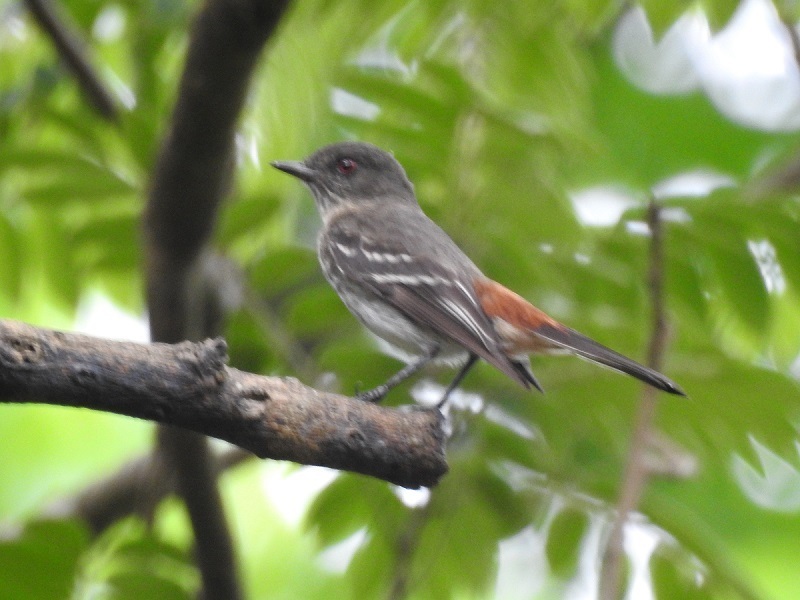
The Sao Francisco black tyrant is 16 to 16.5 cm (6.3 to 6.5 in) long. One female weighed 20.5 g (0.72 oz). Adult males are almost entirely shiny black. Their wings have a wide white band at the base of the primaries that is conspicuous in flight but usually hidden when perched. Adult females have a mostly brownish gray head and upperparts with a rufous-buff rump, uppertail coverts, and base of the tail. The rest of their tail is dark. Their wings are brownish gray with whitish edges on the innermost remiges and pale tips on the coverts that show as two wing bars. Their underparts are mostly whitish with heavy dusky streaking and a buffish wash on the breast and undertail coverts. Both sexes have a blackish bill and dark gray or blue-gray legs and feet. Males have a red iris; the female's is orange-red.
Range & habitat
The Sao Francisco black tyrant is found in east-central Brazil's São Francisco River basin. It has several discrete subpopulations in southwestern Bahia, northern and central Minas Gerais, southeastern Tocantins, northeastern Goiás, and the Federal District. It primarily inhabits caatinga scrublands and semi-deciduous dry forest. It greatly favors areas with outcrops of limestone or sandstone though it occasionally occurs some distance from them.
Wikipedia: “Distribution and habitat”
What it does
The Sao Francisco black tyrant is assumed to feed mostly on insects though details are lacking. It usually forages singly or in pairs, though in the non-breeding season is sometimes joins mixed-species feeding flocks. It perches unobtrusively at any level of the forest but usually in the canopy or sub-canopy. It captures prey mostly with short sallies to glean it from leaves and branches and occasionally in mid-air "(hawking)". It will also drop to the ground to take prey.
Wikipedia: “Feeding”
Listen
Looking for field recordings…
Where it lives
Recorded sightings
—
geo-referenced records in GBIF, from museums, herbaria and field observers.
Drag the globe to turn it. Dots are where records exist, not a range map; darker means more records.
In the stacks
Searching the stacks…
Every page naming Knipolegus franciscanus in the Biodiversity Heritage Library →
This page is assembled live from iNaturalist, GBIF, Wikipedia, the Source Library and the Internet Archive. It is not yet part of the hand-edited codex. iNaturalist taxon 103699.