On eBird ↗
Moss-backed Tanager
Live sightings near you, the range map, bar charts of when it is seen, and Macaulay Library photos and recordings.
Moss-backed Tanager
Bangsia edwardsi
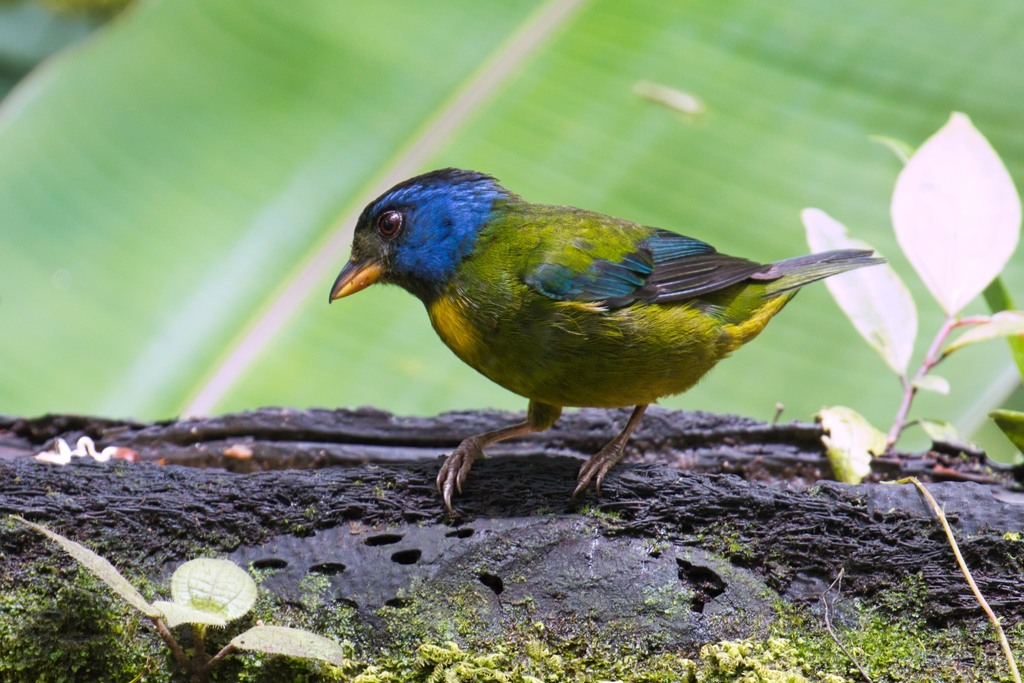
The moss-backed tanager (Bangsia edwardsi) is a species of bird in the family Thraupidae. It is found in Colombia and Ecuador. It is a chunky, large-headed tanager with moss-green upperparts, dark blue-tinged dark green wings, olive green underparts, a bright golden yellow patch on the chest, and black head with shining blue sides. It is endemic to the Western Andes of western Colombia and northwestern Ecuador, where it inhabits dense, humid Pacific slope forests. It feeds on insects and fruit. It is classified as being of least concern on the IUCN Red List due to its sufficiently large range and population.
From the article Moss-backed tanager on Wikipedia (CC BY-SA), quoted section by section
Description
The species is a chunky, large-headed tanager with a distinctive appearance. The upperparts and back mostly moss-green, with dark blue-tinged dark green wings. The underparts are mainly olive green with a yellowish hue, with a bright golden yellow patch in the middle of the chest. There is occasionally an indistinct yellow median line between the chest and belly. The head is black from the throat up to the central nape, with shining blue sides. The beak is stubby and bicolored, with a dusky upper mandible and yellow lower mandible. The eyes are brown and the legs are gray. Both sexes are similar-looking in the visible spectrum, but males reflect UV light more strongly than females. Immatures are duller than adults. It is most similar-looking to the related gold-ringed tanager, but lacks that species' golden-yellow face markings. It also resembles the golden-chested tanager in having a bright yellow chest patch, but the golden-chested tanager is otherwise mostly blackish in color.
Range & habitat
The moss-backed tanager is endemic to the Western Andes of western Colombia and northwestern Ecuador, where it inhabits dense, humid Pacific slope forests. They are usually found in premontane forests between tropical lowland forests and montane evergreen forests, but have also been recorded from woodland edge, secondary growth, and clearings. They have a somewhat discontinuous distribution, being lacking in parts of Cauca that have otherwise suitable habitat, and are typically found at elevations of 600-2200 m. In Ecuador, they are usually recorded between 500 m and 1100 m, although some records are as high as 1700 m. Its distribution is separated elevationally from the closely-related golden-chested tanager, which occupies foothill forests at lower elevations. The lack of golden-chested tanagers in the southern portions of the moss-backed tanager's range may explain its presence at lower elevations in Ecuador.
Wikipedia: “Distribution and habitat”
Listen
Looking for field recordings…
Where it lives
Recorded sightings
—
geo-referenced records in GBIF, from museums, herbaria and field observers.
Drag the globe to turn it. Dots are where records exist, not a range map; darker means more records.
In the stacks
Searching the stacks…
Every page naming Bangsia edwardsi in the Biodiversity Heritage Library →
This page is assembled live from iNaturalist, GBIF, Wikipedia, the Source Library and the Internet Archive. It is not yet part of the hand-edited codex. iNaturalist taxon 10383.