On eBird ↗
Gold-ringed Tanager
Live sightings near you, the range map, bar charts of when it is seen, and Macaulay Library photos and recordings.
Gold-ringed Tanager
Bangsia aureocincta
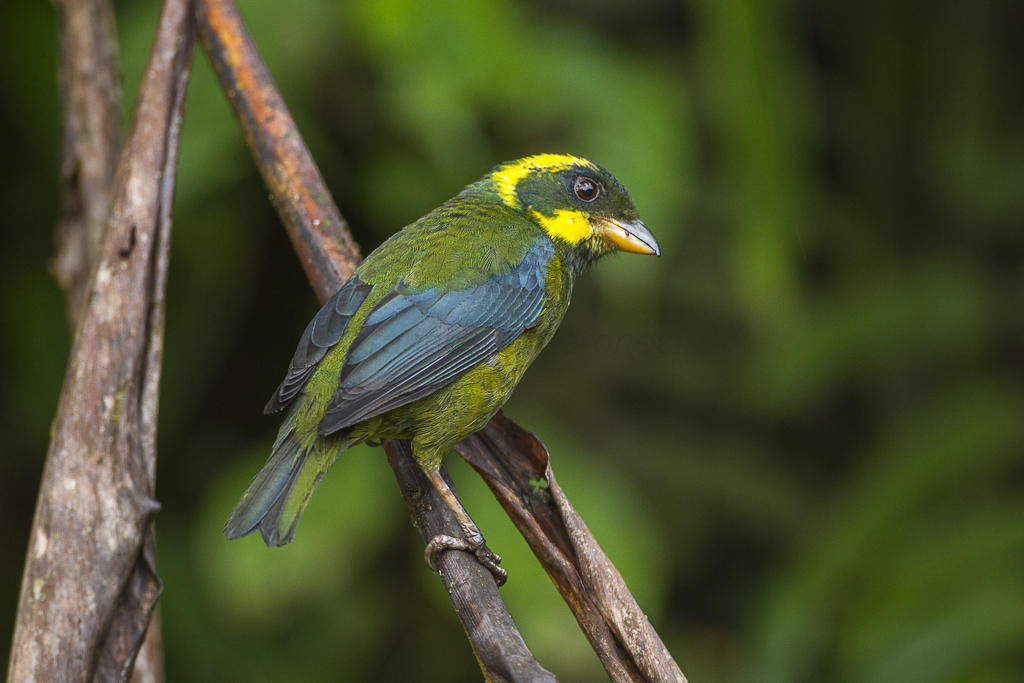
The gold-ringed tanager (Bangsia aureocincta) is a species of bird in the family Thraupidae, endemic to Colombia. It is a plump, relatively short-tailed tanager with a distinctive gold ring around its face. It inhabits a narrow band of high-altitude cloud forest on the slopes of the western cordillera of the Andes, where it survives on a diet of fruit and insects. The bird is found in small numbers within a limited geographical area, and much of its breeding biology has yet to be described. It is considered a vulnerable species, threatened by habitat loss.
From the article Gold-ringed tanager on Wikipedia (CC BY-SA), quoted section by section
Description
Like the other Bangsia tanagers, the gold-ringed tanager is a plump bird with a relatively short tail. They are approximately 16cm in length and typically weigh between 35-45 grams. Adult birds are mostly dark green with a yellow breast. The prominent "gold ring" facial markings of adults, described below, make the bird easy to identify, with the only possible confused species being the slaty-capped shrike-vireo. Detailed descriptions were provided by F. Gary Stiles, based on birds captured at Alto de Pisones in Risaralda Department:
Adult male. The head, throat, and sides of the breast are glossy black, with a ring around the olive-green cheeks and auriculars that is formed by the bright yellow postocular and malar stripes and postauricular bar. The centre of the breast is bright orange-yellow, with the remaining underparts being bright olive-green. The bird's back is dark green, with the rump and upper tail coverts a paler, brighter green. The central tail feathers (rectrices) are dull olive while the outer feathers are dusky, edged with olive. The wings are blackish with the wing coverts and secondaries edged with dull blue. The iris is dark red, the bill is black (upper mandible) and horn coloured (lower mandible), and the tarsi and feet are greyish.
Adult female. …
Range & habitat
The gold-ringed tanager is found on the slopes of the western cordillera of the Andes. Its altitudinal range is from 1350-2195masl, though most birds are found at or above the 1700m level. The only site where the birds are seen at levels as low as 1350m is in the area of San José del Palmar in the Chocó Department. It is thought that this may be related to the absence of the black-and-gold tanager at this site. At any given site the birds occupy a narrow altitude range of 100-200m, corresponding to the principal cloud interception point of the Pacific slope.
Wikipedia: “Altitudinal range”
What it does
Gold-ringed tanagers forage solitarily, in pairs, and in family groups, and also join mixed feeding flocks. Males are most likely to be seen foraging alone. These tanagers usually forage among moss and epiphytes on tree branches, typically from the upper understory to the mid-canopy level. They are often described as moving in a deliberate or even "sluggish" manner. They have been observed bashing fruits against a branch to access the contents. They have also been seen pecking at objects on the ground, sometimes in pairs but usually alone, moving and jumping across the floor in a manner likened to that of a swainson's thrush.
Wikipedia: “Feeding”
Listen
Looking for field recordings…
Where it lives
Recorded sightings
—
geo-referenced records in GBIF, from museums, herbaria and field observers.
Drag the globe to turn it. Dots are where records exist, not a range map; darker means more records.
In the stacks
Searching the stacks…
Every page naming Bangsia aureocincta in the Biodiversity Heritage Library →
This page is assembled live from iNaturalist, GBIF, Wikipedia, the Source Library and the Internet Archive. It is not yet part of the hand-edited codex. iNaturalist taxon 10385.