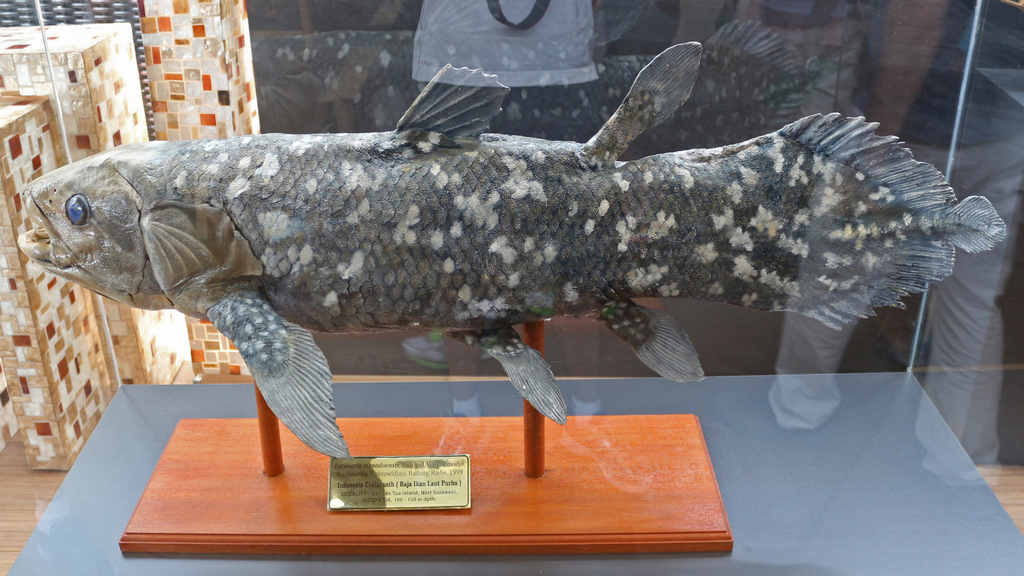
Sulawesi Coelacanth
Latimeria menadoensis
The Indonesian coelacanth (Latimeria menadoensis, Indonesian: raja laut, English: king of the sea), also called Sulawesi coelacanth, is one of two living species of coelacanth, identifiable by its brown color. Latimeria menadoensis is a lobe-finned fish belonging to the class Actinistia and order Coelacanthiformes, classified under the family Latimeriidae and genus Latimeria. As a deep-sea predator, this species plays a crucial role in maintaining the balance of marine ecosystems.
Separate populations of the Indonesian coelacanth are found in the waters of north Sulawesi, Papua, Southwest Papua, and North Maluku, which may be genetically distinct. This species offers insights into the early existence of fish and the first tetrapods.
From the article Indonesian coelacanth on Wikipedia (CC BY-SA), quoted section by section
Description
Superficially, the Indonesian coelacanth, known locally as raja laut ("king of the sea"), appears to be the same as those found in the Comoros except that the background coloration of the skin is brownish-gray rather than bluish. It has the same white mottling pattern as the West Indian Ocean coelacanth, but with flecks over the dorsal surface of its body and fins that appear golden due to the reflection of light. It may grow to 1.4 meters long and about 31–51 kg. These two species also reflect their taxa in certain morphological characteristics, especially in their pectoral and pelvic fin–like structure and in their oil-filled notochord instead of a vertebral spine. It also has unique hollow fin rays which adds to the coelacanth's image as a living fossil. It has also a considerable adipose-filled swim bladder for the control of buoyancy and an intracranial articulation which facilitates the jaw movement during feeding. The head is large relative to the size of the body weighing 27–29% of the total body length. Compared to its African counterpart, Latimeria menadoensis has longer pectoral fins and shorter pelvic fins with fewer second dorsal and pelvic fin rays. The species' arrangement of teeth has sharply curved small premaxillary teeth used in slicing its food and several smaller teeth with fang-like large palatopterygoids. …
Range & habitat
Geological obstacles and ocean currents most likely have an impact on the distribution of the Indonesian coelacanths, which are restricted to particular areas of the country (in contrast, L. chalumnae is found throughout the western Indian Ocean). Living in the lightless depths of the ocean, the Indonesian coelacanth has certain visual adaptations. They appear to be more sensitive to blue light at 480 nm, a typical wavelength in the black, restricted habitation of this animal. This adaptation has undergone further shift, together with the expansion of the rostral organ, which can detect electrical signals, enables the coelacanth to move and feed in the dark environment. It is speculated by the researchers that such evolution process in the deep-sea ecosystems might have started at about 200 million years ago. Teams of researchers using submersibles have recorded live sightings of the fish in the waters of Manado Tua and the Talise islands off north Sulawesi as well as in the waters of Biak in Papua. These areas share similar steep rocky topography full of caves, which are the habitat of the fish. These coelacanths live in deep waters of around 150 metres or more, at a temperature between 14 and 18 degrees Celsius. This species is associated with deep waters, and their occurrence ranges from 100 to 700 meters under the water surface. …
Wikipedia: “Habitat”
What it does
The Indonesian coelacanth is thought to be ovoviviparous, but no females of this species containing eggs or embryos have been taken. Coelacanths take about three years to reach maturity in most species, and their gestation period lasts for about three years – the longest of any vertebrate. The juveniles may emerge at around 30 cm in length. This reproductive strategy leads to production of few offspring, usually between five and twenty five embryos in each reproductive cycle. Mating is believed to be monogamous, indicating that only the male attended the area to mate with the female. The population of Indonesian coelacanths is believed to be quite small. To this date, fewer than ten have been officially documented and out of them, only 3 and 5 are recorded. Such a low number of observations is indicative of the rarity of the species and the challenges involved in studying it.
Wikipedia: “Reproduction and mating”
Where it lives
Recorded sightings
—
geo-referenced records in GBIF, from museums, herbaria and field observers.
Drag the globe to turn it. Dots are where records exist, not a range map; darker means more records.
In the stacks
Searching the stacks…
Every page naming Latimeria menadoensis in the Biodiversity Heritage Library →
This page is assembled live from iNaturalist, GBIF, Wikipedia, the Source Library and the Internet Archive. It is not yet part of the hand-edited codex. iNaturalist taxon 104110.