On eBird ↗
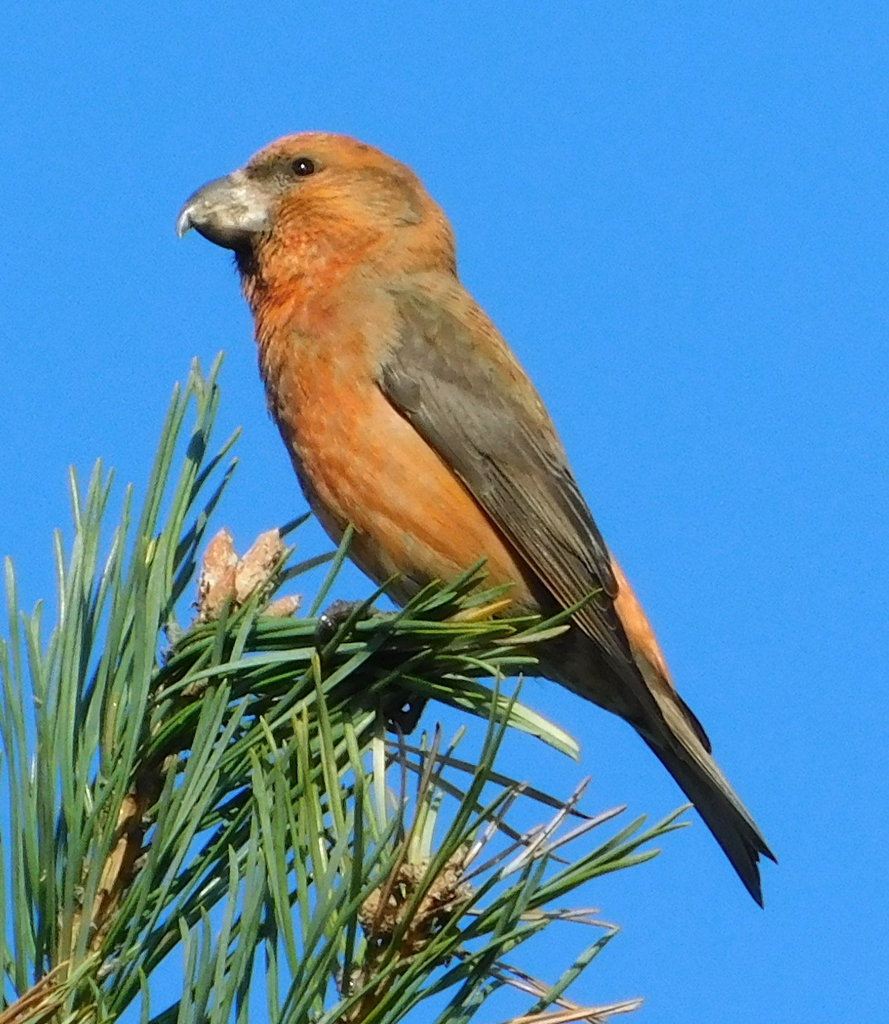
Parrot Crossbill
Live sightings near you, the range map, bar charts of when it is seen, and Macaulay Library photos and recordings.
Parrot Crossbill
Loxia pytyopsittacus
The parrot crossbill (Loxia pytyopsittacus) is a small passerine bird in the finch family Fringillidae. The scientific name is from Ancient Greek. Loxia derives from loxos, "crosswise", and pytyopsittacus is from pitus, pituos, "pine", and psittakos, "parrot.
From the article Parrot crossbill on Wikipedia (CC BY-SA), quoted section by section
Description
Adult males tend to be red or orange in colour, and females green or yellow, but there is much variation. This species is difficult to separate from red and Scottish crossbills, and plumage distinctions are negligible. It is slightly larger than other crossbills, measuring 16 to 18 cm (6.3 to 7.1 in) long and spanning 27 to 31 cm (11 to 12 in) across the wings. It is quite bulky and heavy weighing from 44 to 58.2 g (1.55 to 2.05 oz), with an average of 53 g (1.9 oz). The head and bill are larger than in either of the other species. The bill is thicker than those of its relatives, and the crossed tips are often not readily apparent. Extreme care is needed to identify this species. The deeper, harder choop or tyuup call is probably the best indicator.
Range & habitat
This bird breeds in the pine forests of northwest Europe and into western Russia. There is also a small population in Scotland, adding to the difficulty of distinguishing it from the sympatric red crossbill and the endemic Scottish crossbill. This crossbill is mainly resident, but will migrate south and west if its food source fails.
Wikipedia: “Distribution and habitat”
What it does
Parrot crossbills will form flocks outside the breeding season, often mixed with other crossbills.
Food and feeding. They are specialist feeders on conifer cones, and the unusual bill shape is an adaptation to assist the extraction of the seeds from the cone. The parrot crossbill is a specialist feeder on the cones of Scots pine.
Wikipedia: “Behaviour”
Listen
Looking for field recordings…
Where it lives
Recorded sightings
—
geo-referenced records in GBIF, from museums, herbaria and field observers.
Drag the globe to turn it. Dots are where records exist, not a range map; darker means more records.
In the stacks
Searching the stacks…
Every page naming Loxia pytyopsittacus in the Biodiversity Heritage Library →
This page is assembled live from iNaturalist, GBIF, Wikipedia, the Source Library and the Internet Archive. It is not yet part of the hand-edited codex. iNaturalist taxon 10420.