On eBird ↗
White-winged Crossbill
Live sightings near you, the range map, bar charts of when it is seen, and Macaulay Library photos and recordings.
White-winged Crossbill
Loxia leucoptera
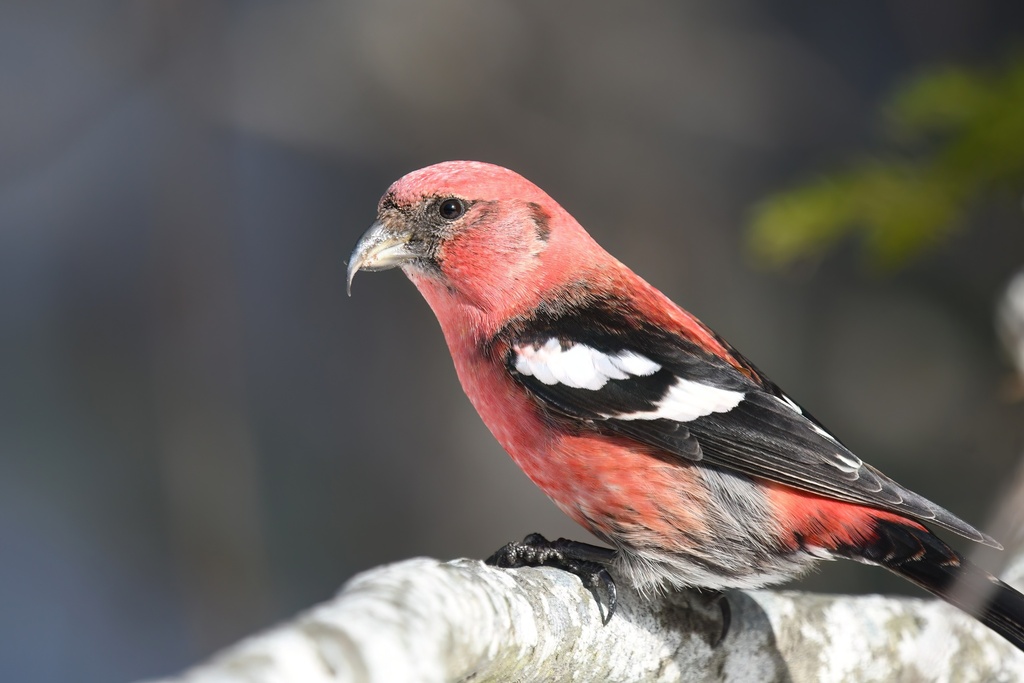
The two-barred crossbill (Loxia leucoptera), known as the white-winged crossbill in North America, is a small passerine bird in the finch family Fringillidae. It has two subspecies, white-winged crossbill Loxia leucoptera leucoptera in North America, and two-barred crossbill Loxia leucoptera bifasciata in NE Europe and N Asia.
From the article Two-barred crossbill on Wikipedia (CC BY-SA), quoted section by section
Description
The two-barred crossbill is 14.5–17 cm (5.7–6.7 in) in length and weighs 25–40 g (0.88–1.41 oz). It has short legs, a forked tail, a crossed bill and two prominent white wing-bars. The male of the nominate subspecies has forehead, crown, nape and upper-parts bright raspberry-red. The scapulars are black or blackish brown with pink edges. The upper tail coverts are black with white fringes. The female lacks the pink and instead has greenish-yellow head and upperparts. The two-barred is easier to identify than other crossbills, especially in North America, where only the red crossbill (Loxia curvirostra) and this species occur. Within its Palearctic range, this species is smaller-headed and smaller-billed than the parrot crossbill and Scottish crossbill, so the main confusion between species both there and in North America is with the red or common crossbill. The main plumage distinction from the red crossbill is the white wingbars which give this species its English and scientific names. There are also white tips to the tertials. The adult male is also a somewhat brighter (pinker) red than other male crossbills. Some red crossbills occasionally show weak white wingbars, so care is needed with the correct identification of this species. …
Range & habitat
This bird breeds in the coniferous forests of Alaska, Canada, the northernmost United States and across the Palearctic extending into northeast Europe. It nests in conifers, laying 3–5 eggs. This crossbill is mainly resident, but will irregularly irrupt south if its food source fails. The American race seems to wander more frequently than the Eurosiberian subspecies. This species will form flocks outside the breeding season, often mixed with other crossbills. It is a rare visitor to western Europe, usually arriving with an irruption of red crossbills.
Wikipedia: “Distribution and habitat”
What it does
They are specialist feeders on conifer cones, and the unusual bill shape is an adaptation to assist the extraction of the seeds from the cone. The two-barred crossbill has a strong preference for larch (Larix), in Eurosiberia using Siberian larch (Larix sibirica) and Dahurian larch (L. gmelinii), and in North America Tamarack larch (L. laricina). It will also take rowan (Sorbus) berries, and in North America, also eastern hemlock (Tsuga canadensis) and white spruce (Picea glauca) cones.
Wikipedia: “Food and feeding”
Listen
Looking for field recordings…
Where it lives
Recorded sightings
—
geo-referenced records in GBIF, from museums, herbaria and field observers.
Drag the globe to turn it. Dots are where records exist, not a range map; darker means more records.
In the stacks
Searching the stacks…
Every page naming Loxia leucoptera in the Biodiversity Heritage Library →
This page is assembled live from iNaturalist, GBIF, Wikipedia, the Source Library and the Internet Archive. It is not yet part of the hand-edited codex. iNaturalist taxon 10423.