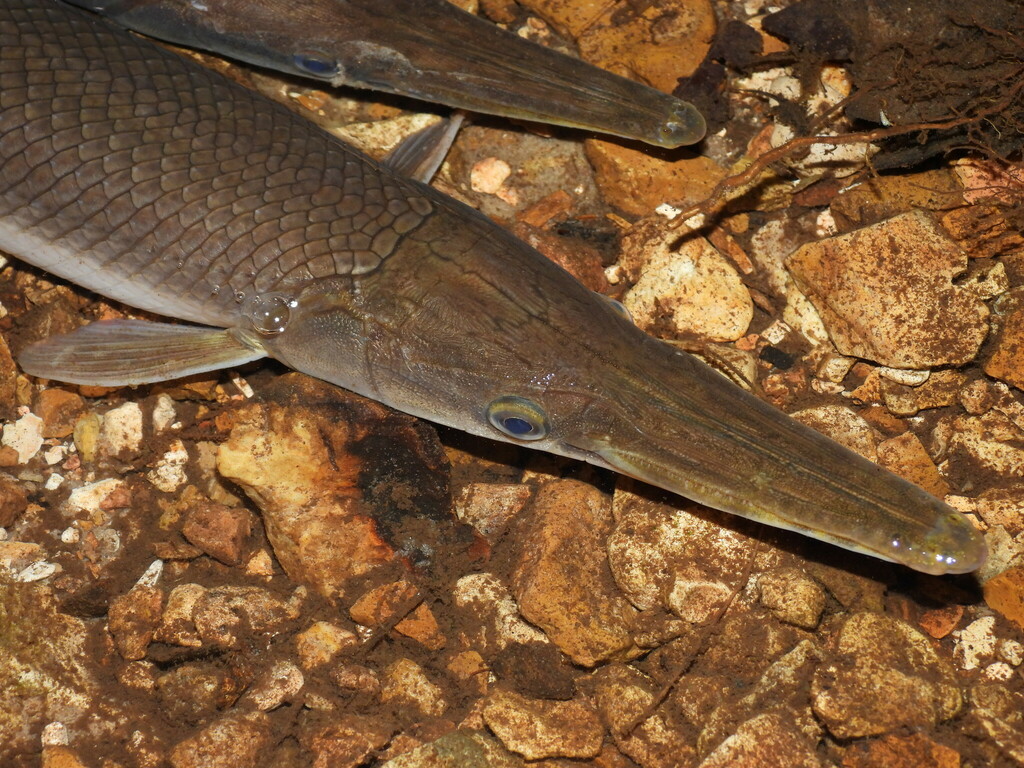
Shortnose Gar
Lepisosteus platostomus
The shortnose gar (Lepisosteus platostomus) is a primitive freshwater fish of the family Lepisosteidae. It is native to the United States where its range includes the Mississippi and Missouri River basins, ranging from Montana to the west and the Ohio River to the east, southwards to the Gulf Coast. It inhabits calm waters in large rivers and their backwaters, as well as oxbow lakes and large pools. It is a long, slender fish, brown or olive green above and whitish below. It typically grows to about 60 cm (24 in) and is armored by rows of interlocking, rhomboidal ganoid scales.
The shortnose gar is an ambush predator, feeding mostly on fish, but also consuming crustaceans, insects, and other invertebrates. Breeding takes place in spring when females, often accompanied by several males, attach their eggs to clumps of submerged vegetation. The eggs, which are toxic to man, hatch after a week or so. After consuming their yolk sac, the young fish feed on insect larvae and small crustaceans, maturing at an age of about three years.
From the article Shortnose gar on Wikipedia (CC BY-SA), quoted section by section
Description
Shortnose gar have a prehistoric-looking appearance. Like many other "lie-in-wait" predators, they have an elongated, torpedo-like body with an elongated head containing one row of sharp, conical teeth. Similar to many Paleozoic and Mesozoic actinopterygians, their bodies are covered in rows of interlocking, rhomboidal ganoid scales that create an exceptionally protective, yet flexible armor around the fish. The dorsal fin is located posterior nearly directly above the anal fin and very near the large caudal fin. Shortnose gar vary in color, changing from brown/olive green on the dorsal surface to yellow on the sides and white on the underbelly. Shortnose gar can be discerned from other gar species in that they lack the upper jaw of the alligator gar, the long snout of the longnose gar, and the markings of the spotted gar. The shortnose gar reaches up to 88 cm (35 in), but a more common length is 62.5 cm (24.6 in).
Range & habitat
Shortnose gar generally inhabit calm waters in large rivers and their backwaters, as well as oxbow lakes and large, quiet pools, typically around vegetation or downed logs. Gar have the ability to survive in environments with very little oxygen and especially turbid conditions because of their specialized gas bladder. Gar gas bladders have the ability to function like a lung to extract and use oxygen from swallowed air in addition to regulating buoyancy.
Wikipedia: “Habitat”
What it does
Shortnose gar typically spawn in the spring during April, May, and June, when water temperatures are between 16 and 21 °C (61 and 70 °F). Often accompanied by more than one male, females scatter large, yellowish-green eggs in quiet, shallow water among submerged vegetation or other underwater structures. A sticky adhesive holds the eggs together in clumps, where they hatch after eight to 9 days. The eggs are poisonous to birds and mammals, including humans. The young remain in the yolk sac for another week, then they feed on insect larvae and small crustaceans. Young gar typically lead solitary lives and sexual maturity is achieved around three years of age when the gar reaches about 15 in (380 mm) in length.
Wikipedia: “Reproduction and lifecycle”
In human culture
In Greek, Lepisosteus translates to "bony scale", and platostomus translates to "broad mouth".
Wikipedia: “Etymology of name”
Where it lives
Recorded sightings
—
geo-referenced records in GBIF, from museums, herbaria and field observers.
Drag the globe to turn it. Dots are where records exist, not a range map; darker means more records.
In the stacks
Searching the stacks…
Every page naming Lepisosteus platostomus in the Biodiversity Heritage Library →
This page is assembled live from iNaturalist, GBIF, Wikipedia, the Source Library and the Internet Archive. It is not yet part of the hand-edited codex. iNaturalist taxon 104250.