- Animals
- ›Chordates
- ›Vertebrates
- ›Cartilaginous Fishes
- ›Sharks and Rays
- ›Sharks
- ›Galean Sharks
- ›Ground Sharks
- ›Barbeled Houndsharks
- ›Leptocharias
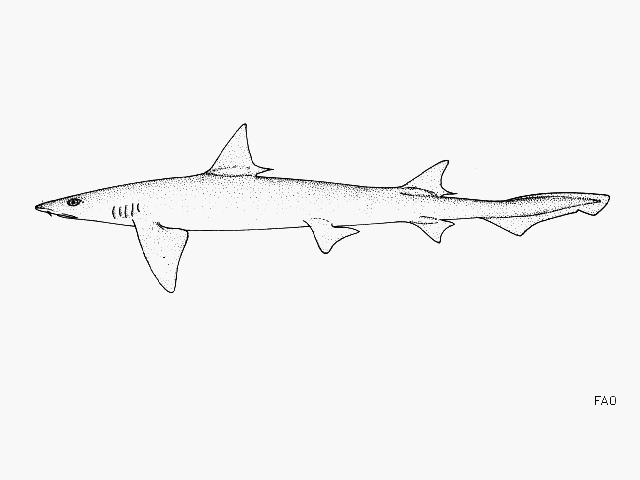
Barbeled Houndshark
Leptocharias smithii
The barbeled houndshark (Leptocharias smithii) is a species of ground shark and the only member of the family Leptochariidae. This demersal species is found in the coastal waters of the eastern Atlantic Ocean from Mauritania to Angola, at depths of 10–75 m (33–246 ft). It favors muddy habitats, particularly around river mouths. The barbeled houndshark is characterized by a very slender body, nasal barbels, long furrows at the corners of the mouth, and sexually dimorphic teeth. Its maximum known length is 82 cm (32 in).
Likely strong-swimming and opportunistic, the barbeled houndshark has been known to ingest bony fishes, invertebrates, fish eggs, and even inedible objects. It is viviparous with females bearing litters of 7 young; the developing embryos are sustained via a unique globular placental structure. The International Union for Conservation of Nature (IUCN) has assessed the barbeled houndshark as Vulnerable, as heavy fishing pressure occurs throughout its range and it is used for meat and leather.
From the article Barbeled houndshark on Wikipedia (CC BY-SA), quoted section by section
Description
The barbeled houndshark has an extremely slender body and horizontally oval eyes equipped with internal nictitating membranes. A pair of tiny spiracles is present behind the eyes. Each nostril is preceded by a slender barbel. The mouth is long and strongly arched, with very long furrows at the corners extending onto both jaws. It has 46–60 upper tooth rows and 43–54 lower tooth rows; each tooth is small, with a narrow central cusp and a pair of lateral cusplets. Unusually for a shark, dental sexual dimorphism occurs, with the front teeth in males being greatly enlarged. The two dorsal fins are small and about equal in size; the first is positioned between the pectoral and pelvic fins, and the second over the anal fin. The dorsal margin of the caudal fin is smooth and lacks a notch (precaudal pit) at its base; the lower caudal fin lobe is virtually absent. This shark is a plain light gray above and whitish below. Males and females grow up to 77 and 82 cm (30 and 32 in) long, respectively.
Range & habitat
The barbeled houndshark occurs along the western coast of Africa from Mauritania to northern Angola, though it may range as far north as the Mediterranean Sea. This species inhabits inshore waters 10–75 m (33–246 ft) deep, with temperatures of 20–27 °C (68–81 °F), salinities of 35–36 ppt, and dissolved oxygen levels of 3–4 ppm. It is typically found close to the bottom over mud, particularly around river mouths.
Wikipedia: “Distribution and habitat”
What it does
The barbeled houndshark seems to be an active swimmer, based on its strong musculature, long tail, short trunk, and small liver. It feeds on a wide variety of bottom- and shore-dwelling organisms. Crustaceans (including crabs, lobsters, and shrimp) are favored prey, while small bony fishes (including sardines, anchovies, snake eels, blennies, gobies, and flatfish), skate and flying fish eggs, octopus, and sponges are also eaten; miscellaneous objects such as feathers, vegetable scraps, and flowers have also been recovered from its stomach. Known parasites of this species include the copepods Eudactylina leptochariae and Thamnocephalus cerebrinoxius. The enlarged anterior teeth of male barbeled houndsharks may function in mating behaviors. This species is viviparous; once the embryos exhaust their supply of yolk, they are nourished through a placental connection formed from the depleted yolk sac. Unlike any other shark, the yolk-sac placenta is globular or spherical. Off Senegal, females bear litters of seven pups around October, after a gestation period of at least four months. The largest fetuses on record measured 20 cm (7.9 in) long, which is presumably close to the birth size. …
Wikipedia: “Biology and ecology”
Where it lives
Recorded sightings
—
geo-referenced records in GBIF, from museums, herbaria and field observers.
Drag the globe to turn it. Dots are where records exist, not a range map; darker means more records.
In the stacks
Searching the stacks…
Every page naming Leptocharias smithii in the Biodiversity Heritage Library →
This page is assembled live from iNaturalist, GBIF, Wikipedia, the Source Library and the Internet Archive. It is not yet part of the hand-edited codex. iNaturalist taxon 104311.