- Animals
- ›Chordates
- ›Vertebrates
- ›Ray-finned Fishes
- ›Carps, Characins, Catfishes and Allies
- ›Minnows, Suckers, Carps, and Loaches
- ›Carps and Minnows
- ›True Minnows
- ›Old World Minnows
- ›Leuciscus
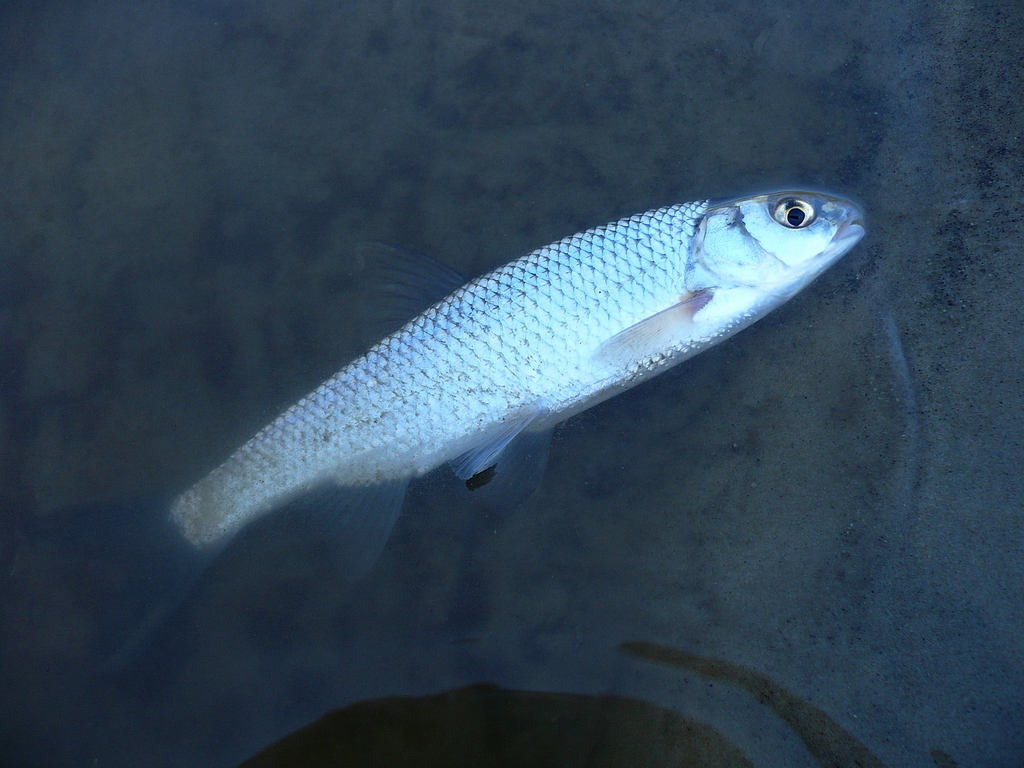
Common Dace
Leuciscus leuciscus
The common dace (Leuciscus leuciscus), the dace or the Eurasian dace, is a fresh- or brackish-water fish belonging to the family Cyprinidae. It is an inhabitant of the rivers and streams of Europe north of the Alps as well as in Northern Asia. It is abundant in much of its range, and has also spread to Ireland where it is used as a bait fish. It will grow to a maximum length of 40 cm (1 ft 4 in),...
From the article Common dace on Wikipedia (CC BY-SA), quoted section by section
Description
The common dace differs from other members in the genus Leuciscus found in Europe by its inferior mouth, slightly longer upper jaw which has the tip of the upper lip level with the centre line of the eye and the lack of an obvious snout. It has a yellowish iris and a body which is covered in large silvery scales, the lateral line having 49–52 scales. The anal fin has a concave margin and the caudal fin is forked. The dorsal fin has 2–3 spines and 7–9 soft rays while the anal fin has 3 spines and 8–9 soft rays. The maximum size attained is a total length of 30 centimetres (12 in).
Range & habitat
The common dace is native to Europe and northern Asia where it occurs in the basins of the North Sea, Baltic Sea, White Sea and Barents Sea. It also occurs in the basin of the Caspian Sea in the drainage systems of the Volga and Ural Rivers and in the Black Sea basin it is found in the Danube and the Dnieper. In France it occurs in the Seine River drainage and in the drainages of the Rhone and Arc which flow into the Mediterranean. In the Danube main river of Romania as well as in Scandinavia north of 69°N and most of central Finland this species has a localised distribution. The populations from Siberia and East Asia are normally assigned to Leuciscus baicalensis and Leuciscus dzungaricus. This species has been widely introduced in areas of Europe where it did not previously occur. For example, it has become established in Ireland since the early 1900s, having been taken there as a bait fish to catch larger fish such as pike. Following its introduction in Ireland, it has benefited from parasite release, meaning that with its introduction it has lost its normal set of parasites and might thus have a competitive advantage over native species.
Wikipedia: “Distribution”
Where it lives
Recorded sightings
—
geo-referenced records in GBIF, from museums, herbaria and field observers.
Drag the globe to turn it. Dots are where records exist, not a range map; darker means more records.
In the stacks
Searching the stacks…
Every page naming Leuciscus leuciscus in the Biodiversity Heritage Library →
This page is assembled live from iNaturalist, GBIF, Wikipedia, the Source Library and the Internet Archive. It is not yet part of the hand-edited codex. iNaturalist taxon 104526.