- Animals
- ›Chordates
- ›Vertebrates
- ›Ray-finned Fishes
- ›Spiny-rayed fishes
- ›Perches, Scorpionfishes, Sticklebacks, and Allies
- ›Scorpionfishes and Allies
- ›Typical Flatheads
- ›Leviprora
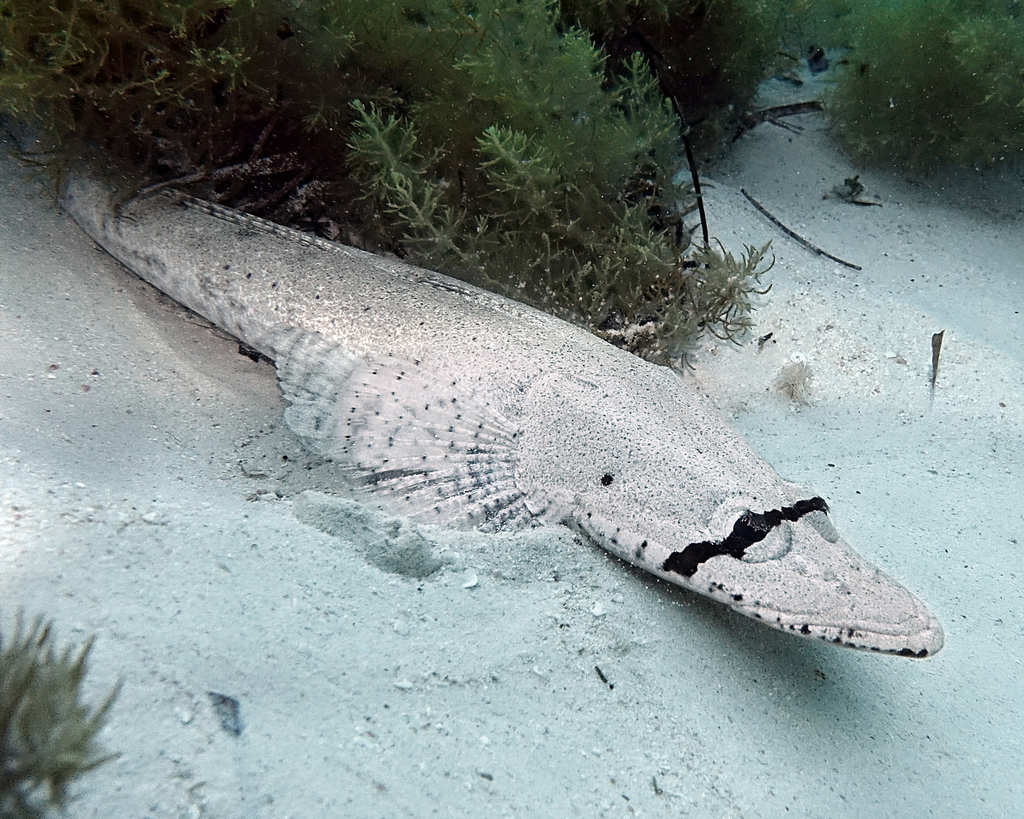
Longhead Flathead
Leviprora inops
The longhead flathead (Leviprora inops), also known as the crocodile flathead or weed flathead, is a species of marine ray-finned fish belonging to the family Platycephalidae, the flatheads. This species is endemic to reefs in the coastal waters of southern Australia.
From the article Longhead flathead on Wikipedia (CC BY-SA), quoted section by section
Description
The longhead flathead has an elongated, slightly flattened body with a very long head, the length of the head being two-fifths of its standard length. The head is highly flattened and comparatively smooth with very few low, bony ridges and large eyes which have a long, fringed lappet on the iris. The mouth is large with a wide band of small teeth on each of the jaws and two distinct patches of vomerine teeth. There are two very small spines on the angle of the preoperculum. The short based first dorsal fin contains 8 or 9 spines with the first spine being separate and very short. The second dorsal fin is long based and contains 12 soft rays. The anal fin is opposite the second dorsal fin and is similar in shape with between 11 and 13 soft rays. The maximum recorded length is 61 cm (24 in) ans maximum weight is no less than 2.5 kg (5.5 lb). The upper body is sandy to pinkish marked with irregularly shaped spots and blotches, paler on the lower body. The fins are marked with vague lines of dark and light spots and there is a diagonal brown band on the upper part of the first dorsal fin.
Range & habitat
The long head flathead is endemic to southwestern Australia where it occurs from Kangaroo Island and Gulf St Vincent in South Australia west to the Swan River in Western Australia. This species lives in shallow coastal waters, particularly on rocky reefs covered in dense vegetation while the juveniles are frequently observed buried in sand in seagrass beds. It is found at depths down to 20 m (66 ft).
Wikipedia: “Distribution and habitat”
Where it lives
Recorded sightings
—
geo-referenced records in GBIF, from museums, herbaria and field observers.
Drag the globe to turn it. Dots are where records exist, not a range map; darker means more records.
In the stacks
Searching the stacks…
Every page naming Leviprora inops in the Biodiversity Heritage Library →
This page is assembled live from iNaturalist, GBIF, Wikipedia, the Source Library and the Internet Archive. It is not yet part of the hand-edited codex. iNaturalist taxon 104557.