On eBird ↗
Brown Tanager
Live sightings near you, the range map, bar charts of when it is seen, and Macaulay Library photos and recordings.
Brown Tanager
Orchesticus abeillei
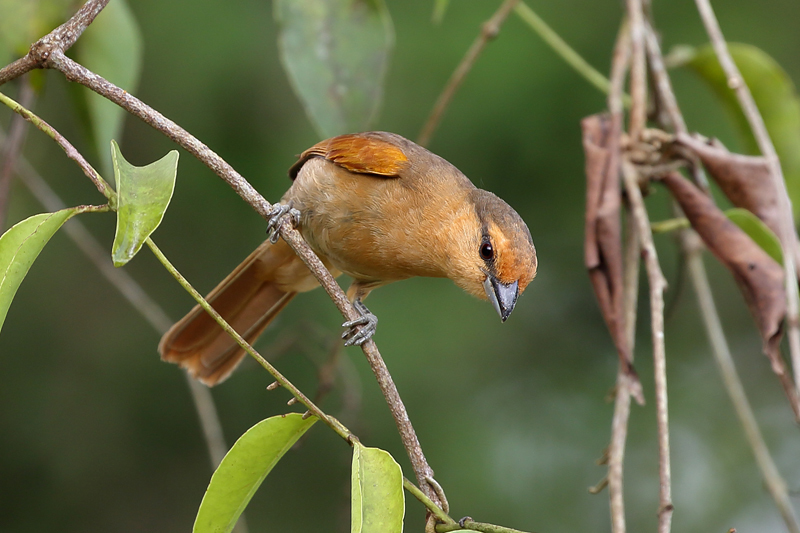
The brown tanager (Orchesticus abeillei) is a Near Threatened species of bird in th family Thraupidae, the tanagers and allies. It is endemic to Brazil.
From the article Brown tanager on Wikipedia (CC BY-SA), quoted section by section
Description
The brown tanager is 17 to 18 cm (6.7 to 7.1 in) long and weighs about 31.5 g (1.1 oz). The sexes have the same plumage. Adults have a thin blackish line from the lores through the eye to the nape on an otherwise cinnamon face. They have a brownish mid-crown and nape with a strong gray tinge. Their mantle, back and rump are medium brown. Their upperwing coverts are cinnamon-rufous and their primary coverts dusky with wide rufous edges. Their primaries and secondaries are dusky with cinnamon-rufous edges and their tertials mostly cinnamon rufous with dusky inner webs. Their tail is dusky with a strong rufous tinge. Their throat and underparts are cinnamon-buff and their underwing coverts orange-buff. They have a dark red iris, a thick blackish bill, and horn-colored legs and feet. Because the brown tanager strongly resembles the buff-fronted foliage-gleaner (Philydor rufum), with whom there is range overlap, some authors have suggested that it is an example of social mimicry.
Range & habitat
The brown tanager is found in southeastern Brazil from southern Bahia south to eastern Paraná and eastern Santa Catarina. It is a bird of the Atlantic Forest, where it primarily inhabits humid primary forest but also secondary forest, somewhat open woodlands, and parks and gardens with tall trees. In elevation it ranges between 750 and 1,500 m (2,500 and 4,900 ft).
Wikipedia: “Distribution and habitat”
What it does
The brown tanager feeds primarily on insects and apparently includes small amounts of fruit in its diet. It forages in pairs and small groups in the forest canopy. It picks and probes in live and dead foliage, mosses, and bromeliads and also takes some prey in mid-air with sallies from a perch. It often joins mixed-species feeding flocks.
Wikipedia: “Feeding”
Listen
Looking for field recordings…
Where it lives
Recorded sightings
—
geo-referenced records in GBIF, from museums, herbaria and field observers.
Drag the globe to turn it. Dots are where records exist, not a range map; darker means more records.
In the stacks
Searching the stacks…
Every page naming Orchesticus abeillei in the Biodiversity Heritage Library →
This page is assembled live from iNaturalist, GBIF, Wikipedia, the Source Library and the Internet Archive. It is not yet part of the hand-edited codex. iNaturalist taxon 10472.