- Animals
- ›Chordates
- ›Vertebrates
- ›Ray-finned Fishes
- ›Carps, Characins, Catfishes and Allies
- ›Minnows, Suckers, Carps, and Loaches
- ›Carps and Minnows
- ›True Minnows
- ›North American Minnows
- ›Luxilus
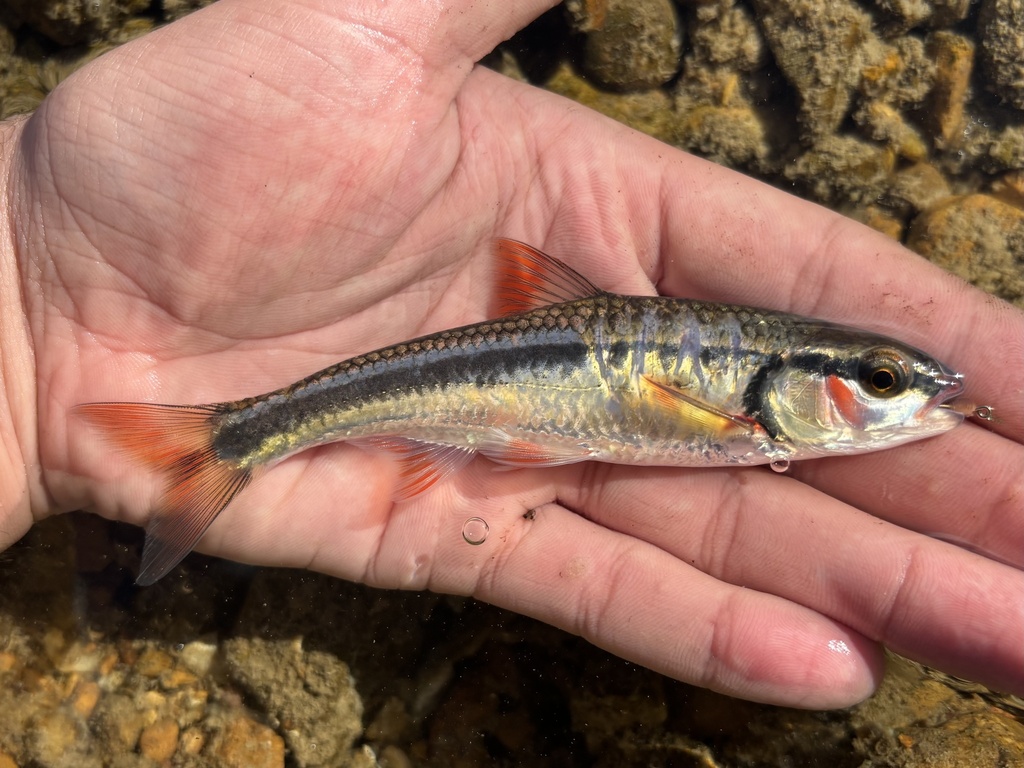
Bleeding Shiner
Luxilus zonatus
The bleeding shiner (Luxilus zonatus) is a species of freshwater ray-finned fish belonging to the family Leuciscidae, the shiners, daces and minnows. It occurs in tributaries of Ozark-draining tributaries of the Missouri, and Mississippi rivers in southern Missouri and northeastern Arkansas. Its preferred habitat is rocky and sandy pools and runs of headwaters, creeks and small rivers.
From the article Bleeding shiner on Wikipedia (CC BY-SA), quoted section by section
Description
The bleeding shiner has an olive brown back with a broad dark stripe along its midline. It has metallic sides and has two black stripes that are separated with a golden stripe. One of these black strips extends to the tip of the snout, while another less obvious black stripe parallels it. The gill opening has a crescent-bar shape and the fish has a silvery white underside. A key difference between this fish and similar minnows is the stripe on the side of the bleeding shiner abruptly narrows directly after the operculum, then widens again down the length of the body to the caudal fin. This fish holds many similarities with L. pilsbryi, but is distinguishable with a few characteristics. L. zonatus has 9 anal rays, 7 gill rakers, 38-43 lateral line scales, and 26 circumferential scales. The origin of the dorsal fin is closer to the tip of the snout than the base of the caudal. The bleeding shiner has a slightly compressed body with relatively large fins for its body size. Breeding males have bright red markings on their head, body, and fins, and the rest of their markings appear darker. The bleeding shiner has an average total length of about 4 in (10 cm) and has a maximum total length of 4.75 in (12.1 cm).
Range & habitat
The Bleeding Shiner is endemic to Missouri and Arkansas where it is restricted to the Ozark Plateau of Missouri and northeast Arkansas. Bleeding shiner inhabits Ozark-draining tributaries of the Missouri River and the St. Francis, Black, Little, and Meramec Rivers. Bleeding shiners inhabit temperate climate regions. Bleeding shiners prefer clear, gravel-bottomed streams and rivers. They have (very rarely) been found in streams with beds of mud, however. They are a demersal fish, they prefer to live close to the bed of the rivers and steams they inhabit. The young tend to inhabit waters that are quieter and flow more gently than the adult shiners.
Wikipedia: “Distribution and habitat”
What it does
The bleeding shiner feeds upon insects and small invertebrates that can be found upon the water's surface or that are being carried by the current. Bleeding shiners have terminal oblique mouths that allow for them to easily eat food from the surface of the water. It is thought that the bleeding shiner searches for food primarily by sight because of its large eyes.
Wikipedia: “Diet”
In human culture
Bleeding shiners rarely live through three summers. The lifespan of this fish is three years.
Wikipedia: “Life history”
Where it lives
Recorded sightings
—
geo-referenced records in GBIF, from museums, herbaria and field observers.
Drag the globe to turn it. Dots are where records exist, not a range map; darker means more records.
In the stacks
Searching the stacks…
Every page naming Luxilus zonatus in the Biodiversity Heritage Library →
This page is assembled live from iNaturalist, GBIF, Wikipedia, the Source Library and the Internet Archive. It is not yet part of the hand-edited codex. iNaturalist taxon 104870.