On eBird ↗
Black-and-white Tanager
Live sightings near you, the range map, bar charts of when it is seen, and Macaulay Library photos and recordings.
Black-and-white Tanager
Conothraupis speculigera
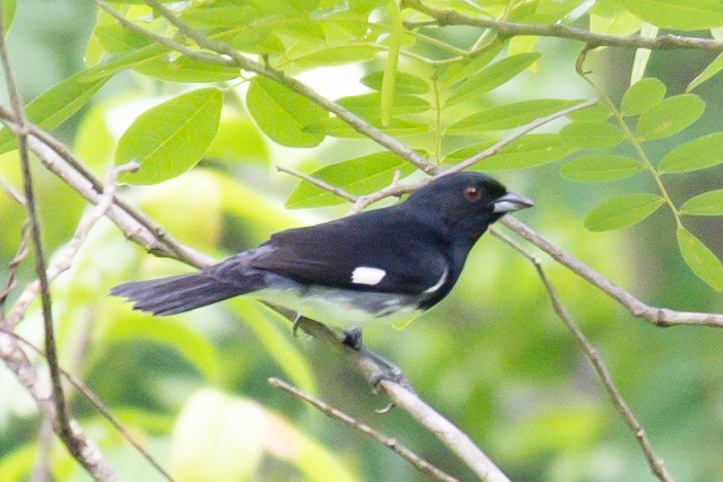
The black-and-white tanager (Conothraupis speculigera) is a tanager found in the Tumbes region of southwestern Ecuador and northwestern Peru; it migrates eastwards as far as Acre. The only other member of its genus is the recently rediscovered cone-billed tanager.
From the article Black-and-white tanager on Wikipedia (CC BY-SA), quoted section by section
Description
The black-and-white tanager is 16 to 16.5 cm (6.3 to 6.5 in) long and weighs 23 to 28 g (0.81 to 0.99 oz). The species is sexually dimorphic. Adult males have a black head, throat, neck, upper breast, and back. Their lower back, rump, uppertail coverts, and tail are gray. Their upperwing coverts and flight feathers are glossy black with white on the outer webs of the latter near their base. Their lower breast and belly are white, their sides and flanks gray, and their underwing coverts white. Adult females have an olive head with a faint broken eye-ring and olive upperparts. Their wings are mostly olive with blackish primary coverts. Their tail is dusky with olive feather edges. Their throat is white with an olive-yellow tinge, their upper breast white with a heavy olive wash and blurry olive streaks, and their lower breast and belly buff-white or white with a yellowish tinge. Both sexes have a red-brown iris, a thickish bluish gray bill with a black tip, and dark gray legs. Juveniles resemble adult females.
Range & habitat
The black-and-white tanager breeds from Loja Province in southwestern Ecuador south into northwestern Peru as far as La Libertad Department. There are also scattered records further north in Ecuador. In the non-breeding season it is found mostly the length of Amazonian Peru from near Ecuador south to Madre de Dios Department and slightly into far western Brazil's Acre state. There are also scattered records in Brazil almost to the Atlantic. The species has also appeared as a vagrant in Colombia and French Guiana and there is an unconfirmed record in Bolivia. The black-and-white tanager breeds in dry woodlands, forest, and scrublands; it apparently seeks areas of local rain. In Amazonia it inhabits the edges of forest along open areas and rivers and also secondary forest. In Ecuador it ranges in elevation mostly between 500 and 1,700 m (1,600 and 5,600 ft). It breeds in Peru up to 1,500 m (4,900 ft) but is found only below 700 m (2,300 ft) in Amazonia. In its small Brazilian range it occurs up to 1,400 m (4,600 ft).
Wikipedia: “Distribution and habitat”
What it does
The black-and-white tanager feeds mostly on insects and spiders and includes smaller amounts of seeds in its diet. It forages singly, in pairs, and in small groups that however occasionally reach more than 50 birds. It forages mostly in the upper parts of trees.
Wikipedia: “Feeding”
Listen
Looking for field recordings…
Where it lives
Recorded sightings
—
geo-referenced records in GBIF, from museums, herbaria and field observers.
Drag the globe to turn it. Dots are where records exist, not a range map; darker means more records.
In the stacks
Searching the stacks…
Every page naming Conothraupis speculigera in the Biodiversity Heritage Library →
This page is assembled live from iNaturalist, GBIF, Wikipedia, the Source Library and the Internet Archive. It is not yet part of the hand-edited codex. iNaturalist taxon 10495.