On eBird ↗
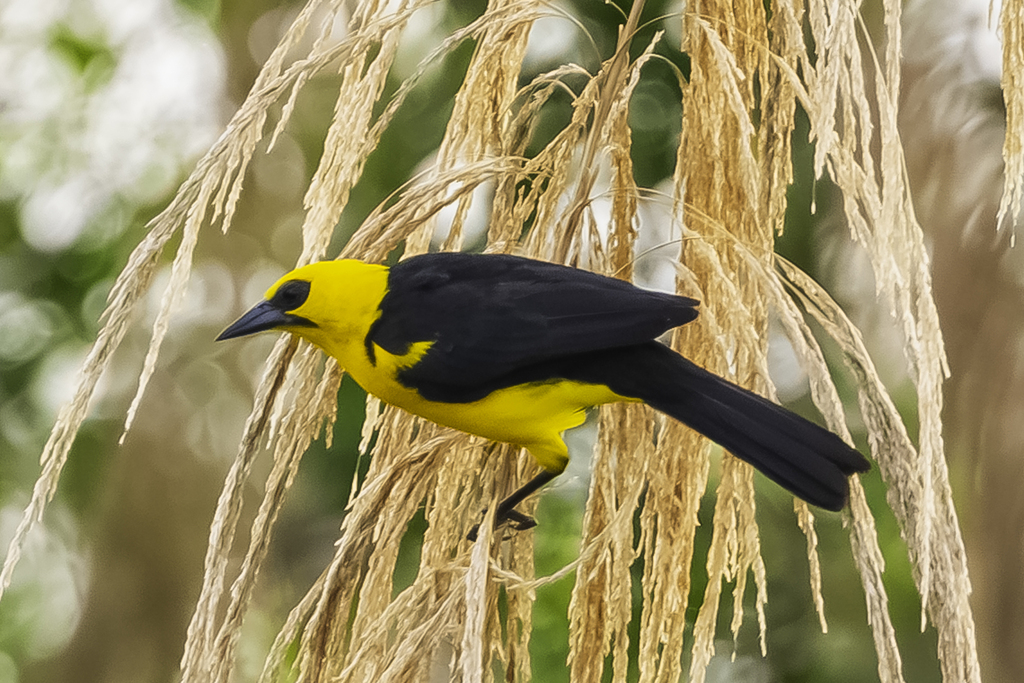
Oriole Blackbird
Live sightings near you, the range map, bar charts of when it is seen, and Macaulay Library photos and recordings.
Oriole Blackbird
Gymnomystax mexicanus
The oriole blackbird (Gymnomystax mexicanus) is a species of bird in the family Icteridae. Its genus, Gymnomystax, is monotypic. It is a medium-sized yellow and black bird found in Brazil, Colombia, Ecuador, French Guiana, Guyana, Peru, Suriname, and Venezuela, where its natural habitats are subtropical or tropical moist lowland forests, subtropical or tropical moist shrubland, subtropical or tropical seasonally wet or flooded lowland grassland, and swamps.
From the article Oriole blackbird on Wikipedia (CC BY-SA), quoted section by section
Description
The oriole blackbird grows to a length of nearly 30 cm (12 in). The sexes are similar in appearance. The head, neck, shoulders and underparts are bright yellow; the back, wings, rump and tail are black, apart from the lower wing-coverts showing a strip of yellow. The eye is brown and is surrounded by a black eye ring, and the large bill and feet are blackish. The voice consists of several loud, scratchy calls, uttered from elevated perches or emitted when on the wing. One is a screech that resembles the sound made by a rusty hinge.
Range & habitat
This icterid is found in the northern part of South America. Its range includes French Guiana, Guyana, Suriname, Venezuela, Colombia, Ecuador, Peru and northern Brazil. Its typical habitat is grassy areas with isolated trees near rivers, marshes, islands in rivers and gallery forest.
Wikipedia: “Distribution and habitat”
What it does
The oriole blackbird is usually seen in pairs or small groups but does not form mixed species flocks. It perches in prominent positions on small trees or on the top of bushes and forages mostly on the ground, especially in muddy areas near water. They feed on invertebrates such as earthworms, caterpillars and winged insects, as well as frogs and fruit, and sometimes tear open ripening maize cobs to feed on the seeds. Breeding takes place in May and June. The nest is a cup-shaped structure about 17 cm (7 in) in diameter, loosely woven out of dry grass and weed stems, and lined with rootlets. The eggs are pale blue with black, brown and lilac blotches and spots. The shiny cowbird, a brood parasite, sometimes lays its egg in an oriole blackbird's nest. The incubation period is about 18 days and the incubation is done solely by the female. Both parents join in feeding the chicks with small invertebrates and frogs which are not regurgitated but brought whole to the nest in the parent's beak.
Wikipedia: “Ecology”
Listen
Looking for field recordings…
Where it lives
Recorded sightings
—
geo-referenced records in GBIF, from museums, herbaria and field observers.
Drag the globe to turn it. Dots are where records exist, not a range map; darker means more records.
In the stacks
Searching the stacks…
Every page naming Gymnomystax mexicanus in the Biodiversity Heritage Library →
This page is assembled live from iNaturalist, GBIF, Wikipedia, the Source Library and the Internet Archive. It is not yet part of the hand-edited codex. iNaturalist taxon 10504.