- Animals
- ›Chordates
- ›Vertebrates
- ›Ray-finned Fishes
- ›Spiny-rayed fishes
- ›Freshwater Sunfishes, Grunters, and Allies
- ›Grunters, Stripeys, and Allies
- ›Halfmoons
- ›Medialuna
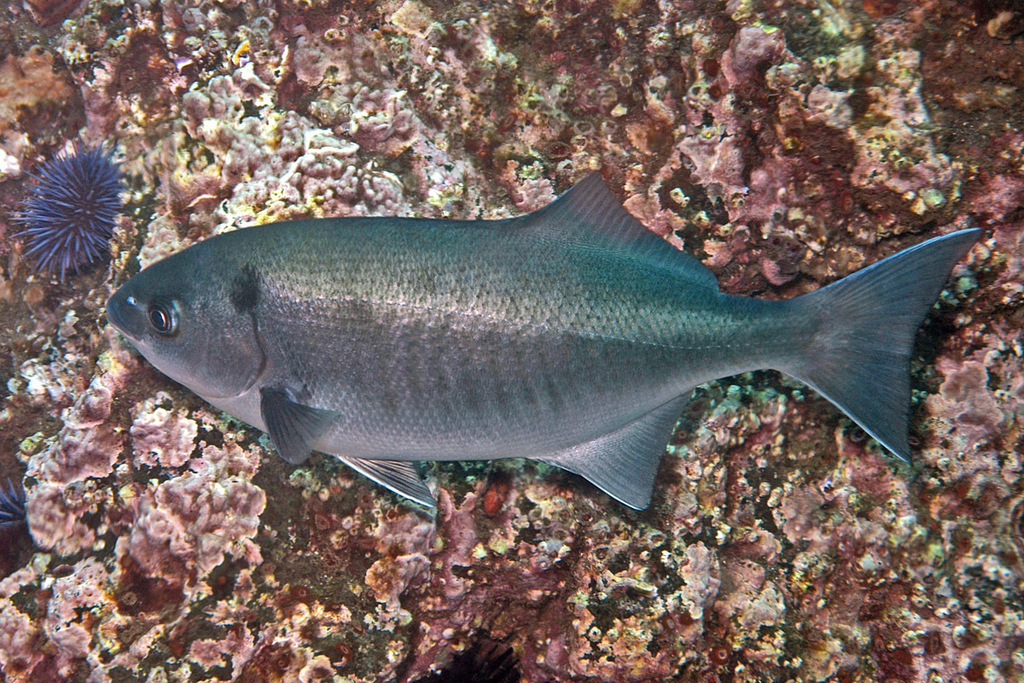
Halfmoon
Medialuna californiensis
The halfmoon, Medialuna californiensis, is a species of sea chub native to the Pacific coast of North America from Vancouver, British Columbia, to the Gulf of California. This species prefers rocky substrates or kelp forests, and can be found from the surface to a depth of 40 m (130 ft). It can reach a total length of 48 cm (19 in). This species is considered to be an excellent food fish.
From the article Halfmoon on Wikipedia (CC BY-SA), quoted section by section
Description
The halfmoon has an elongate, compressed, oval body with a small pointed head. It has a small, horizontal mouth in which the upper jaw is partially hidden by the orbital bone when the mouth has closed. Each jaw has a single row of pointed teeth. It has a continuous dorsal fin which has 9–11 spines in the anterior portion which fold down into a scaly furrow, the posterior portion has 22–27 soft rays and these are higher than the spines. The anal fin has 3 spines and 17–21 soft rays. The caudal fin is marginally concave. Most of the head and body is covered in small, thick and rough scales except foe the area forward of the eyes. The colour is dark bluish grey to grey dorsally, paler ventrally sometimes with faint, narrow, vertical bars along the flanks. It has a dark blotch on the upper corner of the gill cover. The margins of the dorsal, anal and caudal fins are dark and the outer edge of each lobe of the caudal fin is white. Juvenile fish are blue above and silvery below. The maximum recorded total length of the halfmoon is 48 centimetres (19 in). The shape of the caudal fin is said to resemble a crescent moon, leading to the common name.
Range & habitat
The Halfmoon is native to the eastern Pacific Ocean along the western coast of North America from Vancouver Island in the north to the Gulf of California, although it is rare north of Point Conception in California.
Wikipedia: “Distribution”
Where it lives
Recorded sightings
—
geo-referenced records in GBIF, from museums, herbaria and field observers.
Drag the globe to turn it. Dots are where records exist, not a range map; darker means more records.
In the stacks
Searching the stacks…
Every page naming Medialuna californiensis in the Biodiversity Heritage Library →
This page is assembled live from iNaturalist, GBIF, Wikipedia, the Source Library and the Internet Archive. It is not yet part of the hand-edited codex. iNaturalist taxon 105388.