On eBird ↗
White-winged Warbler
Live sightings near you, the range map, bar charts of when it is seen, and Macaulay Library photos and recordings.
White-winged Warbler
Xenoligea montana
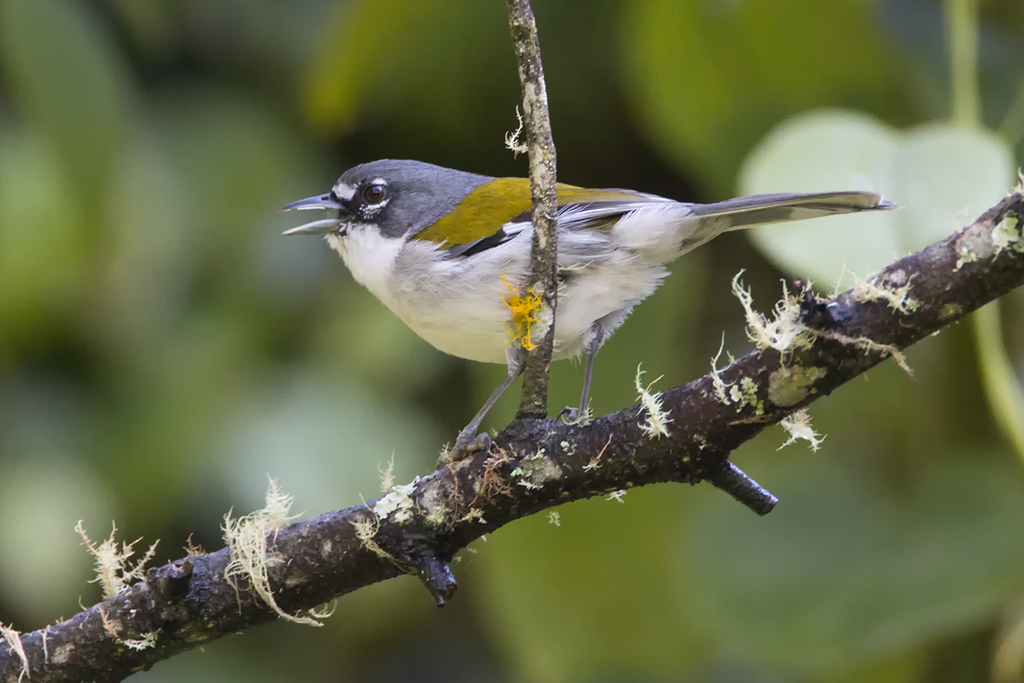
The white-winged warbler (Xenoligea montana), also called the white-winged ground-warbler or Hispaniolan highland-tanager, is a Vulnerable species of bird of the family Phaenicophilidae, the Hispaniolan tanagers. It is endemic to the island of Hispaniola which is shared by Haiti and the Dominican Republic.
From the article White-winged warbler on Wikipedia (CC BY-SA), quoted section by section
Description
The white-winged warbler is 13 to 14 cm (5.1 to 5.5 in) and weighs 12 to 13 g (0.42 to 0.46 oz). The sexes are alike and not particularly dimorphous. Adults have a gray head and neck, a white stripe from the beak to the eye above black lores, and white arcs above and below the eye. The back and rump is olive and the tail an almost-black dark gray with white spots on the tips of the outer feathers. The wings are also very dark gray with white on the primaries that shows as a white patch on the closed wing. The underparts are white-washed with gray on the breast and flanks. Juveniles are similar to adults, but with an overall brown cast to the adult colors.
Range & habitat
The white-winged warbler is limited to montane regions of the Dominican Republic and Haiti. In the former it is found in the Cordillera Central, Sierra de Bahoruco, and Sierra de Neiba. In Haiti it is found in the Massif de la Hotte on the western Tiburon Peninsula and possibly other parts of the peninsula closer to the Dominican Republic. The species inhabits several forest types that have in common a dense understory; they include mature humid broadleaf, pine-broadleaf, pine, and karst limestone forests, as well as secondary forest. In elevation it ranges between 875 and 2,000 m (2,900 and 6,600 ft), but is most numerous above 1,300 m (4,300 ft).
Wikipedia: “Distribution and habitat”
What it does
The white-winged warbler forages in vegetation at all levels of the forest. Its diet includes arthropods and seeds, especially those of Trema micrantha. It frequently forages in small groups and also joins mixed-species foraging flocks with other members of the family Phaenicophilidae and the Hispaniolan spindalis (Spindalis dominicensis).
Wikipedia: “Feeding”
Listen
Looking for field recordings…
Where it lives
Recorded sightings
—
geo-referenced records in GBIF, from museums, herbaria and field observers.
Drag the globe to turn it. Dots are where records exist, not a range map; darker means more records.
In the stacks
Searching the stacks…
Every page naming Xenoligea montana in the Biodiversity Heritage Library →
This page is assembled live from iNaturalist, GBIF, Wikipedia, the Source Library and the Internet Archive. It is not yet part of the hand-edited codex. iNaturalist taxon 10576.