On eBird ↗
Cabot's Tragopan
Live sightings near you, the range map, bar charts of when it is seen, and Macaulay Library photos and recordings.
Cabot's Tragopan
Tragopan caboti
Cabot's tragopan (Tragopan caboti) is a pheasant found in south-east China. The common and scientific names of this large bird both commemorate the ornithologist Samuel Cabot III. Other common names include the Chinese tragopan and the yellow-bellied tragopan. The population is divided into two subspecies, of which the dominant subspecies is found in the provinces of Fujian, Jiangxi, Zhejiang, and Guangdong, and T. c. guangxiensis is confined to northeastern Guangxi and southern Hunan. The IUCN has assessed it as being a "vulnerable species".
From the article Cabot's tragopan on Wikipedia (CC BY-SA), quoted section by section
Description
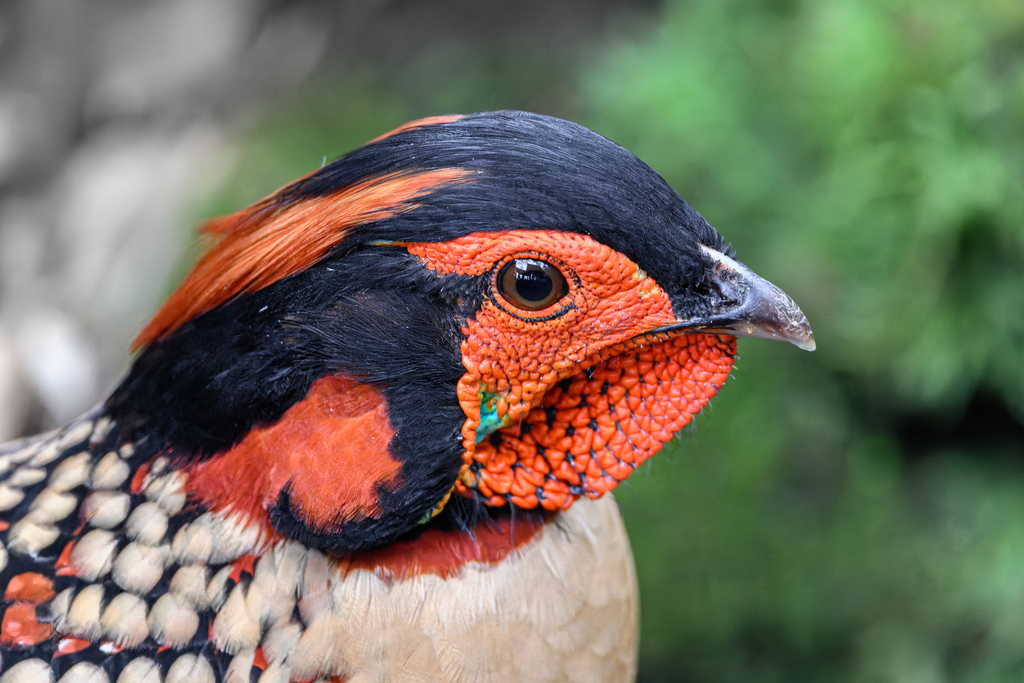
Cabot's tragopan is a plump ground-dwelling bird with relatively short legs. The male grows to a length of about 60 cm (24 in) and a weight of around 1.4 kg (3 lb) while the female is about 10 cm (4 in) shorter and weighs around 0.9 kg (2 lb). The head of the male is black with reddish-orange streaks on either side and on the neck and similar-coloured bare skin on the cheeks and around the eye. Below the beak dangle blue and orange decorative, inflatable wattles and there are a pair of fleshy blue "horns" over the eyes. The upper parts of the body are reddish-brown, with large buff markings and the underparts are straw-coloured. The female is altogether a less-colourful bird. The head and upper parts are reddish-brown spotted with black and marked with triangular-shaped white patches and the underparts are greyish-brown with white markings.
Range & habitat
Cabot's tragopan is endemic to mountain ranges in southeastern China where it is present in the provinces of Fujian, Guangdong, Guangxi, Hunan, Jiangxi and Zhejiang. Its typical habitat is subtropical evergreen forest and other forests with a mix of deciduous and coniferous trees. Its altitudinal range is 600 to 1,800 metres (2,000 to 5,900 ft) and it is also present above the treeline. Populations are fragmented as it has limited ability to disperse and seems not to move across gaps in forest cover of over 500 metres (1,600 ft).
Wikipedia: “Distribution and habitat”
What it does
Cabot's tragopan feeds mostly on the ground, foraging for roots, shoots, buds, flowers, fruits and seeds. A favourite food is the fruit and leaves of Daphniphyllum macropodum, a small tree which is also used for roosting at night. Small invertebrates are also sometimes eaten. Breeding takes place in the spring and Cabot's tragopan has an elaborate courtship ritual. The nest is usually built off the ground in a fork in a tree and is made of grasses, mosses, feathers and leaves, but sometimes an empty nest of another bird species is used. A clutch of two to six eggs is laid and incubation is performed solely by the female. The eggs hatch in about twenty eight days and the female broods the young for two or three days after that. They then all leave the nest together, the chicks being able to fly soon after they hatch, and remain together for the winter, possibly joining with another family in a small group.
Wikipedia: “Behaviour”
Listen
Looking for field recordings…
Where it lives
Recorded sightings
—
geo-referenced records in GBIF, from museums, herbaria and field observers.
Drag the globe to turn it. Dots are where records exist, not a range map; darker means more records.
In the stacks
Searching the stacks…
Every page naming Tragopan caboti in the Biodiversity Heritage Library →
This page is assembled live from iNaturalist, GBIF, Wikipedia, the Source Library and the Internet Archive. It is not yet part of the hand-edited codex. iNaturalist taxon 1059.