- Animals
- ›Chordates
- ›Vertebrates
- ›Cartilaginous Fishes
- ›Sharks and Rays
- ›Sharks
- ›Galean Sharks
- ›Mackerel Sharks
- ›Goblin Sharks
- ›Mitsukurina
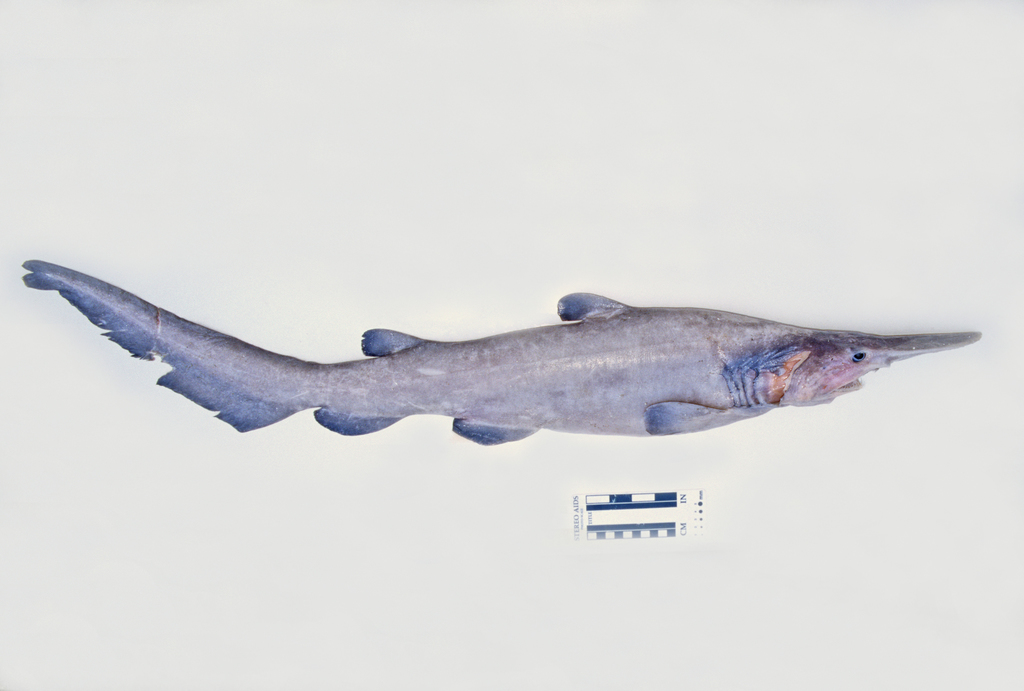
Goblin Shark
Mitsukurina owstoni
The goblin shark (Mitsukurina owstoni) is a rare species of deep-sea shark. Sometimes called a "living fossil", it is the only extant representative of the family Mitsukurinidae, a lineage some 125 million years old. This pink-skinned animal has a distinctive profile with an elongated, flat snout, and highly protrusible jaws containing prominent nail-like teeth. It typically reaches a length of 3 to 4 meters (10 to 13 feet) when fully grown, although it can grow significantly larger—such as one specimen captured in 2000, which was believed to measure around 6 meters (20 feet). Goblin sharks are benthopelagic creatures that inhabit upper continental slopes, submarine canyons, and seamounts throughout the world at depths greater than 100 m (330 ft), with adults found deeper than juveniles. Some researchers believed that these sharks could also dive to depths of up to 1,300 m (4,270 ft), for short periods; footage captured in 2024 suggests that their range could be deeper than previously thought, with a confirmed sighting of an adult swimming at 2,000 m (6,560 ft).
Various anatomical features of the goblin shark, such as its flabby body and small fins, suggest that it is sluggish in nature. This species hunts for teleosts, cephalopods, and crustaceans near the sea floor and in the middle of the water column. Its long snout is covered with ampullae of Lorenzini that sense minute electric fields produced by nearby prey, which it snatches by rapidly extending its jaws. Small numbers of goblin sharks are unintentionally caught by deepwater fisheries.
From the article Goblin shark on Wikipedia (CC BY-SA), quoted section by section
Description
The goblin shark has a distinctively long and flat snout, resembling a blade. The proportional length of the snout decreases with age. The eyes are small and lack protective nictitating membranes; behind the eyes are spiracles. The large mouth is parabolic in shape. The jaws are very protrusible and can be extended almost to the end of the snout, though normally held flush against the underside of the head. It has 35–53 upper and 31–62 lower tooth rows. The teeth in the main part of the jaws are long and narrow, particularly those near the symphysis (jaw midpoint), and are finely grooved lengthwise. The rear teeth near the corners of the jaw are small and have a flattened shape for crushing. Much individual variation of tooth length and width occurs, as for whether the teeth have a smaller cusplet on each side of the main cusp, and regarding the presence of toothless gaps at the symphysis or between the main and rear teeth. The five pairs of gill slits are short, with the gill filaments inside partly exposed; the fifth pair is above the origin of the pectoral fins. The body is fairly slender and flabby. The two dorsal fins are similar in size and shape – both being small and rounded. The pectoral fins are also rather small and rounded. …
Range & habitat
The goblin shark has been caught in all three major oceans, indicating a wide global distribution. In the Atlantic Ocean, it has been recorded from the northern Gulf of Mexico, Suriname, French Guiana, and southern Brazil in the west, and France, Portugal, Madeira, and Senegal in the east. It has also been collected from seamounts along the Mid-Atlantic Ridge. In the Indo-Pacific and Oceania, it has been found off of the coasts of South Africa, Mozambique, Japan, Taiwan, Australia and New Zealand. This species has been recorded from off East Cape to Kaikōura Canyon and from the Challenger Plateau near New Zealand. A single eastern Pacific specimen is known, collected off southern California. This species is most often found over the upper continental slope at depths of 270–960 m (890–3,150 ft). It has been caught as deep as 1,300 m (4,300 ft), a tooth has been found lodged in an undersea cable at a depth of 1,370 m (4,490 ft). It has been sighted as deep as 2,000 m (6,600 ft). Adults inhabit greater depths than juveniles. Immature goblin sharks frequent the submarine canyons off southern Japan at depths of 100–350 m (330–1,150 ft), with individuals occasionally wandering into inshore waters as shallow as 40 m (130 ft).
Wikipedia: “Distribution and habitat”
What it does
Although observations of living goblin sharks are scant, its anatomy suggests an inactive and sluggish lifestyle. Its skeleton is reduced and poorly calcified, the muscle blocks along its sides (myomeres) are weakly developed, and its fins are soft and small. Its long caudal fin, held at a low angle, is also typical of a slow-swimming shark. The long snout appears to have a sensory function, as it bears numerous ampullae of Lorenzini that detect weak electric fields produced by other animals. Due to the snout's softness, it is unlikely to be used for stirring up prey from the bottom as has been proposed. Vision seems to be less important than other senses, considering the relatively small optic tectum in the shark's brain. Yet unlike most deep-sea sharks, it can change the size of its pupils, thus probably does use sight in some situations. Goblin sharks may be the prey of blue sharks (Prionace glauca). Parasites documented from this species include the copepod Echthrogaleus mitsukurinae, and the tapeworms Litobothrium amsichensis and Marsupiobothrium gobelinus.
Feeding. The goblin shark feeds mainly on deep-sea teleost fishes such as rattails and dragonfishes. It also eats cephalopods and crustaceans, including decapods and isopods. Garbage has been recorded from the stomachs of some specimens. …
Wikipedia: “Biology and ecology”
Where it lives
Recorded sightings
—
geo-referenced records in GBIF, from museums, herbaria and field observers.
Drag the globe to turn it. Dots are where records exist, not a range map; darker means more records.
In the stacks
Searching the stacks…
Every page naming Mitsukurina owstoni in the Biodiversity Heritage Library →
This page is assembled live from iNaturalist, GBIF, Wikipedia, the Source Library and the Internet Archive. It is not yet part of the hand-edited codex. iNaturalist taxon 105913.