On eBird ↗
Swallow Tanager
Live sightings near you, the range map, bar charts of when it is seen, and Macaulay Library photos and recordings.
Swallow Tanager
Tersina viridis
The swallow tanager (Tersina viridis) is a species of Neotropic bird in the family Thraupidae, the tanagers and allies. It occurs regularly in Panama, on Trinidad, and in every mainland South American country except Chile and Uruguay. It has occurred as a vagrant in those two countries and on Tobago and Bonaire and there are unconfirmed reports from Curaçao.
From the article Swallow tanager on Wikipedia (CC BY-SA), quoted section by section
Description
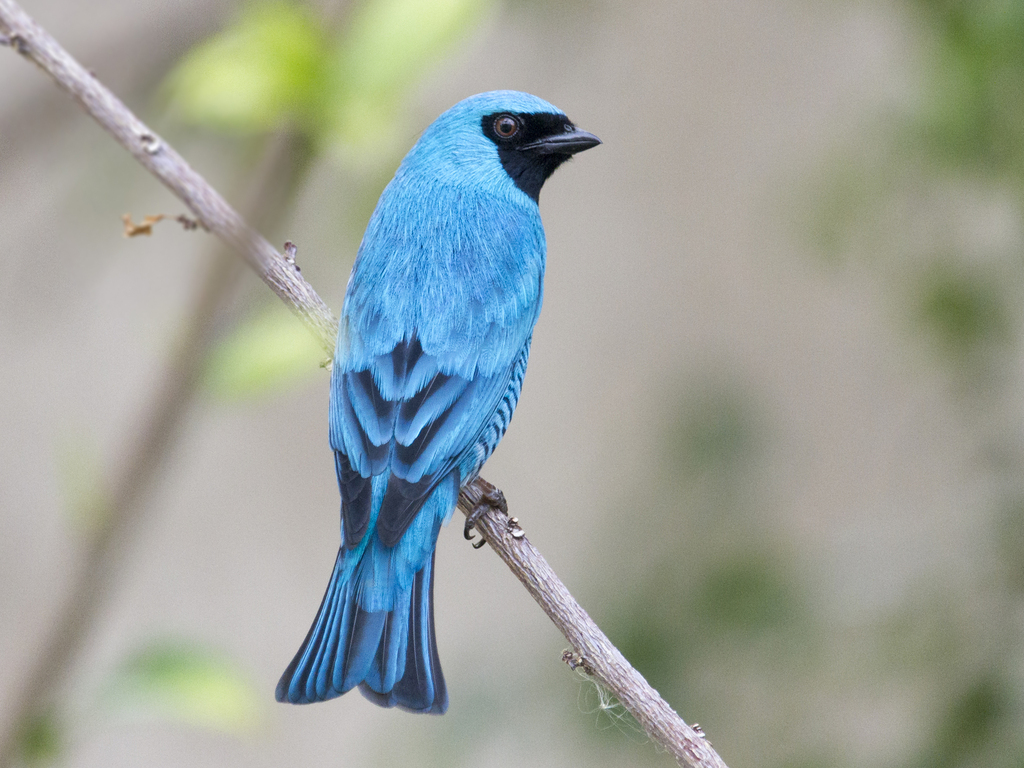
The swallow tanager is 14 to 15 centimetres (5.5 to 5.9 in) long and weighs 26 to 35 g (0.92 to 1.2 oz). It has a broad flat bill, a short tail, and short legs. The species is strongly sexually dimorphic. Adult males of the nominate subspecies T. v. viridis have a mostly bright turquoise-blue head with a triangular black "mask" from the base of the forehead to behind the eye and including the throat. Their upperparts are bright turquoise-blue. Their wings' primary coverts are black with thin turquoise-blue edges, their primaries are turquoise-blue with black tips, their secondaries all turquoise-blue, and their tertials black with turquoise edges. Their tail feathers are black with turquoise edges and grayish undersides. The center of their lower breast, their belly, and their undertail coverts are white. The rest of their underparts are turquoise-blue with coarse black barring on the flanks. Adult females are mostly bright grass-green. Their mask is dingy gray with dusky brown mottling. Their wing coverts are green and their flight feathers black with varying widths of green edging. The center of their lower breast, their belly, and their undertail coverts are pale yellow and their sides and flanks are darker yellow with coarse green barring. Subspecies T. v. occidentalis is smaller than the nominate but has essentially the same plumage. Males of T. v. …
Range & habitat
Subspecies T. v. occidentalis of the swallow tanager is the most northerly of the three and has the widest range. It is found in eastern Panama's Darién Province, in western, central, and most of southeastern Colombia, on both flanks of the Venezuelan Andes, in the Venezuelan Coastal Ranges, and across southern Venezuela and east through the Guianas, on Trinidad, in western Ecuador south to northern Loja Province, through eastern Ecuador and eastern Peru into northwestern and eastern Bolivia, and across much of western and northern Brazil. In contrast, subspecies T. v. grisescens is found only in the isolated Sierra Nevada de Santa Marta in northern Colombia. The nominate subspecies is found from Rio Grande do Norte in northeastern Brazil south near the coast and then from a line roughly from Bahia to southern Mato Grosso south to northern Rio Grande do Sul. Its range extends west into northeastern Bolivia, about half of Paraguay, and northeastern Argentina's Misiones Province. The species has also occurred as a vagrant in Chile and Uruguay, on Tobago, and on Bonaire. There are unconfirmed reports from Curaçao. The swallow tanager inhabits a variety of dry to humid landscapes, most of which are somewhat open. They include the edges of extensive forest, mature secondary woodlands, shade coffee plantations, and clearings and cleared areas with scattered trees. …
Wikipedia: “Distribution and habitat”
What it does
The swallow tanager feeds on fruits and arthropods, with relative numbers appearing to vary seasonally. The species is "notable gregarious" and forms small flocks during the breeding season and much larger ones outside it. However, it seldom joins mixed-species feeding flocks. Individuals and flocks often perch conspicuously in treetops. It plucks fruit while perched and with a brief hover after a sally. It takes many insects in mid-air, and often in a single flight takes more than one from a swarm of flying ants or termites.
Wikipedia: “Feeding”
Listen
Looking for field recordings…
Where it lives
Recorded sightings
—
geo-referenced records in GBIF, from museums, herbaria and field observers.
Drag the globe to turn it. Dots are where records exist, not a range map; darker means more records.
In the stacks
Searching the stacks…
Every page naming Tersina viridis in the Biodiversity Heritage Library →
This page is assembled live from iNaturalist, GBIF, Wikipedia, the Source Library and the Internet Archive. It is not yet part of the hand-edited codex. iNaturalist taxon 10607.