- Animals
- ›Chordates
- ›Vertebrates
- ›Ray-finned Fishes
- ›Carps, Characins, Catfishes and Allies
- ›Minnows, Suckers, Carps, and Loaches
- ›Suckers
- ›Suckers
- ›Typical Suckers
- ›Moxostoma
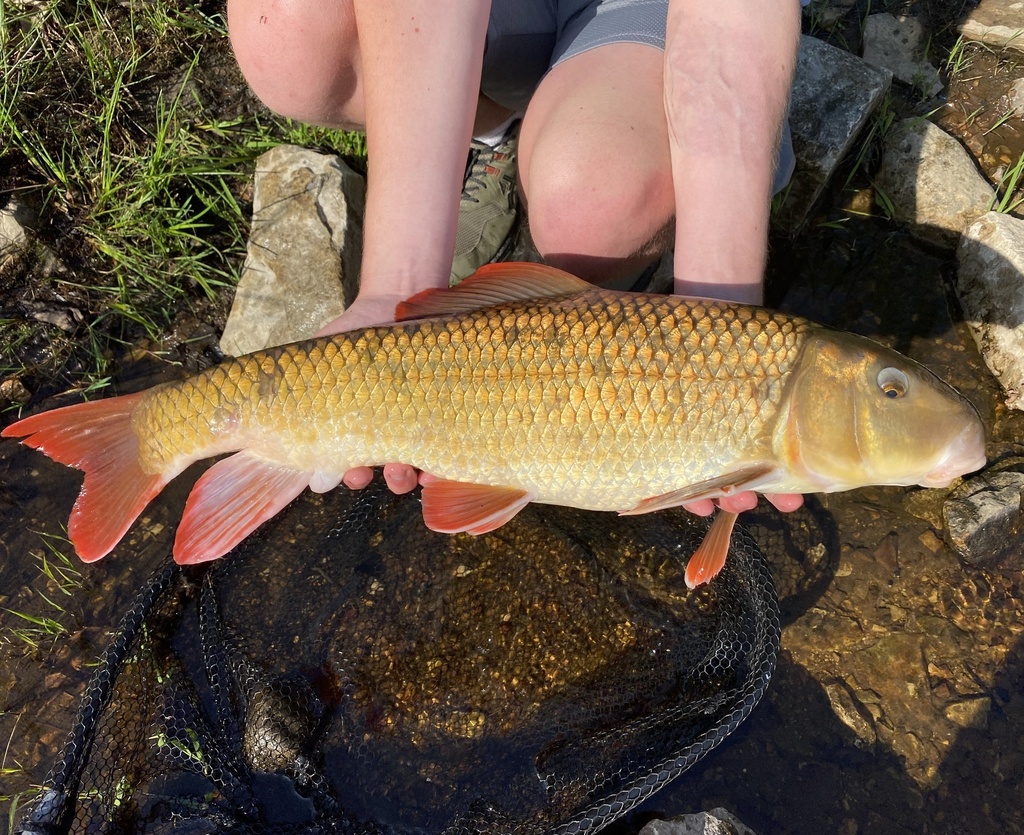
Greater Redhorse
Moxostoma valenciennesi
The greater redhorse (Moxostoma valenciennesi) is a species of freshwater fish found in northeastern North America. It is the largest member of the genus Moxostoma, with a maximum length of 80 cm (31.5 in). The greater redhorse is long lived with a maximum reported age of 27 years.
From the article Greater redhorse on Wikipedia (CC BY-SA), quoted section by section
Description
The greater redhorse is the largest fish in its genus, averaging around 46 cm (18 in) and 2 kg (4.4 lb), and reaching a maximum size of 80 cm (31 in) and 5.9 kg (13 lb). This species of fish has small eye sockets in contrast to their large rounded skull. On either side of the greater redhorse's body are reddish gold pectoral fins and pelvic fins. The posterior part of the dorsal fin varies from slightly concave at youth to slightly convex in adulthood. Their tail fins are only slightly notched, a trait that usually evolved in slow swimming bottom-feeders. The greater redhorse is most easily identified by its bright rusty red colored tail fin and the rows of black spots along its sides and back.
Range & habitat
The greater redhorse is endemic to states in the northcentral and northeastern United States as well as Ontario and Quebec in Canada. It is typically found in clear, relatively fast-moving rivers and in both shallow and deep waters in some lakes. They are unable to survive in even the slightest polluted waters. They, therefore have the ability to detect contaminated water sources.
Wikipedia: “Distribution and habitat”
What it does
A bottom-feeder's mouth opens in the inferior position of the ventral surface of the fish. It feeds on various bottom dwelling organisms including, microcrustaceans, aquatic and larval insects, detritus, snails, and algae.
Wikipedia: “Diet habits”
Where it lives
Recorded sightings
—
geo-referenced records in GBIF, from museums, herbaria and field observers.
Drag the globe to turn it. Dots are where records exist, not a range map; darker means more records.
In the stacks
Searching the stacks…
Every page naming Moxostoma valenciennesi in the Biodiversity Heritage Library →
This page is assembled live from iNaturalist, GBIF, Wikipedia, the Source Library and the Internet Archive. It is not yet part of the hand-edited codex. iNaturalist taxon 106221.