- Animals
- ›Chordates
- ›Vertebrates
- ›Ray-finned Fishes
- ›Spiny-rayed fishes
- ›Mullets and Glassfishes
- ›Mullets
- ›Mugil
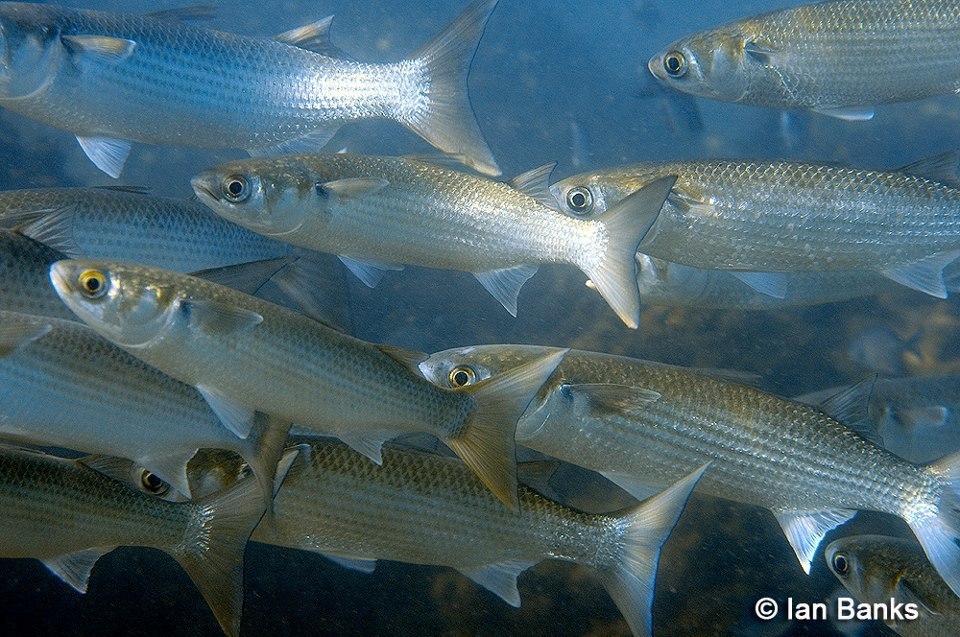
Sea Mullet
Mugil cephalus
The striped mullet (Mugil cephalus) is an important food fish species in the mullet family Mugilidae. It is found in coastal temperate, subtropical, and tropical waters worldwide. Its length is typically 30 to 75 centimetres (12 to 30 in). It is known with numerous English names, including the flathead mullet, flathead grey mullet, striped mullet, black mullet, bully mullet, common mullet, grey mullet, sea mullet, and mullet.
The striped mullet is a mainly diurnal coastal species that often enters estuaries and rivers. It usually schools over sand or mud bottoms, feeding on zooplankton, dead plant matter, microalgae, and detritus. The adult fish normally feed on algae in fresh water. The species is euryhaline, meaning they can acclimate to different levels of salinity.
From the article Flathead grey mullet on Wikipedia (CC BY-SA), quoted section by section
Description
The back of the fish is olive-green; the sides are silvery and shade to white towards the belly. The fish may have six or seven distinctive, lateral, horizontal stripes. Lips are thin. The mullet has no lateral line. A common length is about 50 cm (20 in) and its maximum length is 100 cm (39 in). It can reach a maximum weight of 8 kg (18 lb).
Range & habitat
The striped mullet is cosmopolitan in coastal waters of the tropical, subtropical, and temperate zones of all seas, as far north as the Bay of Biscay and Nova Scotia in the Atlantic Ocean. It occupies fresh, brackish and marine habitats in depths ranging from 0–120 metres (0–394 ft) and with temperatures between 8 and 24 °C (46 and 75 °F). In Australia, this fish is widespread, from Far North Queensland, around southern Australia to the Kimberley region of Western Australia. It also occurs in the Bass Strait area of Tasmania. It lives in tropical and temperate, coastal marine and estuarine waters, but are also often found in the lower reaches of rivers. It is able to live in a wide range of salinity, so may also be found in lagoons, lakes, and far into estuaries, but migrate back to the sea to spawn. In fresh waters of the western United States, striped mullets historically ranged far up the Colorado River to the vicinity of Blythe and up the Gila River to perhaps Tacna. Because of the dams and restricted flows to the Gulf of California, their range in Arizona is restricted to the Colorado River below Laguna Dam and the lower end of the Gila River when water is present. …
Wikipedia: “Distribution”
At the table
The roe of this mullet is salted, dried, and compressed to make a specialty food across the world, such as Greek avgotaraho, Taiwanese wuyutsu, Korean eoran, Japanese karasumi, Italian bottarga, French poutargue, Turkish haviar, and Egyptian batarekh. In Egypt, the fish itself is salted, dried, and pickled to make fesikh. On the coast of Northwest Florida and Alabama, this mullet, called the striped or black mullet, is often a specialty of seafood restaurants. Fried mullet is most popular, but smoked, baked, and canned mullet are also eaten. Local fishermen usually catch mullet in a castnet, though most use a land-based seine net. Mullet is a delicacy in this area and is most often consumed in the home. Mullets are usually filleted, and the remaining frames used for fish stock in chowders and stews. The mullet most commonly consumed in Florida, though, is the white mullet (Mugil curema), because its preference for cleaner water gives it a cleaner and less muddy taste.
Wikipedia: “Cuisine”
In human culture
The generic name Mugil is from Latin: mūgil: "mullet". The specific name cephalus is from Ancient Greek: κέφαλος képhalos: "mullet". Thus, the binomial term Mugil cephalus literally means "Mullet mullet".
Wikipedia: “Etymology”
Where it lives
Recorded sightings
—
geo-referenced records in GBIF, from museums, herbaria and field observers.
Drag the globe to turn it. Dots are where records exist, not a range map; darker means more records.
In the stacks
Searching the stacks…
Every page naming Mugil cephalus in the Biodiversity Heritage Library →
This page is assembled live from iNaturalist, GBIF, Wikipedia, the Source Library and the Internet Archive. It is not yet part of the hand-edited codex. iNaturalist taxon 106222.