- Animals
- ›Chordates
- ›Vertebrates
- ›Cartilaginous Fishes
- ›Sharks and Rays
- ›Sharks
- ›Galean Sharks
- ›Ground Sharks
- ›Houndsharks
- ›Triakine Houndsharks
- ›Mustelus
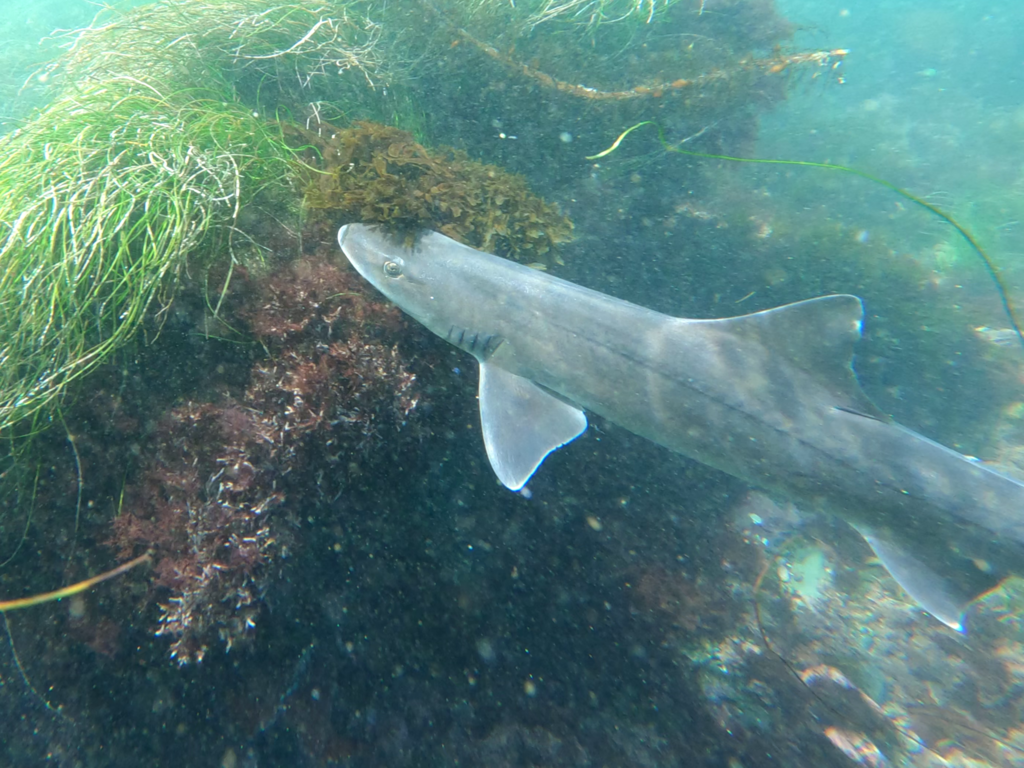
Gray Smooth-hound
Mustelus californicus
The gray smooth-hound (also spelled as smoothhound) (Mustelus californicus) is a houndshark of the family Triakidae. It is spotless and smooth with a narrow head and long blunted snout. This shark is found on continental shelves of the subtropical eastern Pacific. Its range extends from northern California to the Gulf of California (between latitudes 40° N and 23° N), usually residing in waters less than 80 meters (262 ft 6 in) deep. Adults are between 0.5 and 1.6 meters (1 ft 8 in to 5 ft 3 in) long. Furthermore, this shark is viviparous with an egg yolk placenta. Reproduction occurs annually and inland estuaries are common nursery grounds. Although there is little data on the shark's population trends and catch quantities, the gray smooth-hound is not considered as vulnerable to overfishing. Additionally, there have been three reported sightings of albinism in this species, which is rare for elasmobranchs (rays and sharks).
From the article Gray smooth-hound on Wikipedia (CC BY-SA), quoted section by section
Description
The gray smooth-hound is a medium-sized spotless shark with a short narrow head. It is morphologically similar to others of its genus with its slender body, long blunt snout, conspicuous sub-ocular ridges, and dorsolateral eyes. The gray smooth-hound is brown to dark-gray dorsally and white ventrally. The ventral caudal lobe (lower part of tail) is poorly developed and the second dorsal fin is relatively small. The gray smooth-hound can be distinguished by the snout shape and placement of the dorsal fin. It is often confused with the brown smooth-hound (Mustelus henlei), though there are several characteristics that differ between these two species. In the gray smooth-hound, the midpoint of the dorsal fin is closer to the start of the pelvic fin than it is to the end of the pectoral fin (see image below). In the brown smooth-hound, the midpoint of the dorsal fin is equidistant from the pelvic and pectoral fins. Additionally, the tooth shape of these two species differs slightly: gray smooth-hounds have smooth teeth that are blunt and not cusped whereas a basal cup can be seen on the sides of the middle upper teeth in the brown smooth-hound. The sides of the mandible are concaved in the gray smooth-hound but are slightly convex in brown smooth-hounds. …
Range & habitat
The gray smooth-hound can be found in warm waters along the coast of California and Baja California, ranging from Cape Mendocino, California to Mazatlán, Mexico. In the warm waters of Mexico and Southern California, these sharks do not migrate. However, in colder northern waters, sharks will migrate to central-northern California in the summer and then return to more southern regions during the rest of the year. These sharks are bottom-dwellers, living on continental shelves as well as shallow muddy estuaries and bays along the coast and into the Gulf of California. In California, this shark is usually found in shallow waters that are less than 12 meters (39 ft 4 in) deep, but it has been found to a maximum depth of 67 meters (219 ft 10 in). In the Gulf of California, the majority of gray smooth-hounds are found less than 80 meters (262 ft 6 in) deep but have been found up to 265 meters (869 ft 5 in) below the sea surface. Important nursery grounds for the gray smooth-hound include the Biosphere Reserve of the upper Gulf of California, the Colorado Delta, Elkhorn Slough, and Full Tidal Basin in Bolsa Chica have also been identified as nursery grounds. In the Full Tidal Basin (after restoration efforts), gray smooth-hounds have become seasonally abundant in the summer, where the population is mostly made up of juveniles. …
Wikipedia: “Distribution and habitat”
What it does
The gray smooth-hound is a benthic coastal predator and mostly feeds on crustaceans. Specifically, they are known to feed on crabs (Cancrids and Grapsids), shrimps, scallops, ghost shrimp (Callianassa spp.). The red rock crab (Cancer productus) and pacific rock crab (Cancer antennarius) account for most of the adult diet. Gray smooth-hounds smaller than 100 cm (39.3 in) mostly feed on the yellow shore crab (Hemigrapsus oregonensis). The yellow shore crab, along with the slender crab (Cancer gracilis), have been found to be more than 69% of the total food volume for these smaller sharks. Adults will also incorporate fish into their diet such as herring (specifically Clupea harengus pallasi) and toadfish (Porichthys notatus). Though rare, innkeeper worms (Urechis caupo) have been found in gray smooth-hound stomachs.
Wikipedia: “Feeding”
Where it lives
Recorded sightings
—
geo-referenced records in GBIF, from museums, herbaria and field observers.
Drag the globe to turn it. Dots are where records exist, not a range map; darker means more records.
In the stacks
Searching the stacks…
Every page naming Mustelus californicus in the Biodiversity Heritage Library →
This page is assembled live from iNaturalist, GBIF, Wikipedia, the Source Library and the Internet Archive. It is not yet part of the hand-edited codex. iNaturalist taxon 106254.