- Animals
- ›Chordates
- ›Vertebrates
- ›Cartilaginous Fishes
- ›Sharks and Rays
- ›Sharks
- ›Galean Sharks
- ›Ground Sharks
- ›Houndsharks
- ›Triakine Houndsharks
- ›Mustelus
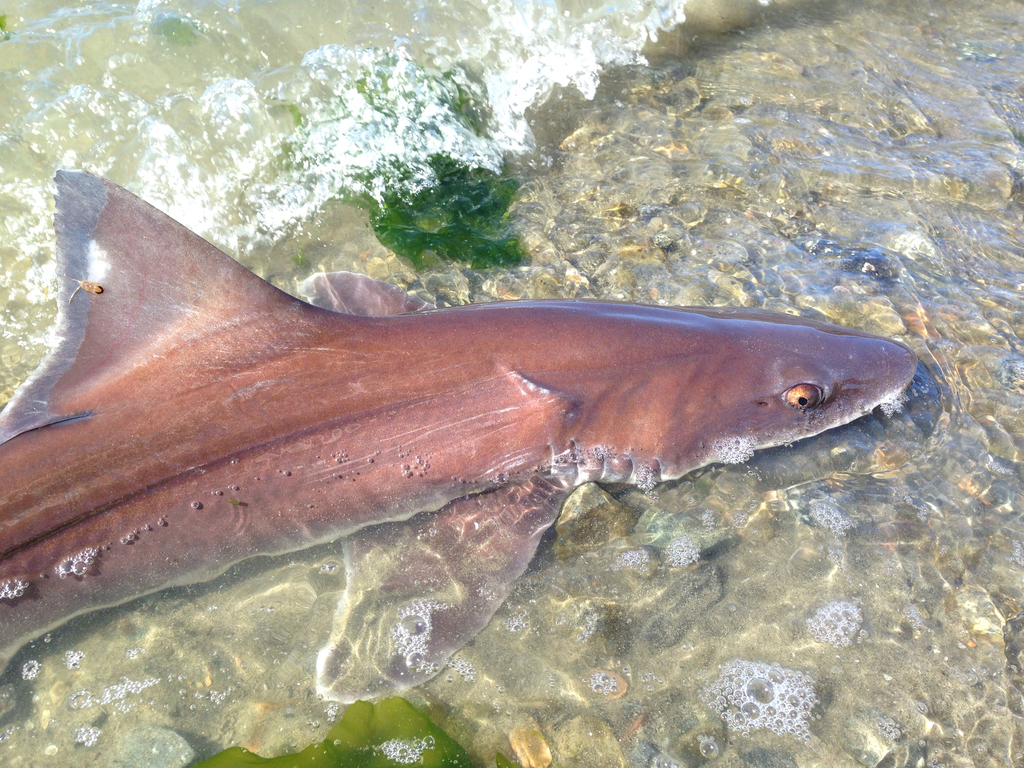
Brown Smooth-hound
Mustelus henlei
The brown smooth-hound (Mustelus henlei) is a houndshark of the family Triakidae. The reproduction of this shark is viviparous. The brown smooth-hound reaches a maximum reported size of 95.0 cm and a minimum of 27.6cm amongst males while females can range from 25.7 cm to 100 cm although males reach their asymptotic length sooner than females. The average size of this species is between 50 and 70 cm and is between 19 and 21 cm at birth. Females at maternity are around 67.6 cm long whereas the average length at maturity is 63.6 cm for males and 65.6 cm for females. This species is a ground shark and has a heterocercal caudal fin bearing an elongate upper lobe, triangular and broad dorsal fins, broad pectoral fins, an inferior mouth, and large eyes, and displays a reddish or bronze coloration from above and a silverish coloration on the underside. The shark is additionally slender, long-snouted, and sharp-toothed. The teeth of the brown smooth-hound often bear a narrow primary cusp and one or two accessory cusplets.
From the article Brown smooth-hound on Wikipedia (CC BY-SA), quoted section by section
Range & habitat
It is found on the continental shelves of the subtropical eastern Pacific, from northern California to the Gulf of California, as well as Ecuador and Peru between latitudes 43° N and 18° S, from the surface to depths of 266 meters and is considered to be endemic to the nearshore shark assemblage in the northeastern Pacific. The shark is generally found in enclosed, shallow, and muddy bays and has the largest distribution in its genus in the eastern Pacific. Although the species is epibenthic, some individuals often foray into the pelagic zone when hunting for prey. The species also engages in seasonal migrations into deeper, coastal waters and although it spends most of its time in the bays, it departs during wintertime as waters cool, migrating out of estuarine waters between November and April specifically and returning in around May. The shark travels an average of 15.3 km per day as part of these migrations and has the ability to cover long distances through continuous swimming. Gene flow and population connectivity investigations have revealed that there are three primary populations of the species, two of which, the Northern Californian population and the Costa Rican population, have genetically diverged greatly from the third, the population at Central-Southern California and Mexico. …
Wikipedia: “Distribution”
Where it lives
Recorded sightings
—
geo-referenced records in GBIF, from museums, herbaria and field observers.
Drag the globe to turn it. Dots are where records exist, not a range map; darker means more records.
In the stacks
Searching the stacks…
Every page naming Mustelus henlei in the Biodiversity Heritage Library →
This page is assembled live from iNaturalist, GBIF, Wikipedia, the Source Library and the Internet Archive. It is not yet part of the hand-edited codex. iNaturalist taxon 106258.