- Animals
- ›Chordates
- ›Vertebrates
- ›Cartilaginous Fishes
- ›Sharks and Rays
- ›Rays
- ›Stingrays
- ›Eagle Rays
- ›Myliobatis
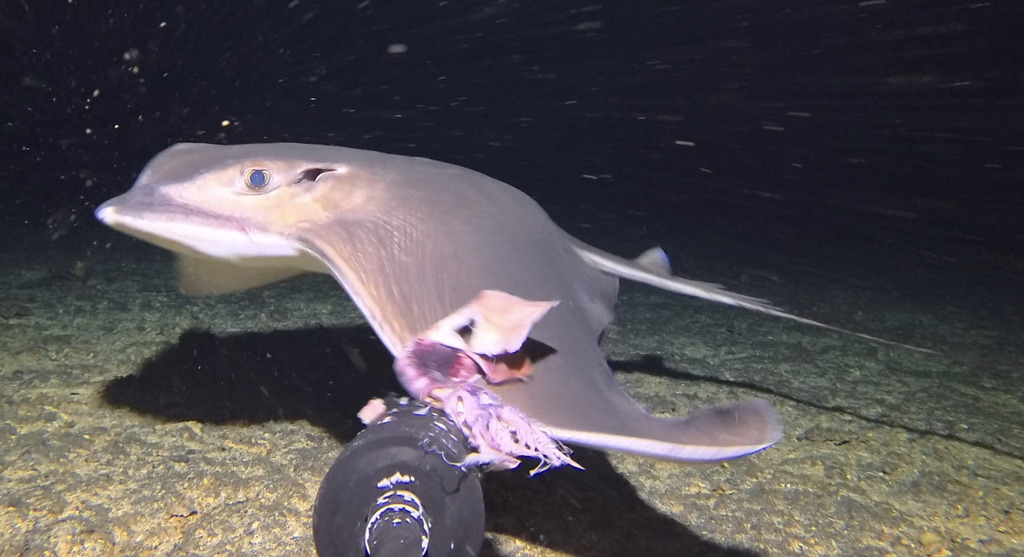
Purple Eagle Ray
Myliobatis hamlyni
The purple eagle ray (Myliobatis hamlyni) is a species of fish in the family Myliobatidae. It was formerly considered endemic to Australia but is now known to be more widespread. Its natural habitat is the open seas where it has a patchy distribution, and the International Union for Conservation of Nature has assessed its conservation status as being "near-threatened".
From the article Purple eagle ray on Wikipedia (CC BY-SA), quoted section by section
Description
The purple eagle ray is a medium-sized species. The disc is diamond-shaped and the pectoral fins are very large and wing-like, the front edge being straight or slightly convex. The slender, whip-like tail has one or two long stinging spines at its base and has a distinctive fold on its ventral surface. There are seven rows of teeth in each jaw, the central one being the largest. An averaged sized adult has a disc-width of 540 mm (21 in), a length of 200 mm (8 in) and a tail of 250 mm (10 in). The largest males in Indonesia had a disc width of 800 mm (31 in), while the females a disc width of 1,140 mm (45 in). The dorsal surface is a uniform purplish-brown or greenish-brown without dark spotting, and the ventral surface is whitish.
Range & habitat
This fish occurs in the tropical and subtropical west Pacific Ocean; its exact range is unclear but includes Australia, Indonesia, the Philippines, Taiwan and Okinawa (Japan). It is a deep-water species with a patchy distribution and is rarely brought to the surface with fishing gear. Its habitat is the open sea, mostly the outer continental shelf and the upper part of the continental slope at depths of between 117 and 330 m (400 and 1,100 ft).
Wikipedia: “Distribution and habitat”
Where it lives
Recorded sightings
—
geo-referenced records in GBIF, from museums, herbaria and field observers.
Drag the globe to turn it. Dots are where records exist, not a range map; darker means more records.
In the stacks
Searching the stacks…
Every page naming Myliobatis hamlyni in the Biodiversity Heritage Library →
This page is assembled live from iNaturalist, GBIF, Wikipedia, the Source Library and the Internet Archive. It is not yet part of the hand-edited codex. iNaturalist taxon 106324.