On eBird ↗
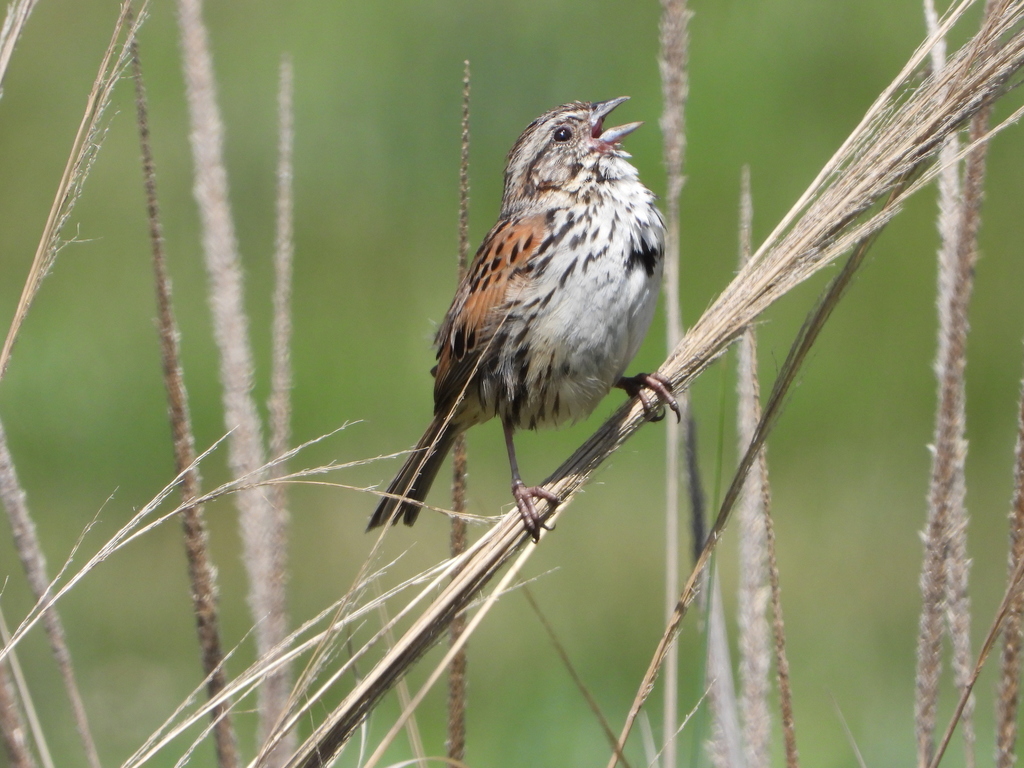
Sierra Madre Sparrow
Live sightings near you, the range map, bar charts of when it is seen, and Macaulay Library photos and recordings.
Sierra Madre Sparrow
Xenospiza baileyi
The Sierra Madre sparrow (Xenospiza baileyi), also known as Bailey's sparrow, is an endangered, range-restricted, enigmatic American sparrow. It is endemic to Mexico and is threatened with extinction through habitat loss.
From the article Sierra Madre sparrow on Wikipedia (CC BY-SA), quoted section by section
Range & habitat
The species is endemic to some mountain ranges in and near the Sierra Madre Occidental, Mexico. It is restricted to bunchgrass and marshland habitat (zacatonal) in volcanic mountain ranges, at elevations of 2,300–3,050 metres (7,550–10,010 ft); the lower part of the range is occupied by the northern, and the higher part by the southern population. Habitat information for the northern population is scant, with pine, oak, and Arbutus (probably Arizona Madrone, A. arizonica) trees being mentioned. Better details are available for the more extensively studied southern population. The dominant bunchgrass species are Festuca amplissima, Peruvian feather grass (Stipa ichu), a muhly grass (Muhlenbergia affinis), and Muhlenbergia macroura. Small woods of Montezuma Pine (Pinus montezumae) and (probably) Lumholtz' Pine (P. lumholtzii) occur on elevated terrain.
Wikipedia: “Distribution and habitat”
In human culture
The genus name Xenospiza is from the Ancient Greek xénos (ξένος), "a stranger", and spíza (σπίζα), "finch". The species name baileyi is a dedication to Alfred M. Bailey, who collected the 1931 specimen for Outram Bangs.
Wikipedia: “Etymology”
Listen
Looking for field recordings…
Where it lives
Recorded sightings
—
geo-referenced records in GBIF, from museums, herbaria and field observers.
Drag the globe to turn it. Dots are where records exist, not a range map; darker means more records.
In the stacks
Searching the stacks…
Every page naming Xenospiza baileyi in the Biodiversity Heritage Library →
This page is assembled live from iNaturalist, GBIF, Wikipedia, the Source Library and the Internet Archive. It is not yet part of the hand-edited codex. iNaturalist taxon 10643.