On eBird ↗
Zapata Sparrow
Live sightings near you, the range map, bar charts of when it is seen, and Macaulay Library photos and recordings.
Zapata Sparrow
Torreornis inexpectata
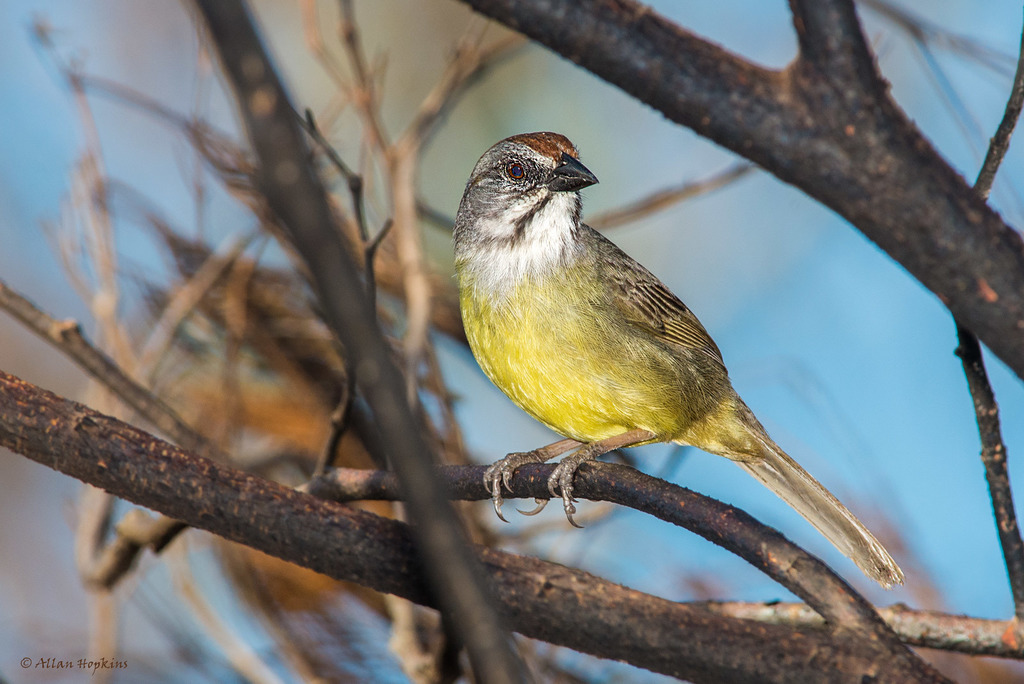
The Zapata sparrow (Torreornis inexpectata) is a medium-sized grey and yellow bird that lives in the grasslands of the Zapata Swamp and elsewhere on the island of Cuba. Measuring about 16.5 centimetres (6.5 in) in length, it is grey and yellow overall with a dark reddish-brown crown and olive-grey upperparts.
From the article Zapata sparrow on Wikipedia (CC BY-SA), quoted section by section
What it does
In the dry seasons the Zapata population feeds on seeds and flowers primarily, as well as, insects, spiders, snails and their eggs. In the wet season the Zapata sparrow is known to eat small lizards. It is thought to breed between March and June.
Wikipedia: “Diet”
In human culture
It was discovered by Spanish zoologist, Fermín Zanón Cervera in March 1927 around Santo Tomás in the Zapata Swamp and formally described by American herpetologist Thomas Barbour and his compatriot, ornithologist James Lee Peters in 1927. Barbour had been accompanied by Cervera on his previous visits to Cuba, and on hearing of the strange birds to be found in the Zapata area, he sent the Spaniard on a series of trips into the region, eventually leading to the finding of the sparrow. Two other populations have since been discovered, on the island of Cayo Coco in Camagüey Province and in a coastal region in Guantánamo Province. As the species is no longer confined to Zapata the alternative name of Cuban sparrow is sometimes suggested.
Wikipedia: “History”
Listen
Looking for field recordings…
Where it lives
Recorded sightings
—
geo-referenced records in GBIF, from museums, herbaria and field observers.
Drag the globe to turn it. Dots are where records exist, not a range map; darker means more records.
In the stacks
Searching the stacks…
Every page naming Torreornis inexpectata in the Biodiversity Heritage Library →
This page is assembled live from iNaturalist, GBIF, Wikipedia, the Source Library and the Internet Archive. It is not yet part of the hand-edited codex. iNaturalist taxon 10645.