On eBird ↗
Hooded Tanager
Live sightings near you, the range map, bar charts of when it is seen, and Macaulay Library photos and recordings.
Hooded Tanager
Nemosia pileata
The hooded tanager (Nemosia pileata) is a species of bird in the tanager family Thraupidae. It is found in Argentina, Bolivia, Brazil, Colombia, French Guiana, Guyana, Paraguay, Peru, and Venezuela. Its natural habitats are subtropical or tropical moist lowland forest, subtropical or tropical mangrove forest, and heavily degraded former forest.
From the article Hooded tanager on Wikipedia (CC BY-SA), quoted section by section
Description
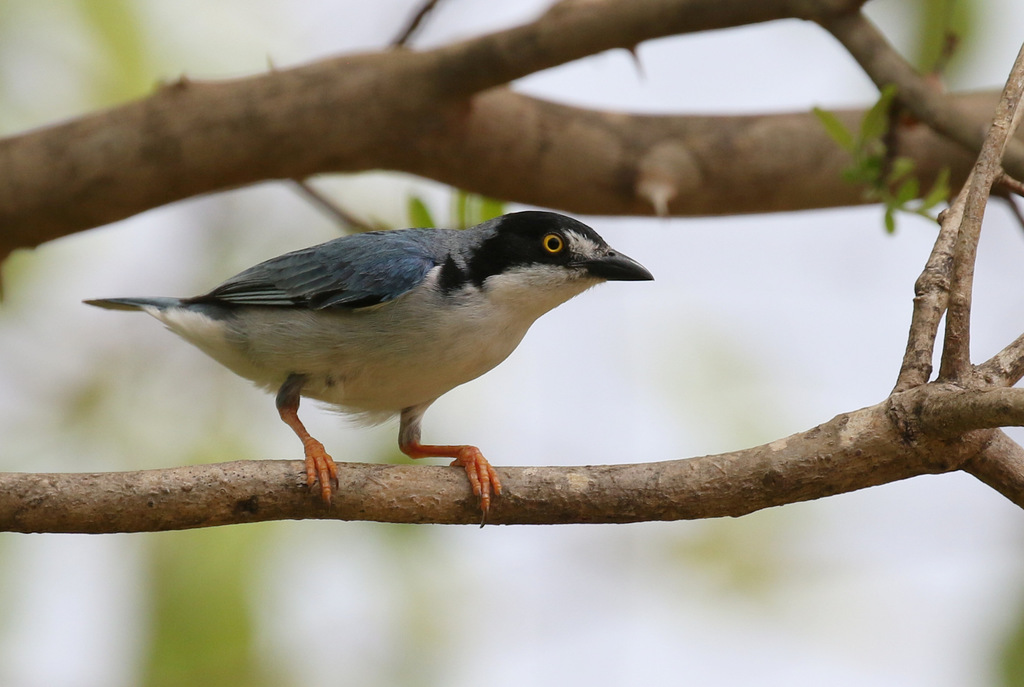
The hooded tanager is 12 to 13.5 cm (4.7 to 5.3 in) long and weighs 12 to 21 g (0.42 to 0.74 oz). The species is sexually dimorphic. Adult males of the nominate subspecies N. p. pileata have white lores and a white throat and sides of the neck on an otherwise black head. Their lower nape and their upperparts, wings, and tail are grayish blue. Their underparts are white with pale gray flanks. Adult females have the same white lores as males but the rest of their head is the same grayish blue as their upperparts. Their white underparts have a buff tinge that is heaviest on the sides of the throat and breast. Both sexes have a yellow iris and yellow or yellow-brown legs and feet. Males have a black bill; females have a black maxilla and a grayish white or light gray mandible. Juveniles have pale blue upperparts, bluish gray underparts, and rose-orange legs and feet. The other subspecies of the hooded tanager differ from the nominate and each other thus:
N. p. hypoleuca: male - little or no gray on the flanks; female - paler buffy tinge on underparts than nominate N. p. surinamensis: larger than nominate with darker upperparts N. p. interna: smaller than nominate with paler upperparts N. p. nana: darker more purplish blue upperparts and darker bluish gray sides than nominate N. p. caerulea: larger than nominate
Range & habitat
The hooded tanager has a disjunct distribution with a large gap in the northern Amazon Basin between N. p. hypoleuca and N. p. surinamensis in the north and N. p. interna, N. p. nana, and N. p. caerulea in the south. In addition, N. p. hypoleuca has gaps in its range, and N. p. pileata has populations on both sides of the Amazon Basin gap. The subspecies are found thus:
N. p. hypoleuca: northern Colombia from Córdoba Department east to Magdalena Department and south in the valley of the Magdalena River to southern Cesar Department; western Venezuela's Maracaibo Basin in Zulia, western Lara, and southeastern Falcón; intermittently in Venezuela east of the Andes from western Apure north to the Capital District and east to western Delta Amacuro and northeastern Bolívar state N. p. surinamensis: Guyana and Suriname N. p. pileata: French Guiana; Brazil south of the Amazon between the Madeira and Tapajós rivers and south into extreme northern Bolivia N. p. interna: north-central Brazil in the Negro and Branco river basins N. p. nana: from northeastern Peru's Marañón River basin east across extreme southeastern Colombia into western Brazil to the lower Madeira N. p. …
Wikipedia: “Distribution and habitat”
What it does
The hooded tanager feeds primarily on insects, occasionally eats fruit, and might also eat nectar. It forages in pairs or family groups and occasionally joins mixed-species feeding flocks. It forages mostly high in trees but sometimes in lower shrubs. It takes most prey by gleaning from leaves and bark and takes some from spider webs with a brief hover.
Wikipedia: “Feeding”
Listen
Looking for field recordings…
Where it lives
Recorded sightings
—
geo-referenced records in GBIF, from museums, herbaria and field observers.
Drag the globe to turn it. Dots are where records exist, not a range map; darker means more records.
In the stacks
Searching the stacks…
Every page naming Nemosia pileata in the Biodiversity Heritage Library →
This page is assembled live from iNaturalist, GBIF, Wikipedia, the Source Library and the Internet Archive. It is not yet part of the hand-edited codex. iNaturalist taxon 10648.