On eBird ↗
Akikiki
Live sightings near you, the range map, bar charts of when it is seen, and Macaulay Library photos and recordings.
ʻAkikiki
Oreomystis bairdi
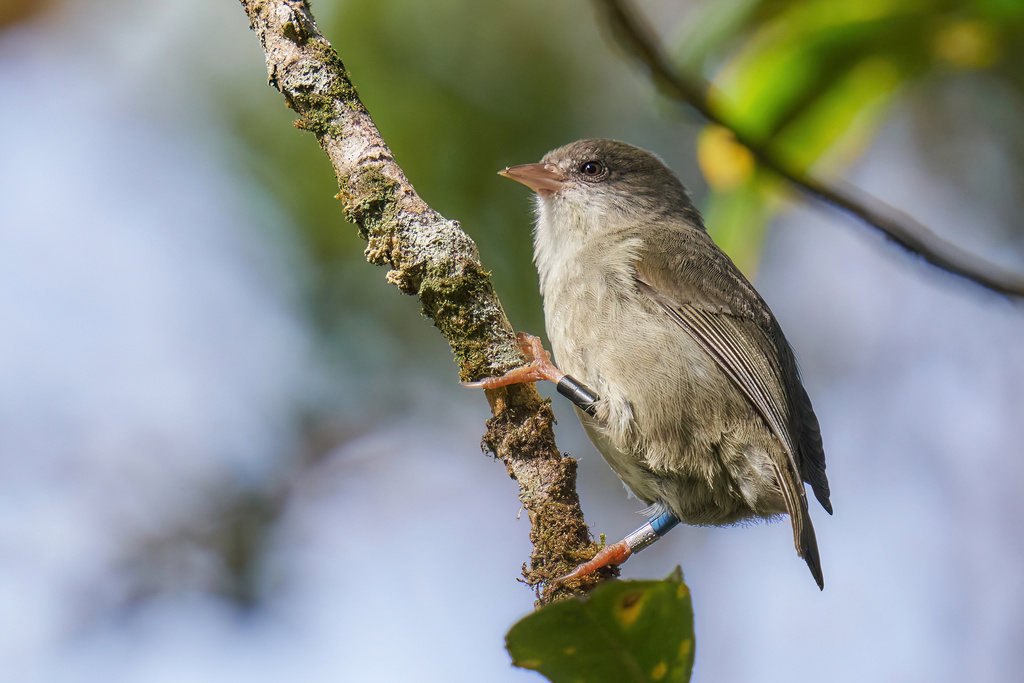
The ʻakikiki (pronounced ) (Oreomystis bairdi), also called the Kauaʻi creeper, is a critically endangered Hawaiian honeycreeper endemic to Kauaʻi, Hawaiʻi. It is the only member of the genus Oreomystis. Of the Hawaiian birds known to be extant, it is thought to be the most endangered, with only 454 wild individuals reported as of 2018. A survey report in 2021 estimated the population at 45 with a 5 percent annual decrease, in July 2023 the remaining number of wild birds was estimated to be just 5 individuals. Pakele, the last known wild ʻakikiki, was last seen on August 29, 2025; she was honored as the last wild member of her species.
From the article ʻAkikiki on Wikipedia (CC BY-SA), quoted section by section
Description
The ʻakikiki is small (13 cm length; 12-17 g mass), with gray plumage above and white below. It is not sexually dimorphic. Juveniles have large white eye rings; adults may retain a pale eyebrow for several years. Legs and bill are pink. The tail is short compared to other birds on Kauaʻi, giving it a stocky appearance.
Range & habitat
It is currently found only in the highest elevation native rainforests of Kokeʻe State Park and the Alakaʻi Wilderness Preserve on Kauaʻi. Subfossil records indicate that it was once found at sea level as well, and thus may have inhabited a wider range of habitats, including dry forest.
Wikipedia: “Distribution and habitat”
What it does
The ʻakikiki is often compared to the nuthatches of North America because it forages by hopping along the trunks and branches of both live and dead trees, picking off arthropods. ʻAkikiki often forage in pairs, family groups, or mixed-species flocks.
Wikipedia: “Diet and foraging behavior”
Listen
Looking for field recordings…
Where it lives
Recorded sightings
—
geo-referenced records in GBIF, from museums, herbaria and field observers.
Drag the globe to turn it. Dots are where records exist, not a range map; darker means more records.
In the stacks
Searching the stacks…
Every page naming Oreomystis bairdi in the Biodiversity Heritage Library →
This page is assembled live from iNaturalist, GBIF, Wikipedia, the Source Library and the Internet Archive. It is not yet part of the hand-edited codex. iNaturalist taxon 10655.