- Animals
- ›Chordates
- ›Vertebrates
- ›Cartilaginous Fishes
- ›Sharks and Rays
- ›Sharks
- ›Galean Sharks
- ›Ground Sharks
- ›Requiem Sharks
- ›Negaprion
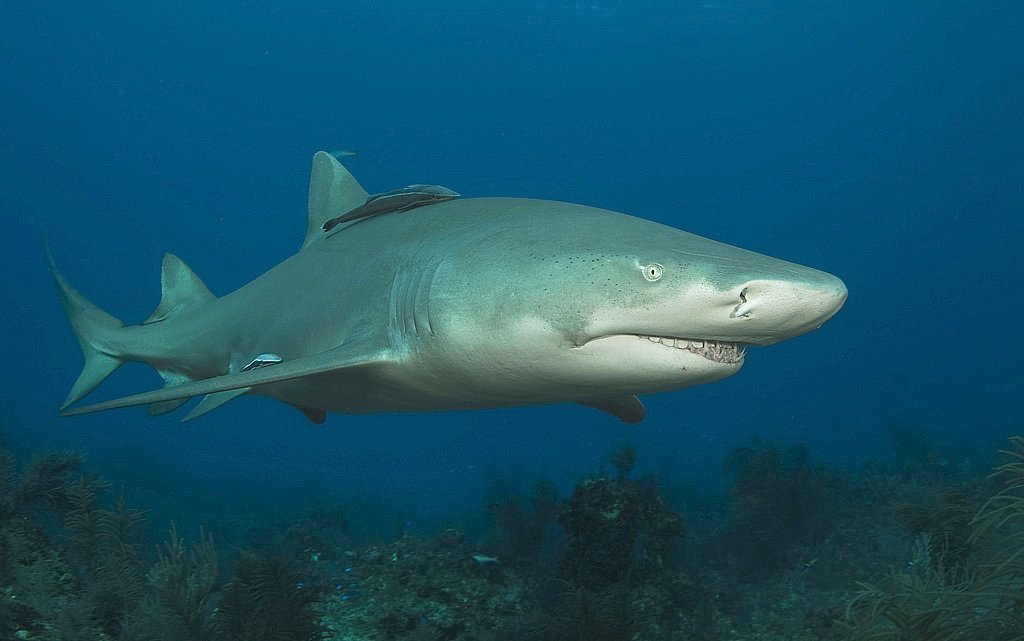
Lemon Shark
Negaprion brevirostris
The lemon shark (Negaprion brevirostris) is a stocky and powerful shark. A member of the family Carcharhinidae, lemon sharks can grow to 3.4 metres (11 ft) in length. They are often found in shallow subtropical waters and are known to inhabit and return to specific nursery sites for breeding. Often feeding at night, these sharks use electroreceptors to find their main source of prey: fish. Lemon sharks enjoy the many benefits of group living such as enhanced...
From the article Lemon shark on Wikipedia (CC BY-SA), quoted section by section
Description
The lemon shark's yellow coloring serves as an excellent camouflage when swimming over the sandy seafloor in its coastal habitat. The lemon shark commonly attains a length of 2.4 to 3.1 m (7.9 to 10.2 ft) and a weight up to 90 kg (200 lb) by adulthood, although sexual maturity is attained at 2.24 m (7.3 ft) in males and 2.40 m (7.9 ft) in females. The maximum recorded length and weight is 3.43 m (11.3 ft) and 183.7 kg (405 lb), respectively. The lemon shark has a flattened head with a short, broad snout, and the second dorsal fin is almost as large as the first. Like all cartilaginous fishes, lemon sharks have electroreceptors concentrated in their heads, known as the ampullae of Lorenzini. These receptors detect electrical pulses emitted by potential prey and allow these nocturnal feeders to sense their prey in the dark. Lemon sharks can be confused with bull sharks; the former have quite similarly sized first and second dorsal fins, whereas those of the latter are differently sized.
Range & habitat
Lemon sharks are found from New Jersey to southern Brazil in the tropical western Atlantic Ocean. They also live off the coast of west Africa in the southeastern Atlantic. In addition, lemon sharks have been found in the eastern Pacific, from southern Baja California to Ecuador and in Cape Verde in Sal Island. Although the lemon shark species is known for occupying the subtropical, shallow waters of coral reefs, mangroves, enclosed bays, and river mouths, they have also been found in the open ocean down to depths of 92 m (302 ft). Lemon sharks have been observed swimming up rivers, but they do not appear to travel very far into fresh water. They are found in open water primarily during migrations, tending to stay along the continental and insular shelves for most of their lives.
Wikipedia: “Distribution”
What it does
Many species of sharks, including the lemon shark, are known to be social, living in groups or loose aggregations. A few benefits of group living are enhanced communication, courtship, predatory behavior, and protection. Group living and a preference for social interaction is thought to be important for the survival and success of juvenile lemon sharks. Up to twenty juveniles have been observed in groups of lemon sharks. Group living, however, comes with its costs, such as increased risk of disease, ease of parasite transmission, and competition for resources. Lemon sharks are found in groups based on similar size. Passive sorting mechanisms such as its ontogenetic habitat shift have been postulated to contribute to the formation of groups organized based on size or sex. One exception to this behavior is that sharks less than a year old show no preference for groups of matched or unmatched size. One hypothesis for this finding is that it is beneficial for the small young lemon sharks to associate with the larger individuals because they have an easier time gathering information about the habitat regarding elements such as predators and local prey. …
Wikipedia: “Social behavior”
In human culture
In the romantic comedy film Couples Retreat (2009), a pair of lemon sharks begin circling two of the characters, who are balancing a bucket of chum on a small floating platform. When the chum falls into the water, the characters are told that the sharks are not dangerous to humans, and that they should simply swim slowly away from the sharks and the chum.
Wikipedia: “In popular culture”
Where it lives
Recorded sightings
—
geo-referenced records in GBIF, from museums, herbaria and field observers.
Drag the globe to turn it. Dots are where records exist, not a range map; darker means more records.
In the stacks
Searching the stacks…
Every page naming Negaprion brevirostris in the Biodiversity Heritage Library →
This page is assembled live from iNaturalist, GBIF, Wikipedia, the Source Library and the Internet Archive. It is not yet part of the hand-edited codex. iNaturalist taxon 106650.