On eBird ↗
Ou
Live sightings near you, the range map, bar charts of when it is seen, and Macaulay Library photos and recordings.
'O'u
Psittirostra psittacea
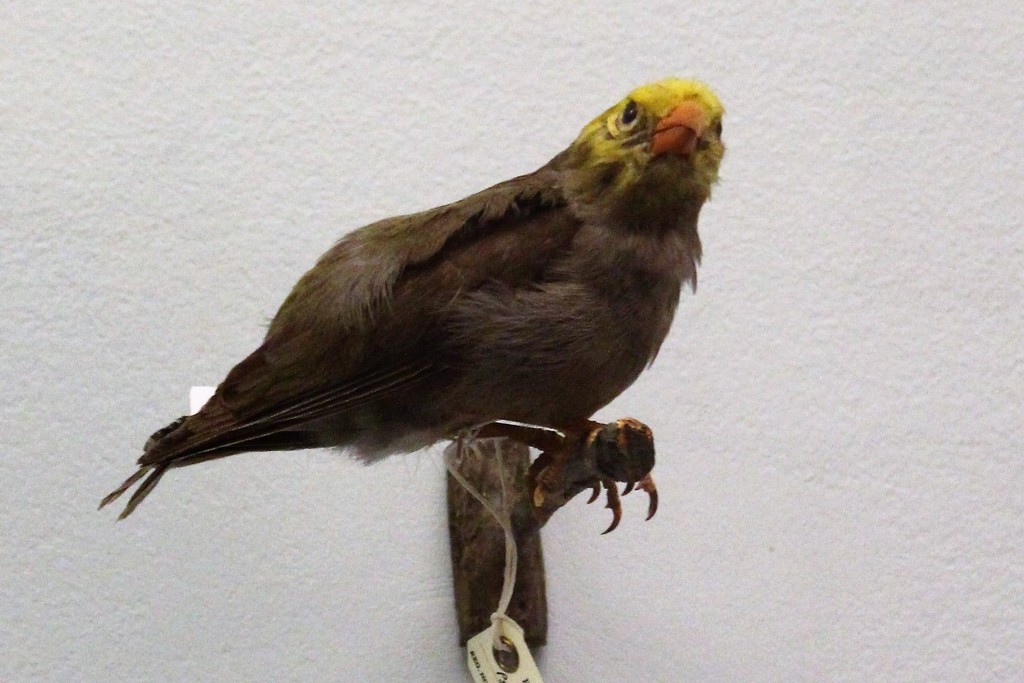
The ʻōʻū (pronounced [ˈʔoː.ʔuː]) (Psittirostra psittacea) is an extinct species of Hawaiian honeycreeper that was endemic to the Hawaiian islands. It had a dark green back and olive green underparts; males had a yellow head while females had a green head. Its unusual beak seems to have been adapted to feeding on the fruits of Freycinetia arborea. It had a strong flight which it used to fly considerable distances in search of this vine, but it also ate other fruits, buds, flowers and insects.
Although formerly widespread and present throughout the island group, numbers declined dramatically during the twentieth century. The bird had been listed by the International Union for Conservation of Nature as being Critically Endangered since 1994, but in 2024 it was assessed as extinct. The U.S. Fish and Wildlife Service had separately declared the bird extinct in a 2022 study review. The last recorded sighting was in 1989.
From the article ʻŌʻū on Wikipedia (CC BY-SA), quoted section by section
Description
The ʻōʻū was a large, plump forest bird measuring 17 centimetres (6.7 in) in length. Males had a bright yellow head, dark green back, and an olive-green belly. Females were duller with an olive-green head. The ʻōʻū had a pink, finch-like bill and pink legs. It was very similar in morphology to a parrot; both the genus and specific epithets allude to this ("psitta" means "parrot" in Greek").
What it does
The breeding biology of this bird is unknown, although juveniles were observed in June, suggesting a March to May breeding season. The ʻōʻū's call was an ascending or descending whistle that may break into a sweet and distinct canary-like song. Its unique bill was apparently adapted for feeding on the fruits of the ʻieʻie (Freycinetia arborea) vine, although when the fruiting season ended the ʻōʻū readily moved both up– and downslope in search of other foods, both native and introduced. In addition to fruits, it fed on insects, and buds and blossoms of the ʻōhiʻa lehua (Metrosideros polymorpha). It was known to have been a nomadic forager that made strong flights to follow seasonally available fruit crops across a broad elevational gradient.
Wikipedia: “Behavior”
Listen
Looking for field recordings…
Where it lives
Recorded sightings
—
geo-referenced records in GBIF, from museums, herbaria and field observers.
Drag the globe to turn it. Dots are where records exist, not a range map; darker means more records.
In the stacks
Searching the stacks…
Every page naming Psittirostra psittacea in the Biodiversity Heritage Library →
This page is assembled live from iNaturalist, GBIF, Wikipedia, the Source Library and the Internet Archive. It is not yet part of the hand-edited codex. iNaturalist taxon 10672.