On eBird ↗
Scarlet-headed Blackbird
Live sightings near you, the range map, bar charts of when it is seen, and Macaulay Library photos and recordings.
Scarlet-headed Blackbird
Amblyramphus holosericeus
The scarlet-headed blackbird (Amblyramphus holosericeus) is a species of bird in the family Icteridae, the oropendolas, New World orioles, and New World blackbirds. It is found in Argentina, Bolivia, Brazil, Paraguay, and Uruguay.
From the article Scarlet-headed blackbird on Wikipedia (CC BY-SA), quoted section by section
Description
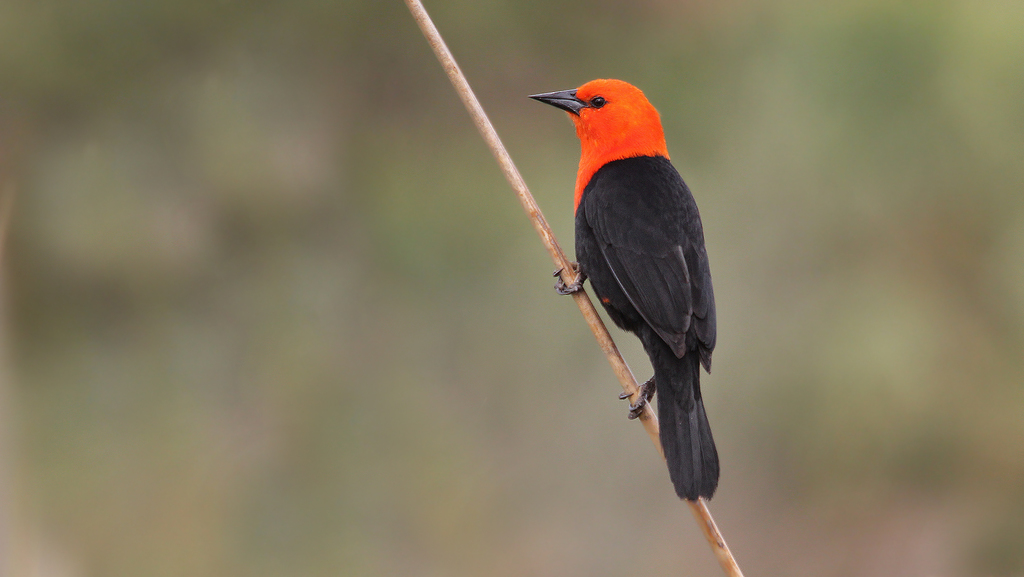
Male scarlet-headed blackbirds average 25 cm (9.8 in) long and weigh an average of 86 g (3.0 oz). Females average 22.5 cm (8.9 in) long and weigh an average of 75 g (2.6 oz). The sexes have the same plumage. Adults have a thin black stripe behind the lores and black eyelids. The rest of their head and their neck, upper breast, and thighs are scarlet-red. The rest of their plumage is a slightly glossy black. They have a black iris, a sharp, chisel-shaped black bill, and black legs and feet. Juveniles are almost entirely brownish black with a yellowish wash on the throat and breast; they gradually acquire the adult's red.
Range & habitat
The scarlet-headed blackbird has a disjunct distribution. Its largest range from northern Buenos Aires Province in northeastern Argentina north through Uruguay into far southern Brazil's southern and eastern Rio Grande do Sul state. Further west it extends north through northeastern Argentina and southern and central Paraguay, Brazil's Paraná and western São Paulo states, extreme eastern Bolivia, and western Mato Grosso do Sul and southwestern Mato Grosso states in Brazil. There are isolated reports in Brazil east and north of its regular range. The species' second largest range is in north-central Bolivia's Beni and Santa Cruz departments. There are also small isolated populations in northwestern Argentina. The scarlet-headed blackbird primarily inhabits marshes with extensive stands of Cyperus sedge, Typha cattail, and Thalia arrowroot. It also is found in nearby grasslands and agricultural fields. In elevation it seldom exceeds 600 m (2,000 ft).
Wikipedia: “Distribution and habitat”
What it does
The scarlet-headed blackbird feeds mostly on insects though there are reports of its eating small frogs. During the dry season it also feeds on the seeds of cultivated crops like maize (Zea mays) and sorghum (Sorghum bicolor). It extracts prey from plant stems with its chisel bill. In the breeding season it usually forages in pairs in their territory but in the non-breeding season forms flocks that may have 100 individuals.
Wikipedia: “Feeding”
Listen
Looking for field recordings…
Where it lives
Recorded sightings
—
geo-referenced records in GBIF, from museums, herbaria and field observers.
Drag the globe to turn it. Dots are where records exist, not a range map; darker means more records.
In the stacks
Searching the stacks…
Every page naming Amblyramphus holosericeus in the Biodiversity Heritage Library →
This page is assembled live from iNaturalist, GBIF, Wikipedia, the Source Library and the Internet Archive. It is not yet part of the hand-edited codex. iNaturalist taxon 10694.