On eBird ↗
Velvet-fronted Grackle
Live sightings near you, the range map, bar charts of when it is seen, and Macaulay Library photos and recordings.
Velvet-fronted Grackle
Lampropsar tanagrinus
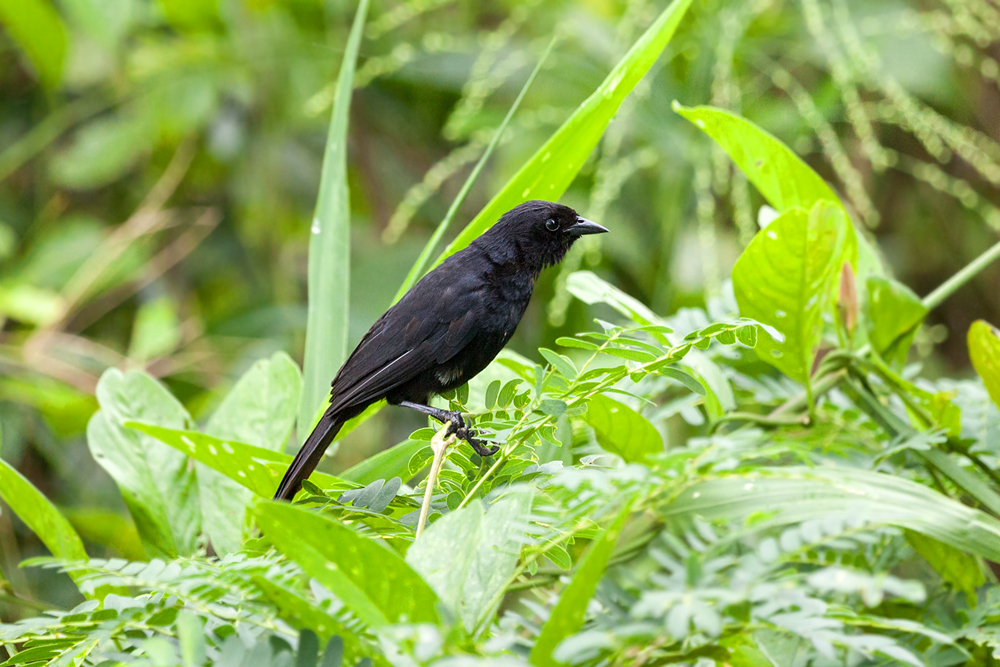
The velvet-fronted grackle (Lampropsar tanagrinus) is a species of bird in the family Icteridae, monotypic within the genus Lampropsar. It is found in Bolivia, Brazil, Colombia, Ecuador, Guyana, Peru, and Venezuela where its natural habitats are subtropical or tropical swamps and heavily degraded former forest.
From the article Velvet-fronted grackle on Wikipedia (CC BY-SA), quoted section by section
Description
The male velvet-fronted grackle grows to about 22 cm (9 in) and the female about 19 cm (7.5 in). Both sexes are entirely black, with a slight bluish gloss on the dorsal surfaces. The feathers at the front of the crown are very short and dense, giving a velvet-like appearance at close quarters. The beak is short, conical and pointed, the iris is dark and the tail is long and somewhat rounded. The calls produced include a crackling "chack" and a whistling "cheziit", and the song, sometimes sung at dusk from a perch, is a moderately-musical rapid gurgling sound. This species could be confused with the shiny cowbird (Molothrus bonariensis), but their calls and habits are quite different.
Range & habitat
The velvet-fronted grackle has two separate populations; one is in Venezuela and Guyana; the other is in southern Colombia, eastern Ecuador, northern Peru, western Brazil and northern and central Bolivia. Its typical habitat is várzea forests which periodically become flooded, forest borders and swamps near ponds; rivers and lakes.
Wikipedia: “Distribution and habitat”
What it does
This species often congregates with others of its kind in small groups of up to about twenty birds. Sometimes these coalesce with groups of tanagers and caciques. The birds move noisily through the canopy, foraging high and low, and sometimes hopping around on floating vegetation on lakes. The diet includes insects such as winged ants and beetles but is poorly described. In Guyana it breeds in March, in Ecuador in September and in Bolivia in October and February.
Wikipedia: “Behaviour”
Listen
Looking for field recordings…
Where it lives
Recorded sightings
—
geo-referenced records in GBIF, from museums, herbaria and field observers.
Drag the globe to turn it. Dots are where records exist, not a range map; darker means more records.
In the stacks
Searching the stacks…
Every page naming Lampropsar tanagrinus in the Biodiversity Heritage Library →
This page is assembled live from iNaturalist, GBIF, Wikipedia, the Source Library and the Internet Archive. It is not yet part of the hand-edited codex. iNaturalist taxon 10696.