- Animals
- ›Chordates
- ›Vertebrates
- ›Ray-finned Fishes
- ›Carps, Characins, Catfishes and Allies
- ›Catfishes
- ›Siluroidei
- ›North American Freshwater Catfishes
- ›Noturus
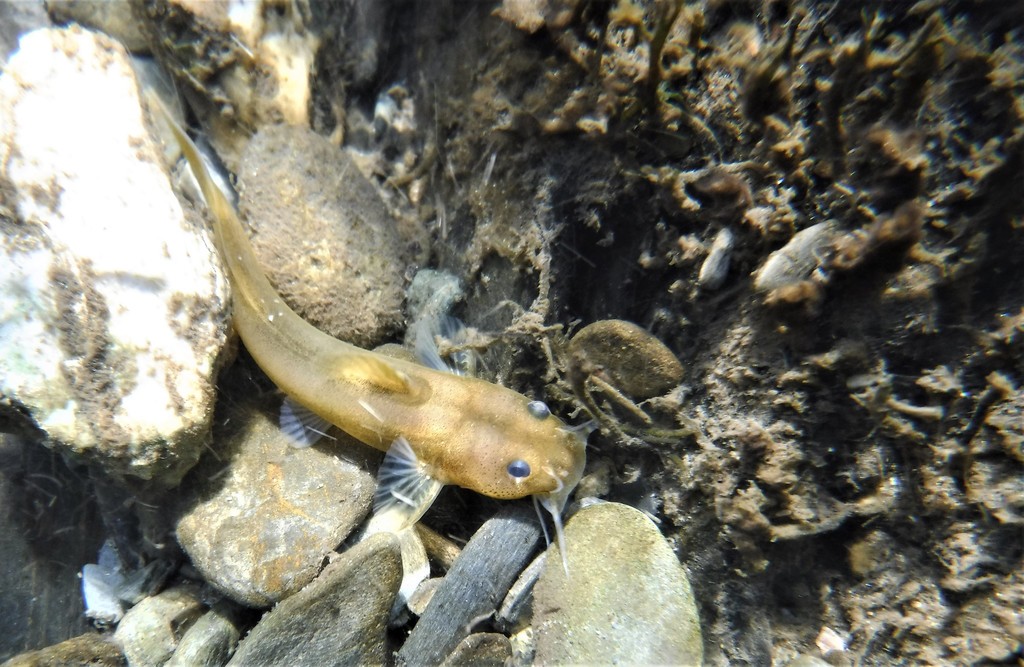
Smoky Madtom
Noturus baileyi
The smoky madtom (Noturus baileyi) is a species of catfish. Little information exists about the smoky madtom, along with other members of the Noturus species, due to the high turbidity in which they spawn, preventing observation, as well as their nocturnal behaviors.
From the article Smoky madtom on Wikipedia (CC BY-SA), quoted section by section
Description
The madtom is a small member of the family Ictaluridae, only reaching a maximum of 5 cm (2 in) long. It is olive brown on top with white to yellow below. Four saddles line the back of this species.
Range & habitat
The smoky madtom is endemic to Abrams Creek in the Great Smoky Mountains National Park, Tennessee. In 1957, Chilhowee Dam was closed and an ichthyocide was administered to Abrams Creek, in an attempt to improve trout fishery. Extirpation of the smoky madtom resulted. The smoky madtom was presumed extinct until in 1980, when another population was found in Citico Creek in the Cherokee National Forest within Monroe County, Tennessee. In 1986, a restoration project was begun to restore this native population. Efforts include collecting egg masses from Citico Creek, rearing them in the lab, and reintroducing them into Abrams Creek after a year.
Wikipedia: “Distribution”
What it does
The smoky madtom is a very secretive catfish. During the day, it buries itself under gravel. It is nocturnal and feeds at night on aquatic invertebrates and small fish. It prefers areas of transition between pools and riffles and spawns in the summer under large, flat rocks. Specimens have been collected in areas of transition between pools and riffles in depths around 25 cm (10 in). In the winter and spring, it seems to prefer more gentle runs and pools. The area also includes large boulders for the madtom to hide under, which it has been documented to do when disturbed at night. The water is clear and its temperature is also intermediate between cold and cool water. Stream width is about 4–10 m (13–32 ft). Smallmouth bass have been recorded preying on the smoky madtoms. Noturus species can be used as an indicator of the environment because they are very susceptible to changes. Human disturbances such as logging, mining, and cattle grazing can cause siltation of the water and drop the populations dramatically. The female madtom reaches maturity after two years. Spawning happens once per year, and on average 30 eggs are produced. The life expectancy is 4 years, allowing only 2 years of reproduction, with a total of 72 eggs. This low reproduction, coupled with extirpation and low tolerance, has led the smoky madtom to be federally listed as endangered. …
Wikipedia: “Ecology”
Where it lives
Recorded sightings
—
geo-referenced records in GBIF, from museums, herbaria and field observers.
Drag the globe to turn it. Dots are where records exist, not a range map; darker means more records.
In the stacks
Searching the stacks…
Every page naming Noturus baileyi in the Biodiversity Heritage Library →
This page is assembled live from iNaturalist, GBIF, Wikipedia, the Source Library and the Internet Archive. It is not yet part of the hand-edited codex. iNaturalist taxon 107275.