- Animals
- ›Chordates
- ›Vertebrates
- ›Ray-finned Fishes
- ›Carps, Characins, Catfishes and Allies
- ›Catfishes
- ›Siluroidei
- ›North American Freshwater Catfishes
- ›Noturus
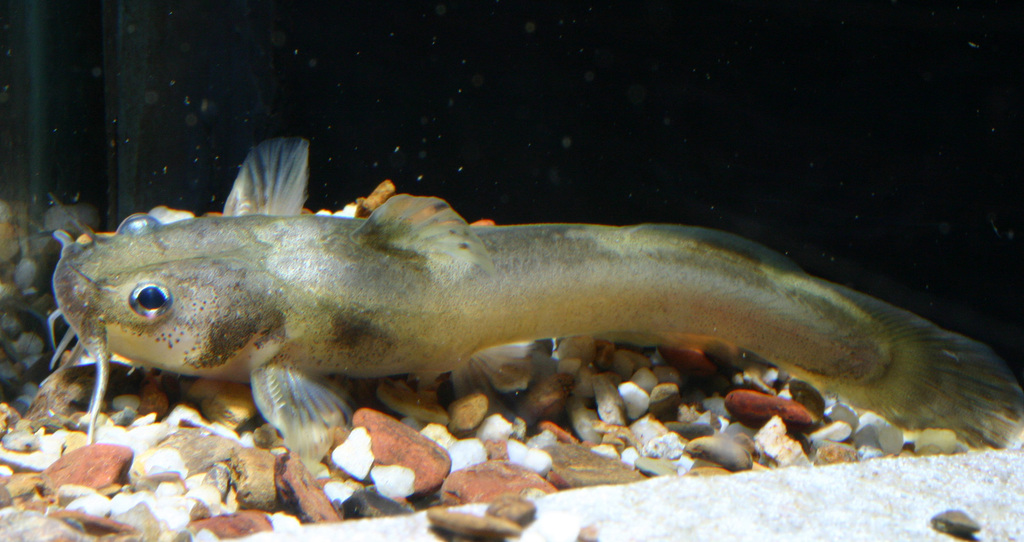
Chucky Madtom
Noturus crypticus
The chucky madtom (Noturus crypticus) is a critically endangered freshwater fish endemic to the U.S. state of Tennessee.
It has been observed in two streams in eastern Tennessee, Little Chucky Creek and Dunn Creek. It was described to science as a new species in 2005. It is in the N. elegans clade.
From the article Chucky madtom on Wikipedia (CC BY-SA), quoted section by section
Description
Chucky madtoms can grow up to 7.4 centimeters (2.9 inches). The dorsal side of this fish consists of three dark blotches with pale saddles in front of each blotch.
Wikipedia: “Appearance and anatomy”
Range & habitat
The chucky madtom has an extremely small distribution and is only known from two streams in the French Broad river system in eastern Tennessee. In 1940, one specimen was found in Dunn Creek in Sevier County. No other individuals have been recovered from that location despite suitable habitat and a healthy fish population, potentially indicating that the population in Dunn Creek has been extirpated. Fourteen chucky madtoms have been collected from Little Chucky Creek in Greene County, the last of which was found in 2004. It is not known why these two small streams are the only place where the species is found, as there is similar habitat along portions of the Little Chucky Creek. Further conventional capture surveys of surrounding areas with suitable habitat did not yield any more specimens. However, eDNA sampling in 2023 and 2024 detected chucky madtom DNA in both creeks, yielding the first evidence for the potential persistence of the species in decades.
Wikipedia: “Distribution”
What it does
Due to the small range and lack of specimens, little is known about the life history of the chucky madtom. There is currently no information about diet, predators, spawning times, fecundity, or sex ratio. The low species count and protected status of this species makes it challenging for researchers to examine the diet of this species. Although exact life history details are unknown, the chucky madtom may exhibit some of the same life history traits as other Noturus species, including spring or summer spawning, low fecundity, cavity nesting, nest guarding, and a diet primarily consisting of aquatic macroinvertebrates. The chucky madtom requires clear and slow to moderate flowing water in stream runs. All collected specimens were found in areas where the dominant substrate included gravel, cobble, or rock slabs. Other fish species found during chucky madtom surveys include the central stoneroller, banded sculpin, greenside darter, redline darter, and banded darter.
Wikipedia: “Life history and ecology”
Where it lives
Recorded sightings
—
geo-referenced records in GBIF, from museums, herbaria and field observers.
Drag the globe to turn it. Dots are where records exist, not a range map; darker means more records.
In the stacks
Searching the stacks…
Every page naming Noturus crypticus in the Biodiversity Heritage Library →
This page is assembled live from iNaturalist, GBIF, Wikipedia, the Source Library and the Internet Archive. It is not yet part of the hand-edited codex. iNaturalist taxon 107276.