- Animals
- ›Chordates
- ›Vertebrates
- ›Ray-finned Fishes
- ›Carps, Characins, Catfishes and Allies
- ›Catfishes
- ›Siluroidei
- ›North American Freshwater Catfishes
- ›Noturus
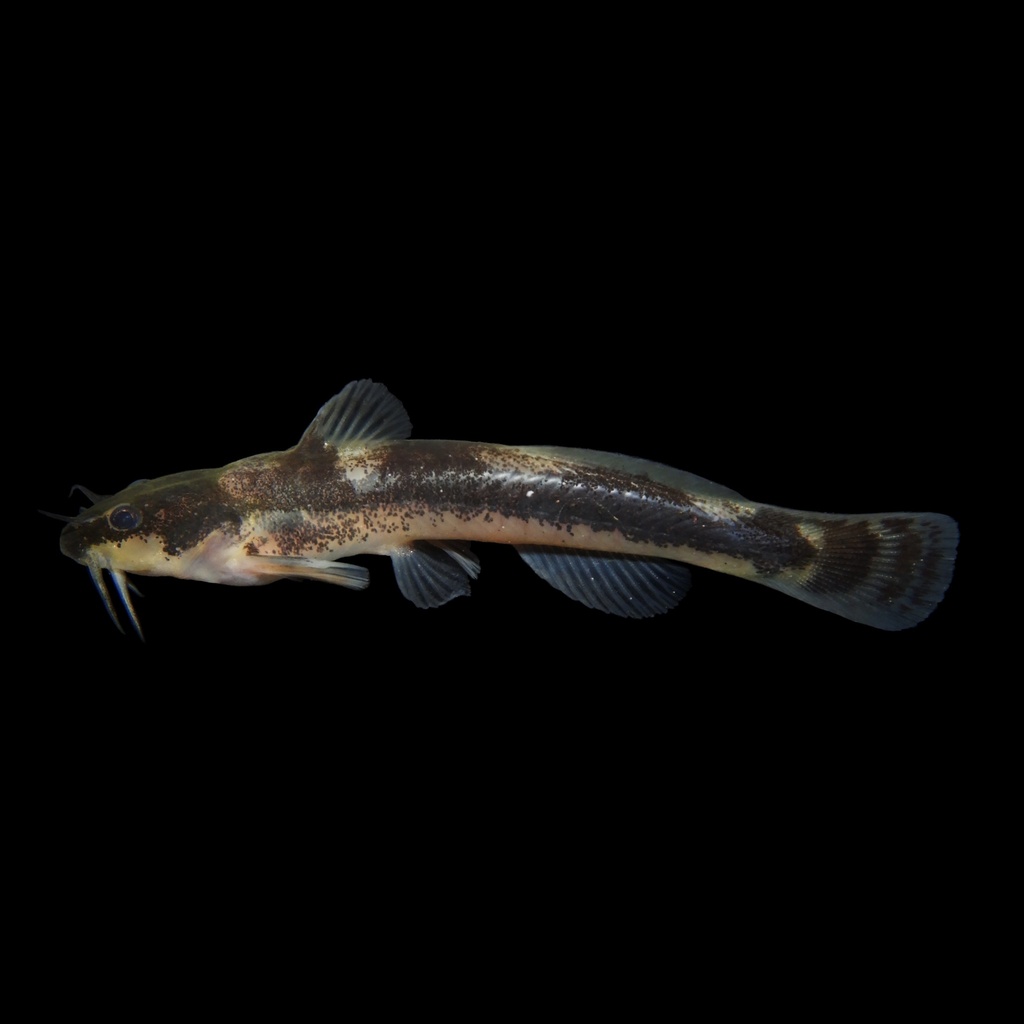
Least Madtom
Noturus hildebrandi
Noturus hildebrandi, also known as the least madtom, is a species of catfish. Its native range stretches from the Obion River in Kentucky to the Homochitto River in Mississippi.
From the article Noturus hildebrandi on Wikipedia (CC BY-SA), quoted section by section
Description
The least madtom is a small slender-bodied fish with a flat head. It measures up to 6.9 centimetres (2.7 in) in length. The adipose fin is either clear or white; however, populations in Mississippi sometimes have a dark patch on the adipose fin. Body coloration varies by geography. There are two known subspecies, Noturus h. hildebrandi and Noturus h. lautus. N. h. hildebrandi, which inhabits the Homochitto River and Bayou Pierre, has a long head and a mottled coloration. N.h. lautus lives in the Obion and surrounding rivers; this subspecies has a shorter head and four light-colored oval areas on a red-brown to black back. Males and females are identical in appearance. Most live about 12 to 15 months, dying shortly after reproducing.
Range & habitat
The least madtom inhabits sandy riffles, mixed rock riffles, creeks, pools, and small rivers. It is commonly found in shallow areas containing submerged logs, sticks, leaves, and other debris.
Wikipedia: “Habitat”
What it does
The least madtom's spawning season lasts from June through August. During this time the males increase in size. The females spawn during their second summer. To prepare for spawning, adults take shelter, either singly or in pairs, under stones, shells, or in debris. An average of 19 orange oocytes are laid in these areas. Both parents guard the nest as the eggs develop. Eggs hatch within 8 to 9 days. Yolk resorption takes about 9 to 10 days after hatching.
Wikipedia: “Reproduction”
Where it lives
Recorded sightings
—
geo-referenced records in GBIF, from museums, herbaria and field observers.
Drag the globe to turn it. Dots are where records exist, not a range map; darker means more records.
In the stacks
Searching the stacks…
Every page naming Noturus hildebrandi in the Biodiversity Heritage Library →
This page is assembled live from iNaturalist, GBIF, Wikipedia, the Source Library and the Internet Archive. It is not yet part of the hand-edited codex. iNaturalist taxon 107287.