On eBird ↗
Prothonotary Warbler
Live sightings near you, the range map, bar charts of when it is seen, and Macaulay Library photos and recordings.
Prothonotary Warbler
Protonotaria citrea
The prothonotary warbler (Protonotaria citrea) is a small songbird of the New World warbler family. It is named for its plumage, which resembles the yellow robes once worn by papal clerks (named prothonotaries) in the Roman Catholic Church.
The prothonotary warbler is the only member of the genus Protonotaria and the only eastern warbler that nests in natural or artificial cavities.
From the article Prothonotary warbler on Wikipedia (CC BY-SA), quoted section by section
Description
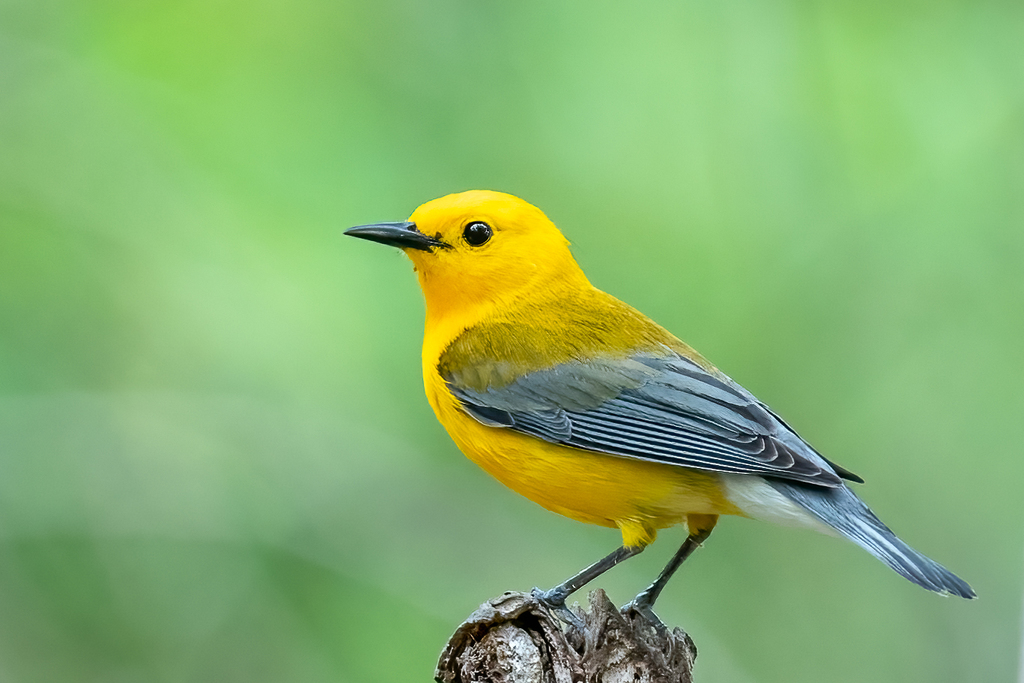
The prothonotary warbler is 13 cm (5.1 in) long, weighs a mean 14.3 g (0.50 oz), and has a wingspan of 22 cm (8.75 in). It has an olive-coloured back with blue-grey wings and tail, yellow underparts, a relatively long pointed bill, and black legs. The adult male has a bright orange-yellow head. Females and immature birds are duller and have a yellow head. In flight from below, the short, wide tail has a distinctive two-toned pattern, white at the base and dark at the tip.
Range & habitat
The prothonotary warbler mostly breeds in hardwood swamps in extreme southeastern Ontario and the eastern United States. However, it may nest near other bodies of water such as creeks, streams, ponds, and swimming pools. The habitat of the warblers during migration is not well known. However, they are particularly prominent in Belize during spring migration. The warblers winter in the West Indies, Central America and northern South America, primarily in mangrove swamps. It is a rare vagrant to parts of the western United States, most notably California.
Wikipedia: “Distribution and habitat”
What it does
The prothonotary warbler is the only eastern warbler that nests in natural or artificial cavities, sometimes using old downy woodpecker holes. The male often builds several incomplete, unused nests in his territory; the female builds the real nest and lays 3–7 eggs. The preferred foraging habitat is dense, woody streams, where the prothonotary warbler forages actively in low foliage, mainly for insects and snails. The song of this bird is a simple, loud, ringing sweet-sweet-sweet-sweet-sweet. The call is a loud, dry chip, like that of a hooded warbler. Its flight call is a loud seeep.
Wikipedia: “Behavior and ecology”
Listen
Looking for field recordings…
Where it lives
Recorded sightings
—
geo-referenced records in GBIF, from museums, herbaria and field observers.
Drag the globe to turn it. Dots are where records exist, not a range map; darker means more records.
In the stacks
Searching the stacks…
Every page naming Protonotaria citrea in the Biodiversity Heritage Library →
This page is assembled live from iNaturalist, GBIF, Wikipedia, the Source Library and the Internet Archive. It is not yet part of the hand-edited codex. iNaturalist taxon 10729.